Introduction
Many people wonder if trusting horoscopes and numerology is a wise decision in our modern, data-driven world. Millions of people worldwide wake up every morning and check their horoscope before making major decisions. In India, specifically, many families consult an astrologer before a wedding, a job change, or even buying a new home. But here is the big question: do these systems actually work in the real world? As a practising gemologist, I want to give you an honest, balanced answer. This guide respects your cultural beliefs while helping you make smart, informed choices. Consequently, we will explore what science says and how you can safely enjoy these ancient traditions. You should also read our guide on gemstone buying mistakes to avoid financial pitfalls when purchasing “remedial” stones.
Is Trusting Horoscopes and Numerology Scientifically Sound?
First, let us look at the scientific evidence regarding the accuracy of celestial predictions. Researchers have tested astrology extensively over many decades. Specifically, the results remain consistent: astrology does not perform better than random chance. In a famous 1985 study published in Nature, trained astrologers could not match birth charts to personality profiles any better than a computer-generated random guess. Scientists have found no physical mechanism by which distant planets can influence your daily mood or career outcomes.
Psychological Reasons for Trusting Horoscopes and Numerology
Moreover, numerology faces similar challenges from the scientific community. Experts classify it as a pseudoscience because no evidence supports the idea that numbers carry special vibrations. However, science does explain why trusting horoscopes and numerology feels so accurate to many people. The “Barnum Effect” describes how vague personality descriptions feel deeply personal to the reader. Furthermore, confirmation bias plays a major role; people naturally remember when a prediction comes true and forget the many times it failed. Therefore, while these systems are not scientifically reliable, they remain psychologically powerful tools for self-reflection and emotional comfort.
Why Are Gemstones Linked to Indian Astrology?
Now, we must discuss gemstones, where the connection between jewelry and astrology runs thousands of years deep. In India, this relationship is rooted in Jyotisha Shastra, or the Vedic science of light. Unlike Western birthstones, which are mainly decorative, Indian astrological gems serve as “remedial tools.” Practitioners believe these stones help balance planetary energies based on a person’s birth chart, known as the Kundli.
The Power of the Navaratna
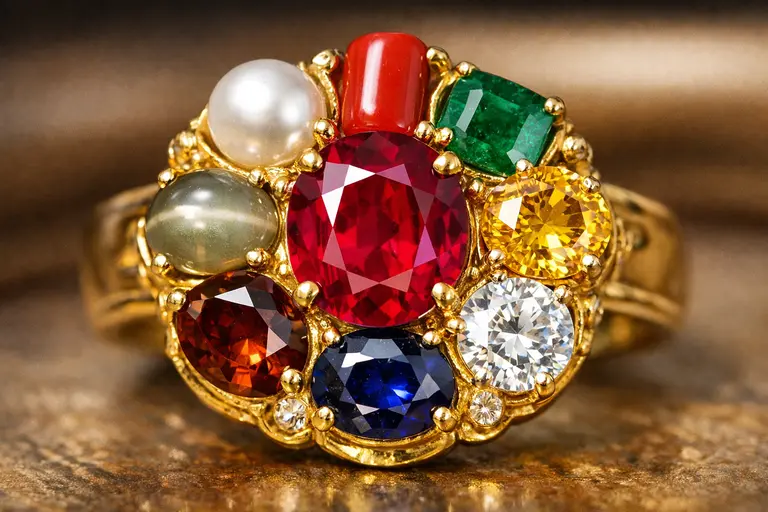
At the heart of this belief system is the Navaratna, a sacred group of nine gemstones representing the nine celestial bodies. For instance, the Ruby represents the Sun, while the Blue Sapphire is tied to Saturn. Vedic tradition teaches that these stones act as spiritual antennas. Consequently, practitioners often set these stones in rings, so they touch the skin directly. Numerologists also connect these gems to birth numbers. For example, a person with a life number of six may wear a diamond to enhance the influence of Venus. To understand the quality of the metals used in these settings, you can refer to professional standards at the Gemological Institute of America.
The Historical Origins of Trusting Horoscopes and Numerology
This belief system evolved over thousands of years through the contributions of Vedic sages. Specifically, Sage Parashara introduced the idea that planetary positions at birth influence human destiny. Scholars also regard Varahamihira, who lived from 505 to 587 CE, as the Father of Classical Indian Gemology. His work, the Brihat Samhita, was one of the first texts to explicitly link astrology with the metaphysical powers of gemstones.
Additionally, the system absorbed significant outside influences over time. During the second century CE, Greek zodiac concepts entered Indian astrology through the Yavanajataka. Later, during the Mughal era, emperors further popularised elaborate gemstone jewelry. As a result, modern trusting horoscopes and numerology reflect a rich, shared heritage of Persian and Indian spiritual traditions.
Gemologist Advice on Trusting Horoscopes and Numerology
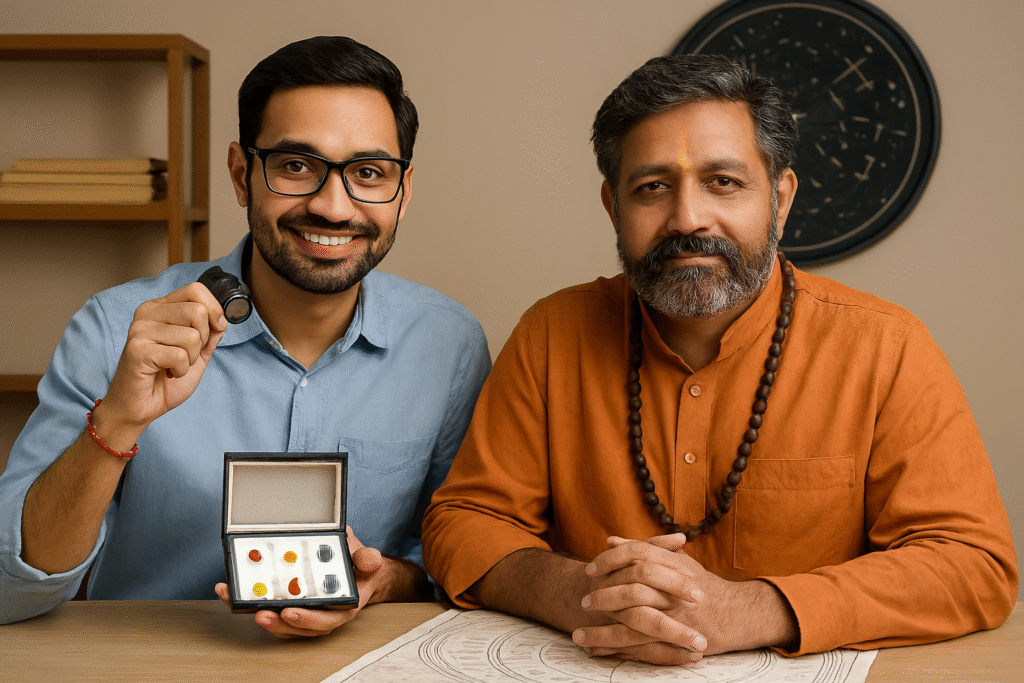
As a gemologist, I stand at the crossroads of science and culture. I respect your traditions, but I also have a professional responsibility to protect you from financial loss. Therefore, here is how you can enjoy astrology and gemstones safely.
First, treat your stone as a “mindfulness anchor” rather than a magic wand. Use a yellow sapphire to remind you to pursue wisdom, or a pearl to remind you to stay calm. Second, you must always demand a certified lab report. This step is non-negotiable because a “blessed” stone is worthless if it is a synthetic or a simulant (imitation). No planetary alignment justifies overpaying for a low-quality stone. Consequently, always verify authenticity before making a purchase.
Third, follow the “supplement, not substitute” rule. Gemstones are spiritual additions; they should never replace professional medical or financial advice. If you are seeking a stone for health reasons, see a doctor first. A gemstone should serve as a supportive layer on top of practical, real-world action. Finally, respect tradition without expecting science to validate it. You can honour your cultural roots while staying grounded in reality.
Trusting Horoscopes and Numerology for the Rest of Us
Can wearing the wrong gemstone cause physical harm?
Scientifically, no gemstone has been proven to cause harm. However, some astrologers warn against certain combinations. Therefore, you should consult a trusted expert while prioritising medical advice for health issues.
How do I know if an astrological gemstone is genuine?
You must always buy from a reputable seller and request a laboratory certificate. A certified gemologist can test the stone to ensure it is not synthetic or heavily treated.
Is it wrong to believe in gemstone remedies?
Not at all. Many people find immense comfort and identity through these traditions. The key is maintaining a balance between cultural heritage and practical decision-making.
Do all practitioners use the same gemstones?
No, different regions and schools of astrology may recommend different stones. Consequently, you might receive varying advice depending on the tradition the astrologer follows.
Is modern numerology ancient?
Actually, modern numerology often uses the Gregorian calendar and English alphabet. Therefore, it is a blend of Chaldean, Western, and Vedic systems rather than a purely ancient Vedic practice.
Disclaimer
This article is intended for educational and informational purposes only. The author is a practising gemologist and does not endorse horoscopes, numerology, or astrological gemstone remedies as scientifically proven systems. Nothing in this article constitutes medical, legal, financial, or personal advice. Always consult qualified professionals for important life decisions. When purchasing gemstones, insist on certified laboratory reports to verify authenticity and quality.