Introduction
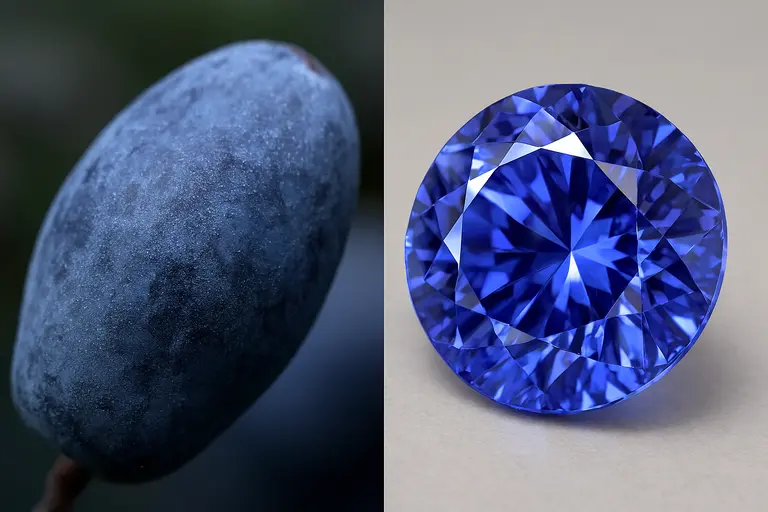
Undeniably, nature has a remarkable way of producing the same breathtaking shade of blue in the most unexpected places. Blue Honeysuckle vs Benitoite represents a fascinating parallel between the botanical and geological worlds. On one hand, the Blue Honeysuckle (also known as Haskap or Honeyberry) offers a deep, jewel-toned fruit that has fed communities across the Northern Hemisphere for centuries. On the other hand, Benitoite—one of the rarest gemstones on Earth—dazzles collectors with its electric, sapphire-like sparkle found only in a single corner of California.
Although a fruit and a gemstone have nothing in common biologically, both share a striking, violetish-blue color. As a Gemologist who appreciates rare finds, I see this as a perfect example of nature’s palette. In this guide, we will explore how these two blue wonders stack up in terms of color, origin, and rarity. Whether you are a foodie looking for antioxidants or a collector looking for investment gems, read on to discover the magic of blue.
The Shared Color: A Blue that Stops You in Your Tracks
The most immediately obvious similarity between Blue Honeysuckle and Benitoite is, of course, their color. However, it is not just “Blue.” It is a specific shade.
The Berry’s Hue
Specifically, the fruit of Lonicera caerulea produces berries with an intense dark blue to violet-blue skin. Often, it is finished with a powdery, waxy coating (bloom) that gives it an almost frosted, otherworldly appearance. Beneath that skin, the flesh reveals deep red and purple tones. In fact, this visual texture makes each berry look like a tiny, edible bead of Iolite.
The Gem’s Hue
Meanwhile, Benitoite is celebrated among gemologists for a blue that ranges from a delicate sky-blue to a deeply saturated, vivid violetish-blue. Interestingly, the most desirable stones share almost the same rich hue as the darkest Blue Honeysuckle berries. Both can display what enthusiasts describe as a “Neon” quality—an electric intensity that makes the color leap forward. For more on color grading, check my Colored Stone Grading guide.
Origins of Blue Honeysuckle vs Benitoite
Their origins, however, could not be more different.
The Global Berry
Blue Honeysuckle is native to cool temperate regions of the Northern Hemisphere. It thrives in the cold climates of Siberia, Russia, Japan (Hokkaido), and Canada. Because of its cold-hardiness and exceptional antioxidant content, farmers have cultivated it as a food crop for generations. Today, it is gaining popularity as a “Superfruit.”
The Local Gem
By contrast, Benitoite is extraordinarily localized. It is found exclusively in a small deposit along the San Benito River in San Benito County, California. First discovered in 1907, the government declared it California’s official state gemstone in 1985. Crucially, the main commercial source (The Benitoite Gem Mine) ceased operations in 2005. Consequently, virtually no new supply enters the market, making it far rarer than diamonds or tanzanite. If you like rare origin stories, read my guide on Tanzania’s Cloves and Tanzanite.
Color Science: Blue Honeysuckle vs Benitoite
Why are they blue? The science differs.
- The Berry: The color comes from Anthocyanins (specifically Cyanidin-3-glucoside). Chemically, these are powerful antioxidants that protect the plant from UV radiation.
- The Gem: The color comes from Titanium impurities within the Barium Titanium Silicate crystal structure.
Furthermore, Benitoite has a secret weapon: Dispersion. Its dispersion (fire) is actually higher than that of diamond. Therefore, a well-cut Benitoite doesn’t just look blue; it sparkles with flashes of red and white fire that a berry can never mimic.
Identifying Blue Honeysuckle vs Benitoite
Identifying Blue Honeysuckle is straightforward—just taste it! Taste-wise, it is a complex blend of blueberry, raspberry, and tartness. However, identifying genuine Benitoite requires a technical approach.
As an expert, I rely on the UV Light Test. First and foremost, genuine Benitoite has a spectacular reaction to Short-Wave Ultraviolet light. When exposed, it glows with an intense, vivid Chalky Blue Fluorescence. Gemologists consider this property diagnostic. Remarkably, almost no other blue gem glows like this. Additionally, it displays strong Pleochroism (looking colorless from one angle and dark blue from another). Read more about identifying stones in my Gemstone Buying Mistakes guide.
Treatments: Natural vs. Enhanced
Fortunately, both treasures are largely natural.
- The Berry: Requires no treatment. It is eaten fresh or dried.
- The Gem: Benitoite is typically untreated. However, labs occasionally apply heat treatment to pale stones to create orange varieties, but fortunately, the valuable blue stones are almost always natural. Buyers seeking authentic deep-blue Benitoite can generally assume the color is natural, though a lab certificate is always recommended.
Buying Guide for 2026
Given the closure of the primary mine, anyone purchasing Benitoite should approach the process with care. Prices for stones over 1 carat can exceed $5,000 to $10,000. Always insist on a certificate from a recognized lab like GIA.
For the berry lover, you can buy Haskap plants for your garden or dried berries online. In India, while fresh berries are rare, imported jams and supplements are available in gourmet stores. This connects to the “Exotic Fruit” trend I discussed in Japan Luxury Fruits vs India.
Conclusion on Blue Honeysuckle vs Benitoite
Ultimately, the comparison of Blue Honeysuckle vs Benitoite reminds us of nature’s creativity. One nourishes the body; the other captivates the eye. In summary, whether you are eating a handful of berries or wearing a ring, you are enjoying the rarest color in nature.
FAQ: Blue Honeysuckle vs Benitoite
Are Blue Honeysuckle vs Benitoite related?
No. One is a plant (Lonicera caerulea); the other is a mineral (Barium Titanium Silicate). They share only their color and name similarities in poetic descriptions.
Why is Benitoite so expensive?
It reflects extreme rarity. It is found in gem quality in only one location on Earth (California), and that mine is closed. Combined with its diamond-like sparkle, this scarcity drives prices up.
Can you eat Blue Honeysuckle berries raw?
Yes, absolutely. They are entirely edible and delicious. They have a thin skin and tiny seeds, making them perfect for snacking, unlike the thick-skinned Bangalore Blue Grapes.
How can I tell if a Benitoite stone is genuine?
The most reliable field test is Fluorescence. Under short-wave UV light, it will glow bright blue. Also, look for strong “Fire” (sparkle) and Pleochroism (color shifting).
Where can I buy Blue Honeysuckle?
Plants and berries are available at nurseries in North America and Europe. In India, look for “Haskap” or “Honeyberry” products in health food stores.