Introduction
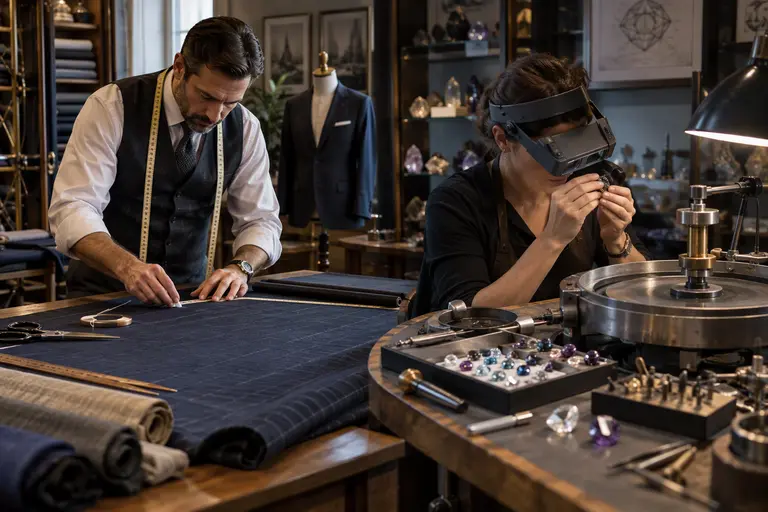
What links the craft of bespoke tailoring to the art of gemstone cutting? Surprisingly, both practices turn raw materials into something lasting through expert precision. Moreover, both crafts reward buyers who understand what they purchase. For instance, in October 2026, Singapore tailor Javin Tan became the first non-Italian winner of the Milano su Misura Trofeo Arbiter in Naples. Meanwhile, the American Gem Trade Association (AGTA) honours similar levels of skill through its Spectrum and Cutting-Edge Awards. Therefore, this article explores how the principles of bespoke tailoring and gemstone cutting define high-quality craftsmanship. Furthermore, it explains why you do not need a luxury budget to buy wisely when you prioritize these techniques. If you are new to these crafts, check our guide to gemstone shapes and cuts to learn the basics.
Shared Principles of Bespoke Tailoring and Gemstone Cutting
Why Proportion Matters in Bespoke Tailoring and Gemstone Cutting
To begin with, a master tailor studies a customer’s posture, shoulders, and movement before cutting any cloth. Similarly, a gemstone cutter studies the rough crystal’s colour, internal inclusions, and natural shape before faceting. Consequently, both expert craftspeople adapt their work to the specific material instead of forcing a standard pattern onto it. However, perfect symmetry does not always win the day. A tailor may adjust a jacket for uneven shoulders, while a cutter may choose an asymmetrical shape to protect a stone’s vibrant colour.
Drape and Light in Bespoke Tailoring and Gemstone Cutting
Drape describes how fabric falls and moves with the body, which dictates the comfort of a bespoke suit. Likewise, internal proportions control how a gemstone handles light. For example, poor pavilion angles allow light to escape through the bottom of the gem, creating a dull area called a “window.” Thus, both crafts use careful proportions to improve performance. Meanwhile, tailors manage gravity and physical movement, whereas lapidaries manage light refraction, hardness, and cleavage.
Respecting Material Character in Bespoke Tailoring and Gemstone Cutting
Because natural materials vary, absolute perfection rarely exists. For instance, natural emeralds often contain internal inclusions that jewellers call jardin, which give each stone its unique identity. However, jardin does not definitively prove natural origin on its own. Therefore, a laboratory report remains the safest way to confirm identity and treatments. Likewise, linen wrinkles and silk variations rarely signal poor quality. Instead, they simply reflect the fibre’s honest, natural character.
Recognising Bespoke Tailoring and Gemstone Cutting Excellence
Bespoke Tailoring at the Milano su Misura Trofeo Arbiter
In Naples, Javin Tan beat 23 other tailors to win the sixth Trofeo Arbiter. Moreover, the contest opened to international tailors only in 2024, making his win a historic first. Specifically, his winning design paired an ocean-blue double-breasted jacket, cut from a Loro Piana wool, silk, and linen blend, with ivory trousers. Furthermore, he drew on his personal sailing experience to add a microfibre insert under the cuff for wiping sea spray from his glasses. In addition, ribbons hidden beneath the cuffs, inspired by sailboat telltales, demonstrate an incredible attention to detail. As a result, the suit linked tailoring directly to Naples and its maritime heritage.
Gemstone Cutting at AGTA Spectrum and Cutting Edge Awards
In the first place, Spectrum honours finished jewellery that features natural coloured gemstones and pearls. In contrast, Cutting Edge honours loose gemstones and lapidary artistry, including intricate carving. Moreover, a panel of five experts inspects every entry by hand to judge technical quality and craftsmanship. However, the criteria vary by category, so they do not form a universal grading system for brilliance or yield.
Climate and Material Adaptation
Bespoke Tailoring Adaptation for Tropical Weather
Because heat and humidity make heavy suits uncomfortable, tropical tailors favour breathable linen, lightweight wool, and high-twist fabrics. Additionally, they often reduce internal padding and lining. Nevertheless, some internal structure helps a jacket keep its shape, so a skilled tailor balances ventilation, fit, and durability. Consequently, a suit designed for the climate of Kochi needs very different choices than a European winter garment. Meanwhile, the guide to choosing suits for Keralam’s climate explains these fabric options.
Protecting Fragile Gemstones
Hardness alone does not ensure durability, because toughness, cleavage, and fractures also affect daily wear. For example, fluorite and kunzite can split along cleavage planes, and emeralds often contain fine fractures. Consequently, cutters adjust orientation, pressure, and polishing methods for each individual stone. Likewise, a bezel setting protects edges, but it cannot make a fragile gem indestructible. Therefore, you should always choose a stone that suits your active lifestyle.
Lessons for Bespoke Tailoring and Gemstone Cutting Buyers
Valuing Quality in Bespoke Tailoring and Gemstone Cutting
Many buyers equate excellence with perfection, yet natural materials rarely look uniform. For example, a natural emerald with visible jardin can look beautiful, just as wrinkled linen can suit a hot day. Still, buyers should separate acceptable natural traits from damaging fractures, poor workmanship, and undisclosed treatments. Therefore, ask about fabric composition, construction, durability, and treatments before you pay. In addition, always request a laboratory report for valuable gemstones.
Design for Daily Life
Above all, good design must function in daily life. For instance, a jacket should let you sit and walk comfortably, and a ring should suit your specific routine. Similarly, people who work with their hands often prefer low-profile settings, while frequent travellers prefer lightweight suits. Moreover, repairable garments and maintainable jewellery reduce waste and last for generations. Finally, designers who listen to customers create products that people actually keep. Additionally, our jewellery care and maintenance guide shows how to protect your pieces.
Frequently Asked Questions
What connects bespoke tailoring with gemstone cutting?
In short, both crafts turn raw materials into finished products through precision, proportion, and deep material knowledge.
Why does Javin Tan’s win matter?
Javin Tan became the first non-Italian to win the Milano su Misura Trofeo Arbiter, showing how the field of bespoke tailoring has widened globally.
What do the AGTA awards recognise?
Spectrum recognises finished jewellery, while Cutting Edge recognises loose gemstones and lapidary artistry.
Does climate affect what I should buy?
Yes, because climate shapes fabric choice. Tropical buyers should prefer breathable cloth, while gemstone buyers should match durability to daily wear.
Disclaimer
This article offers educational commentary. Organisers should verify all safety and security requirements before any public event. The author has no financial affiliation with the brands or organizations mentioned.