Introduction
Have you ever noticed how nature echoes itself across kingdoms? In the vibrant landscapes of Karnataka, two specific blue wonders thrive. Bangalore Blue Grapes vs Iolite Gemstone represents a fascinating parallel between agriculture and geology. One is a juicy, tart delight grown in the red soils of the Nandi Valley. The other is a durable mineral, known as “Water Sapphire,” found in the ancient rocks of the Deccan plateau.
Both share a mesmerizing violet-blue hue that captivates the eye. However, one is perishable, while the other is eternal. As a Gemologist who appreciates local heritage, I find this connection striking. In this article, we will explore their parallels in color, origin, and appeal. Additionally, I will explain why Iolite is the best “Value for Money” blue stone in the Indian market today.
Color Connection: Bangalore Blue Grapes vs Iolite
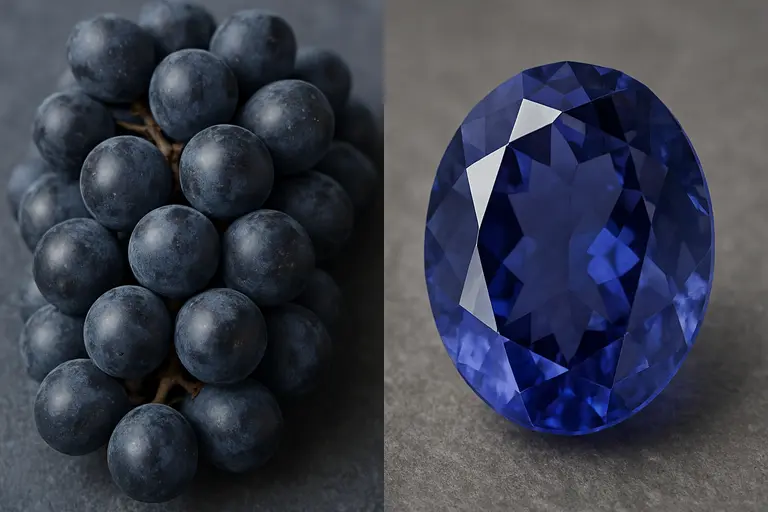
At first glance, the deep violet-blue saturation draws you in. Bangalore Blue Grapes boast an “inky” blue-purple skin. Scientifically, this comes from high Anthocyanin levels that intensify under Karnataka’s tropical sun. In contrast, Iolite derives its rich blue from Iron impurities locked within its Cordierite crystal structure.
Bloom vs. Pleochroism
What makes them even more intriguing is their play with light. Iolite dazzles with Pleochroism. This means it shifts colors from Violet-Blue to Honey-Yellow or Gray when viewed from different angles. Historically, Vikings used this property to navigate the seas.
Similarly, Bangalore Blue Grapes have a visual trick called “The Bloom.” This is a silvery-white, waxy coating that softens the dark purple beneath. As a result, as light scatters off this bloom, the fruit appears to have a velvet texture. Therefore, while Pleochroism is an internal mineral marvel, the Bloom is an external natural shield. If you love blue comparisons, read my guide on Marble Berry vs Blue Diamond.
Origins of Bangalore Blue Grapes vs Iolite
Moving from how they look to where they come from, both treasures have different, interesting backgrounds.
The Grape: A GI Tagged Legacy
Bangalore Blue Grapes are a Geographical Indication (GI) tagged variety. They flourish primarily in the Nandi Valley and Chikkaballapur districts near Bangalore. Farmers have cultivated them in red sandy loam soils for over 150 years. Unlike the sweet table grapes (like Thompson Seedless) from Nashik, these are distinct. They have a “Foxy” flavor and a thick skin, making them perfect for juice and wine, but an acquired taste for eating raw.
The Gem: Indian Heritage
On the other hand, Iolite forms in metamorphic rocks. India has always been a key source. Regions in Tamil Nadu, Orissa, and Rajasthan produce fine specimens. In Indian Astrology, Iolite is known as Neeli or Kaka Neeli. Significantly, it is an effective, affordable substitute for Blue Sapphire (Neelam) to appease the planet Saturn (Shani). Thus, while grapes tie to Karnataka’s fertile heritage, Iolite connects to India’s spiritual geology. Read more about astrological gems in Gemstone Therapy: Science vs Belief.
Identifying Bangalore Blue Grapes vs Iolite
Buyers in both markets need to make sure items are real.
Identifying the Grape: The “Slip Skin” Test
How do you know it is a real Bangalore Blue? Use the “Slip Skin” test. Gently squeeze the grape. The skin should slip off the pulp, leaving the green meat intact. In contrast with regular table grapes, the skin sticks to the flesh. Also, look for the seeds. Bangalore Blues are seeded, not seedless.
Identifying the Gem: The Dichroscope
For Iolite, professionals rely on the Dichroscope. Because of its strong Pleochroism, if you look through the tool, you will see two distinct colors (Blue and Yellow/Gray) side-by-side. Additionally, check the Refractive Index (RI), which is typically between 1.542 and 1.551. As a certified gemologist, I also look for “Bloodshot” inclusions (Hematite plates), which are common in Indian Iolite. To avoid fakes, check my Gemstone Buying Mistakes guide.
Purity of Bangalore Blue Grapes vs Iolite
Fortunately, both Bangalore Blue Grapes and Iolite remain largely untreated.
The Grape: Farmers in the Nandi Valley region often use traditional methods. While sulfur dioxide pads are sometimes used for transport preservation, the fruit itself is rarely genetically modified or artificially colored.
The Gem: Similarly, Iolite stands out in gemology as virtually Untreated. Why? Because it has a low melting point. If you try to Heat Treat Iolite (like you do with Sapphire or Tanzania’s Cloves and Tanzanite), it will crumble or melt. Therefore, what you buy is Earth’s pure gift. No dyes, no oil, no heat. This makes it a favorite for collectors who value natural integrity.
Smart Consumer Tips
Finally, how should you buy and use them?
- For the Foodie: Buy Bangalore Blue Grapes for Juicing or Jams. Do not buy them for a fruit salad, as the seeds and thick skin can be annoying. The high tannin content makes them excellent for homemade wine.
- For the Jewelry Lover: Buy Iolite as a Pendant or Earrings. Why not a ring? Iolite has a hardness of 7–7.5, which is good, but it has distinct cleavage. A hard knock can split it. Consequently, it is safer in pieces that don’t get banged around.
In India, source your Iolite from trusted hubs like Jaipur or Cochin. For jewelry settings, consider Men of Platinum Jewelry or Silver, as the cool white metal complements the violet-blue stone.
Conclusion: The Blues of the South
In summary, the comparison of Bangalore Blue Grapes vs Iolite reveals the diversity of India’s blue treasures. One provides the flavor of the South (in wine or juice); the other provides the sparkle of the South (in jewelry). Ultimately, both are reminders that luxury doesn’t always have to be imported; it grows right here in our soil.
FAQ: Bangalore Blue Grapes vs Iolite
What causes the blue color in these items?
In Bangalore Blue Grapes, the color comes from organic Anthocyanin pigments in the skin. In Iolite, the color comes from inorganic Iron impurities in the crystal lattice.
Are Bangalore Blue grapes good for eating raw?
Generally, no. They have a thick skin, large seeds, and high acidity. They are best suited for processing into juice, squash, jams, or wine.
How do you test Iolite pleochroism at home?
Simply rotate the stone under a light source. If it is genuine Iolite, you should see the color shift from violet-blue to a watery clear or yellowish-gray tone from different angles.
Is Iolite a good Sapphire alternative?
Yes. It is often called “Water Sapphire.” It offers a similar violet-blue hue at a fraction of the price of Blue Sapphire, making it excellent for budget-friendly astrology rings.
Where can I buy authentic Bangalore Blue grapes?
Look for the GI Tag label. You can find them in local markets like K.R. Market in Bangalore or via specialized organic delivery apps in Karnataka.