Introduction
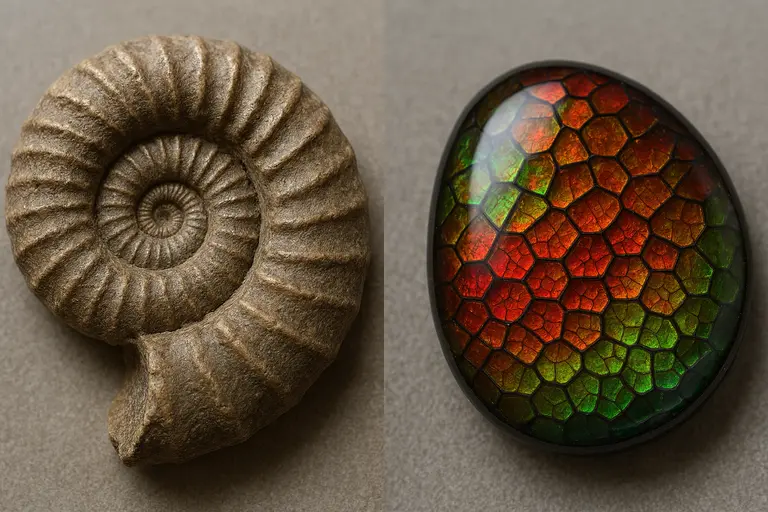
Discover the magic of the Ammolite Gemstone, one of the rarest gems on Earth. Unlike diamonds or rubies, which are minerals, Ammolite is an Organic Gemstone. It forms from the fossilized shells of ancient Ammonites (sea creatures) that lived 70 million years ago. The CIBJO officially recognized it as a gemstone only in 1981; it is a relatively new addition to the luxury world, yet it carries the weight of prehistoric history.
As a Gemologist, I find Ammolite fascinating because it shares the same chemistry as a Pearl (Aragonite) but displays the fire of an Opal. In this guide, we will cover its Canadian sources, how to spot the “Dragon Skin” pattern, and why Feng Shui masters call it the “Prosperity Stone.” Whether you are a collector or a jewelry lover, this guide will reveal the allure of its shifting colors.
Origins of Ammolite Gemstone: The Bearpaw Formation
To begin with, where does it come from? Ammolite Gemstone hails almost exclusively from southern Alberta, Canada. Specifically, the Bearpaw Formation yields commercial quantities. Miners focus on the banks of the St. Mary River near Lethbridge.
Why here? Significantly, 70 million years ago, this area was an inland sea (The Western Interior Seaway). When the Ammonites died, they sank to the bottom and were buried by volcanic ash. This unique combination of minerals prevented the shells from turning into chalk. Instead, they mineralized into iridescent sheets. However, only 0.1% of these fossils qualify as jewelry-grade. Therefore, top-quality Ammolite is statistically rarer than Diamond. While minor deposits exist in Saskatchewan and Utah, they produce inferior stones. Thus, always prioritize Alberta sources for vibrant, authentic Ammolite.
Color Science of Ammolite Gemstone
Next, let’s look at the “Fire.” Pigment does not cause the color in Ammolite. It is caused by the interference of light. The shell is composed of thin layers of Aragonite (Calcium Carbonate). When light hits these layers, it bounces back in different wavelengths.
- Thick Layers: Produce Red and Green (Common).
- Thin Layers: Produce Blue and Violet (Rare).
Comparatively, this is the same material found in Mississippi Pearls but arranged differently. Pearls have a soft glow (Orient); Ammolite has a metallic flash (Iridescence).
Spotting Authentic Ammolite Gemstones
Identification starts with its spectral flash. Real Ammolite Gemstone shifts colors as you rotate it (a phenomenon called Chromatic Shift).
Authentic patterns include:
- Dragon Skin: A cracked, scale-like texture that is highly prized.
- Stained Glass: Mosaic fractures that look like a church window.
- Sheet: Smooth, unbroken layers of color.
Rare colors like Blue or Violet can fetch up to $50,000 per carat. However, since the gem is soft (Mohs 3.5–4.5), jewelers rarely sell it as a solid stone. Jewelers stabilize it for durability. For more on gem durability, check my Colored Stone Grading guide.
Treatments for Ammolite Gemstone
Because of its fragility, treatments are mandatory and accepted. Unlike treating a Ruby, which lowers value, treating Ammolite enables its use.
1. The Doublet
A thin layer of Ammolite is glued to a dark backing (usually Shale or Onyx). This backing adds strength and creates a dark background that makes the colors pop.
2. The Triplet
A Doublet is capped with a clear dome of Spinel or Quartz. Consequently, this protects the soft Ammolite surface from scratches and impact. For Indian buyers, I recommend Triplets for rings. The quartz cap protects the stone from the humidity and heat of Kerala. Doublets are fine for pendants and earrings where impact is less likely.
Feng Shui and Ammolite Gemstone
Furthermore, Ammolite has a spiritual side. In Feng Shui, it is known as the “Seven Color Prosperity Stone.” Masters believe that because the stone has absorbed the earth’s energy for 70 million years, it radiates a powerful “Qi” (Chi).
- Red: Stimulates energy and growth.
- Green: Promotes wisdom and intellect.
- Orange: Enhances creativity.
Indigenous Heritage: Long before gemologists found it, the Blackfoot (Kainai) Nation of North America used it for talismans, calling it “Iniskim” (Buffalo Stone). Today, the Kainai Nation owns a significant stake in the mining operations via Buffalo Rock Mining, ensuring ethical sourcing.
Suppliers and Buying Guide
Where should you buy? Currently, Korite International leads globally, controlling 90% of the supply. They operate the largest mine and have strict grading standards. Other reliable distributors include:
- FossilEra: Top fossil retailer with direct sourcing.
- Gemexi: Indian wholesaler for silver jewelry settings.
In Kerala, Ammolite is still a novelty. However, its vibrant colors blend beautifully with 22K Gold. Ideally, set it in a bezel setting (metal surrounding the stone) rather than prongs, to protect the edges. You can read about setting styles in Jewelry Sales Secrets.
Conclusion: A Rainbow in Stone
Ultimately, Ammolite Gemstone is a bridge between the animal kingdom and the mineral kingdom. It is a gemstone that used to be alive. For the collector, it offers a color palette that no other stone—not even Opal—can match in intensity. In summary, if you want a piece of jewelry that is 70 million years in the making, Ammolite is your answer.
FAQ: Ammolite Gemstone
Is Ammolite rarer than diamonds?
Yes. Top-grade “AA” Ammolite from Alberta is significantly rarer than diamond. The supply is limited to one specific geological formation that is slowly being mined out.
How do I clean Ammolite jewelry?
Gently. Wipe with a soft cloth and mild soapy water. Never use an ultrasonic cleaner or steam cleaner, as the layers can separate or the glue in the triplet can fail.
What determines the value of Ammolite Gemstone?
Color and pattern. Stones with three or more colors (especially Blue/Purple) are most valuable. Also, the brightness (“Iridescence”) is key—the brighter, the better.
Is it a good investment?
Potentially. As the mines in Alberta become exhausted (estimated within 20 years), prices for high-grade material are expected to rise.
What is the difference between Ammolite and Ammonite?
An ammonite is the fossilized shell (the whole creature). Ammolite is the trade name for the gem-quality, iridescent material cut from that shell.
Author Bio
P.J. Joseph, also known as Saju Elizamma, Gemstone & Gold Consultant serving Kerala, Tamil Nadu, and Karnataka.