Introduction to Ammachi Panapillai Amma Jewelry
The women known as the Ammachi Panapillai Amma—the noble consorts of the Maharajahs of Travancore—wore some of the most distinctive ornaments in history. However, because the Travancore royal family followed the Marumakkathayam matrilineal system, these women were not Queens in the conventional sense. Instead, they held a noble status rooted in the Thampi caste of the Nair aristocratic tradition. Their Ammachi Panapillai Amma Jewelry, therefore, reflected a proud heritage consisting of heavy gold, religious motifs, and deep symbolism. To fully understand these pieces, you must explore their origins and the specific social status they represented. Furthermore, you should read our guide on gemstone buying mistakes to understand how quality standards apply to both modern and antique acquisitions.
The Noble Owners of Ammachi Panapillai Amma Jewelry
The Maharajahs of Travancore selected their consorts exclusively from a small group of noble families known as Ammaveedus. These families—Arumana, Vadasseri, Thiruvattar, and Nagercoil—held a privileged social position within the kingdom. The formal union followed a tradition called Pattum Parivattavum, a ceremony where the consort received fine silk cloth and gold. Because the Maharajahs supported their consorts in luxury, the Ammachi Panapillai Amma Jewelry collections grew steadily as a visible record of their family connections. Consequently, these ornaments served as more than fashion; they were permanent assets of the noble house. You can find more historical details on Heritage University of Kerala’s heritage resources.
Defining the Style of Ammachi Panapillai Amma Jewelry
The noble consorts wore multiple gold pieces simultaneously to signal their high rank. Moreover, each item carried a specific meaning that went well beyond mere decoration.
Iconic Necklaces in the Ammachi Panapillai Amma Jewelry Collection
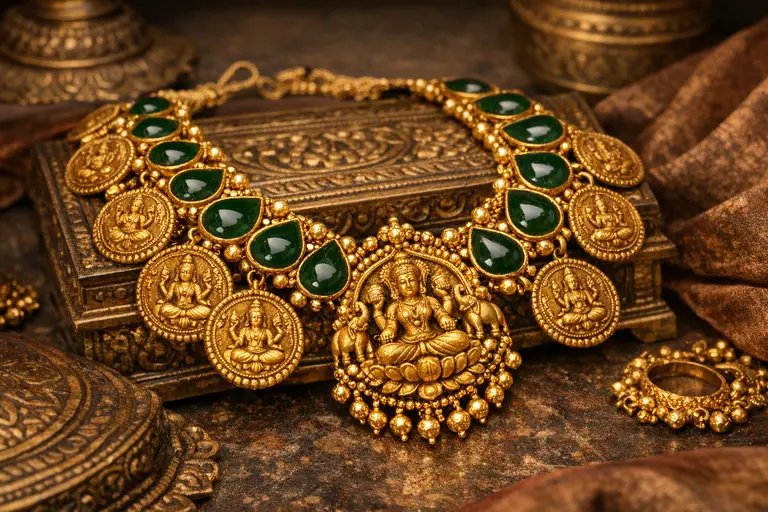
The Palakka Mala featured mango-shaped pendants set with green or red stones, edged with tiny gold beads. This necklace remains one of the most recognizable pieces in the Ammachi Panapillai Amma Jewelry repertoire today. Alongside it, the Nagapadam Necklace carried the form of a serpent’s hood, inlaid with rubies or emeralds. Furthermore, the Kasumala, also known as Kaasaali, was a long coin chain featuring the goddess Lakshmi. Worn as the longest piece, the Pathakkam was a circular pendant engraved with a deity, functioning as both a devotional object and a statement of prestige. To understand the authenticity of such stones, refer to the Gemological Institute of America.
Personal Ornaments within Ammachi Panapillai Amma Jewelry
Specifically, the Elakkathali sat close to the throat and consisted of thin, interlocking layers of gold leaf. This technically demanding piece required a highly skilled goldsmith. In addition, the Karimani Mala, a chain of black and gold beads, indicated married status and carried deep personal significance. For the ears, the Ammachis wore Jimmiki, bell-shaped drops, and the Pappada Thaali, a flat disc earring closely associated with Nair aesthetics.
Craftsmanship Standards of Ammachi Panapillai Amma Jewelry
Goldsmiths crafted virtually all Ammachi Panapillai Amma Jewelry in 22-karat (916 purity) gold. This high purity gave the pieces the deep, warm yellow tone characteristic of South Indian goldwork. Specifically, craftsmen used two key techniques to create these masterpieces. First, Jadau work involved setting stones directly into the gold without the use of modern claws; the metal itself held the gemstone. Second, Meenakari, or enamel work, added vibrant color to the reverse sides of pendants. Because these techniques were labor-intensive, each piece became a unique work of art. If you are buying modern versions of these, check our guide on Understanding BIS Hallmark.
Comparing Ammachi Panapillai Amma Jewelry with Other Traditions
It is helpful to compare Ammachi Panapillai Amma Jewelry with other regional traditions. The noble consorts favored heavy, stone-set gold that signaled their proximity to the throne. By contrast, the women of Namboothiri Brahmin households favored more restrained, ancient designs such as the Kettarimbu, worn primarily during religious festivals. Furthermore, tribal traditions in Kerala used entirely different materials, such as seeds and beads, reflecting a separate aesthetic. Consequently, the jewelry of the Ammaveedus stands as a bridge between temple art and royal regalia.
The Historical Legacy of Ammachi Panapillai Amma Jewelry Design
Notably, the portraits of consorts painted by Raja Ravi Varma show women adorned in these rich layers of gold. Unlike royal Maharanis who wore elaborate silk shawls, the Ammachis consistently appear in a restrained style where the jewelry speaks loudest. Today, jewelers produce various imitations of this historic style. While modern “Temple Jewelry” captures the visual character, original Ammachi Panapillai Amma Jewelry carries hallmarks of hand-forming and metal density that replicas cannot match. Therefore, preserving these heirlooms is essential for maintaining Kerala’s cultural identity.
FAQ: Common Questions on Ammachi Panapillai Amma Jewelry
What gold purity did traditional Ammachi jewelry use?
Goldsmiths used 22-karat (916 purity) gold for virtually all period pieces. This purity ensured the jewelry retained its monetary and cultural value.
What is the difference between a Palakka Mala and a Kasumala?
The Palakka Mala features mango-shaped stone-set pendants. In contrast, the Kasumala is a coin chain incorporating goddess imagery, often given as a bridal asset.
Can I purchase authentic Ammachi jewelry today?
Authentic period pieces are rare and typically appear only in heritage auctions. Most “traditional” items sold today are modern replicas or 1-gram gold imitations.
Why was the Nagapadam necklace so important?
The Nagapadam represents the serpent’s hood, a sacred symbol in Kerala. It was believed to offer divine protection and prosperity to the wearer.
Did these women wear stones other than rubies and emeralds?
Yes, craftsmen occasionally used diamonds and pearls, but rubies and emeralds remained the preferred stones due to their traditional significance in Vedic astrology.
Disclaimer
This article is intended for general educational and cultural awareness purposes only. While the information draws on documented historical sources, oral traditions, and scholarly references, it does not constitute academic or archival certification of any specific jewelry piece or family history. Jewelry attributions, karatage standards, and design terminologies may vary by region, craftsman, and period. If you are evaluating, purchasing, or authenticating antique Kerala jewelry, please consult a qualified heritage appraiser or a recognized institution such as a state museum or certified gemological body. The author and publisher accept no responsibility for decisions made based solely on this content.