Introduction
In the realm of luxury, color is currency. Imagine a fruit so exquisite it is crowned the “King of Mangoes,” and a gemstone so regal it is dubbed “Imperial.” Surprisingly, the Alphonso Mango and Imperial Topaz share striking parallels. Both boast intense golden-orange hues, colonial histories tied to Portuguese explorers, and an elite status that drives premium prices.
For instance, their warm colors evoke tropical sunsets, while their rarity makes them seasonal treasures. As a Gemologist who loves the summer fruit season in India, I see the same “Saffron” glow in both. In this article, we will explore these connections in detail. Whether you are a gemologist in Kerala or a food lover in Mumbai, these similarities reveal nature’s luxurious patterns. Ultimately, one feeds the stomach, and the other feeds the eyes.
Colors of Alphonso Mango and Imperial Topaz
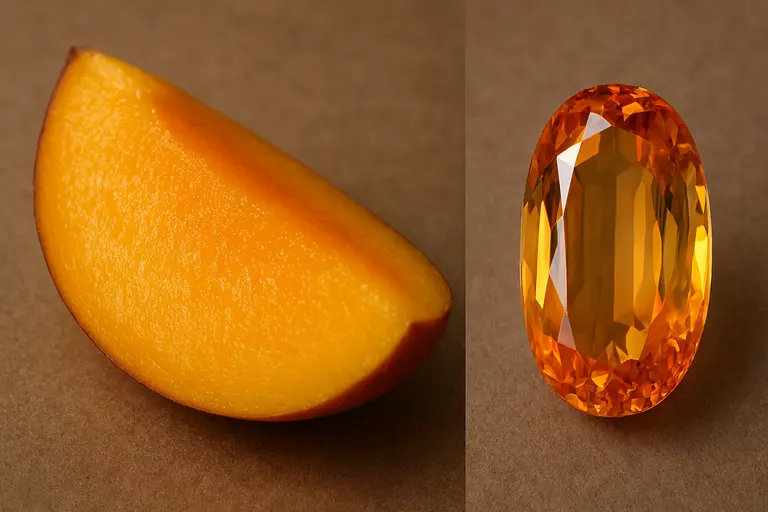
First, let’s look at the palette. Both the Alphonso Mango and Imperial Topaz captivate with their rich, warm tones. These hues set the gold standard for quality in their respective worlds.
The Mango: Edible Saffron
The ripe Alphonso (locally known as Hapus) features vibrant golden-yellow skin. Often, a reddish or saffron blush appears near the top of the stem. Inside, its flesh glows with deep saffron-yellow tones. Visually, this saturated color delivers intense appeal to the appetite. It looks like solidified sunshine.
The Gem: Mineral Fire
Similarly, Imperial Topaz shines in golden-orange to reddish-orange shades. Experts describe it as “fiery,” much like the vivid pulp of the fruit. For example, high-quality specimens from Ouro Preto, Brazil, show a distinct “Pinkish Orange” flash (Pleochroism) that mimics the blush on a ripe mango skin. Therefore, collectors seek them for that unmatched aesthetic punch. If you love orange gems, compare this to Mandarin Fruit vs Mandarin Garnet.
Origins of Alphonso Mango and Imperial Topaz
Next, history links these treasures through a shared lineage. Both emerged from 16th-century adventures.
The General and the Mango
Consider the Alphonso Mango. It is named after the Portuguese general Afonso de Albuquerque. In the 1500s, he established colonies in India. His team introduced grafting techniques in Goa, birthing this variety. Today, the finest grow in India’s Konkan region (Ratnagiri and Devgad). Just as we value Kashmiri Saffron and Padparadscha for their origin, we value Alphonso for its specific soil.
The Czar and the Topaz
On the other hand, Imperial Topaz has roots in Brazil—another Portuguese colony. The term “Imperial” was coined in the 19th century because the rare pinkish-orange stones were allegedly reserved for the Russian Czar. However, the primary source today is Ouro Preto. Thus, the Portuguese empire accidentally connected these two golden treasures across continents.
Identifying Alphonso Mango and Imperial Topaz
Furthermore, spotting authentic versions is essential. Substitutes flood markets for both.
Identifying the Mango
For Alphonso mangoes, look for a medium oval shape, not a perfect circle. Most importantly, use the “Aroma Test.” A real Alphonso emits a powerful, sweet fragrance that fills the room, even from afar. When ripe, the skin should be soft and thin, often wrinkling slightly near the stem. Avoid imitations like the “Karnataka Alphonso”, which often lacks the aroma of the Ratnagiri original.
Identifying the Gem
Imperial Topaz identification relies on gemology basics.
- Hardness: It scores 8 on the Mohs scale. It is harder than Quartz (Citrine), which is the most common fake.
- Weight: Topaz has a high Specific Gravity (density). It feels heavier in the hand than a Citrine of the same size.
- Brilliance: Its high refractive index creates a sharp, glassy sparkle. Beware of “Heating” common yellow topaz to mimic the Imperial color. Read my Gemstone Buying Mistakes guide to avoid Citrine scams.
Rarity of Alphonso Mango and Imperial Topaz
Both command luxury prices due to rarity. The Alphonso earns “King of Mangoes” fame, while Imperial Topaz is the “Precious” pinnacle of the topaz family.
Pricing reflects this.
- The Gem: Top-quality Imperial Topaz can exceed $1,000 to $3,000 per carat, especially for stones over 5 carats with pink tones.
- The Fruit: Genuine Alphonsos fetch premium rates, often ₹1,500 to ₹3,000 per dozen in export markets.
Additionally, seasonality adds allure. Mangoes are short-lived (April-June). Once the monsoon hits Kerala, the season ends. Similarly, fine Topaz mining yields are sporadic. Therefore, savvy buyers act quickly when the “Season” opens.
Expert Warning: Fragility in Gems
As an expert, I must add a warning about the stone. While the Mango is fragile because it rots, the Topaz is fragile because of Cleavage. Topaz has “Perfect Basal Cleavage.” This means that if you hit it at the wrong angle, it can split cleanly in half like a slice of bread. Consequently, jewelers must set it carefully in protective bezels. It is durable (hard) but not tough (it breaks). This is different from Jadeite vs Nephrite, where the stone is incredibly tough.
Conclusion on Alphonso Mango and Imperial Topaz
Ultimately, the Alphonso Mango and Imperial Topaz comparison proves that nature loves the color gold. Whether it is the fructose in the fruit or the chromium in the crystal, the result is the same: Pure Joy. For the gem lover, owning an Imperial Topaz is like owning a slice of summer that never fades. In summary, enjoy the fruit while it lasts, and keep the stone forever.
FAQ: Guide to Alphonso Mango and Imperial Topaz
Where can I buy authentic Alphonso mangoes?
Source from Ratnagiri or Devgad via trusted exporters. Look for the GI Tag (Geographical Indication) sticker on the crate to ensure it is not a hybrid from another region.
How do I distinguish real Imperial Topaz from Citrine?
Real Imperial Topaz feels heavier (denser) and feels “colder” to the touch than Citrine due to thermal conductivity. Also, Topaz has a slicker, glassier feel compared to the slightly “plasticky” feel of Quartz/Citrine.
Are Alphonso mangoes and Imperial Topaz seasonal?
Yes. Mangoes are strictly seasonal (April-June). While Topaz is available year-round, new mining parcels from Ouro Preto are often released in batches, creating “market seasons” for traders.
Why the Portuguese connection?
Historically, Portuguese traders took the grafting tech to India (creating the Mango) and opened the mines in Brazil (finding the Topaz). They built the bridge between these two worlds.
Can I wear Imperial Topaz daily?
Yes, but with care. Due to its perfect cleavage, do not wear it while doing heavy work or sports. A hard knock can split the stone. It is best for necklaces or earrings rather than rings.
Author Bio
P.J. Joseph, also known as Saju Elizamma, Gemstone & Gold Consultant serving Kerala, Tamil Nadu, and Karnataka.