Introduction
When we talk about Indian gem history, we often think of Golconda diamonds. However, the true ancient backbone of India’s gem trade lies in a small town in Gujarat. Artisans in Khambat meticulously craft the semi-precious Agates of Cambay. Remarkably, for over 4,000 years, this town has stood as a global hub for agate artistry, tracing its roots back to the Harappan Civilization (Indus Valley).
Significantly, in 2008, it earned a prestigious Geographical Indication (GI) Tag, safeguarding its unique heritage against imitations. Today, in 2026, these vibrant stones continue to captivate jewelry lovers, spiritual seekers, and interior designers worldwide. Personally, as a Gemologist, I revere Khambat because it is where gem cutting began. In this article, we will explore the history, the dangerous beauty of the craft, and why this town is the “One District One Product (ODOP)“ star of Gujarat.
History of Agates of Cambay
To begin with, the story of Agates of Cambay begins in ancient times. For instance, archaeological digs at Lothal (a nearby Harappan port) reveal that Khambat artisans produced these beads as early as the third millennium B.C. Moreover, evidence from Roman graves, Egyptian ruins, and Mesopotamian sites confirms their role in early global trade. For instance, imagine this: a Roman Emperor likely wore a ring made by a Khambat artisan 2,000 years ago.
Transitioning to spiritual depths, Carnelian Agate earns the title of the “most pious stone” in Islam. Often, artisans fashion it into Tasbihs (rosaries), cherished across the Middle East. However, this enduring legacy faces challenges today. While it supports 80% of local families, the industry struggles to modernize. You can read about the broader jewelry traditions of the state in my Gujarati Jewellery guide.
Varieties of Agates of Cambay
Rough agates for Cambay gemstones hail primarily from the Rajpipla Hills, roughly 200 km away. Typically, naturally, these nodules display a spectrum of hues: white, grey, brown, and green. But it is the processed varieties that truly shine.
Carnelian (The Star)
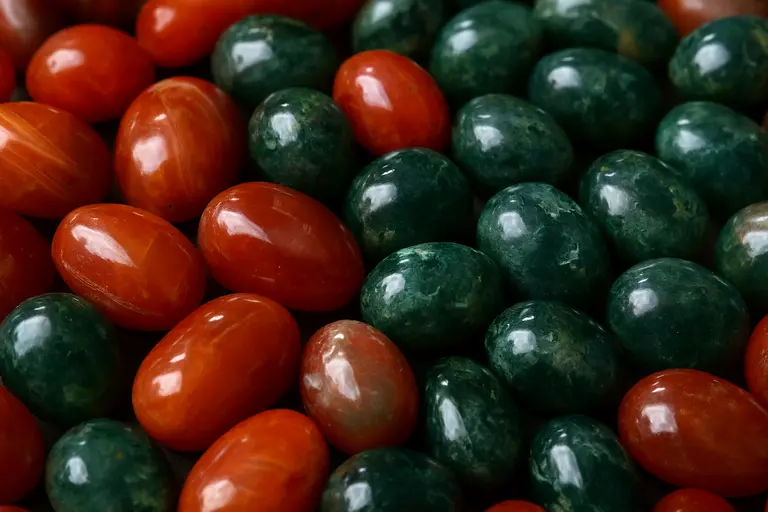
This boasts a rich reddish-orange glow. The Secret: specifically, artisans bake the brown stones in clay pots. Chemically, the heat oxidizes the iron content, turning the stone from drab brown to vibrant red. Visually, it rivals the color of Stuller’s Signature Red.
Moss Agate and Bloodstone
Next, Khambat is famous for Moss Agate, which is enchanted with green, vegetation-like patterns. If you saw my post on Moss Agate and Cabbage Thoran, you know how beautiful these inclusions are. Additionally, bloodstone (Heliotrope)—a dark green stone with red spots—is a Khambat specialty used for signet rings.
Craftsmanship of Agates of Cambay
What sets Agates of Cambay apart is the unchanged, hands-on process. Truly, it is a labor of love that has not changed much in centuries.
- Sun-Drying: Raw nodules are dried to remove moisture.
- Heating: Baking them in terracotta vessels to enhance color.
- Chipping (Bhongiya): Traditionally, using buffalo horn hammers to flake off the crust.
- Grinding: Smoothing the shape on emery wheels.
- Polishing: Tumbling in drums for weeks to achieve a mirror finish.
Furthermore, for beads, traditional bow-drills (or modern diamond drills) ensure tiny, perfect holes. Consequently, each piece carries the mark of human effort.
The Dark Side: The Silicosis Crisis
As an expert, I must address the reality of the trade. Sadly, this labor-intensive craft isn’t without risks. Unfortunately, Silicosis—a lung disease caused by inhaling fine silica dust—remains a critical issue in home workshops. Although dust control tech exists, regrettably, adoption is slow due to costs. Therefore, when you buy Agates of Cambay, you should look for exporters who support “Green” or “Safe” workshops. Supporting modernized units helps save lives.
Modern Uses of Agates of Cambay
Beyond beads, Khambat artisans create an array of items. Currently, spiritual offerings include meditation pyramids and Chakra sets, aligning with “New Age” trends. Items like wire-branched agate trees, decorative vases, and polished paperweights bring a touch of elegance to any home. Ayurvedic doctors prize functional wares for grinding medicines. See how gems fit into wellness in my Ayurvedic vs Gemstone Treatments article.
Authenticity: The GI Tag Advantage
Fast-forward to 2026. Crucially, the GI Tag (No. 80) is your guarantee. Because cheap dyed agate from Brazil or China floods the market, the GI tag ensures the stone was processed in Khambat using traditional methods. Meanwhile, supply chains rely on Rajpipla, with Gujarat dominating production. Positively, the government’s ODOP (One District One Product) support elevates visibility.
Conclusion: A Living Fossil of Trade
In summary, Agates of Cambay are not just stones; they are survivors. Indeed, they survived the fall of the Indus Valley, the rise of the British Raj, and the modern digital era. Ultimately, owning a piece of Khambat Agate is owning a piece of human history. Whether it is a simple bead or an elaborate bowl, it represents 4,000 years of continuity.
FAQ: Agates of Cambay
What makes Agates of Cambay unique?
Their 4,000-year history and the specific heat-treatment technique used in Khambat to turn brown stones into vivid Red Carnelian sets them apart. They are protected by a GI Tag.
Where can I buy authentic Khambat Agate?
Look for GI-certified sellers or established exporters in Khambat town. Fortunately, many have an online presence now under the “Khambat Gems” banner.
Are Cambay agates good for healing?
Traditionally, yes. Historically, carnelian is believed to boost energy and creativity. Likewise, bloodstone is believed to purify the blood. However, always consult experts for personal use.
What is the “Baking” process?
It is a traditional method where workers pack stones in pots with sawdust and heat them. Significantly, this changes the oxidation state of iron minerals, enhancing the color permanently.
What stones are found in Khambat?
Primarily, the main ones are Carnelian, Moss Agate, Bloodstone, Jasper, and Onyx. They are all varieties of the Chalcedony family.