Summary
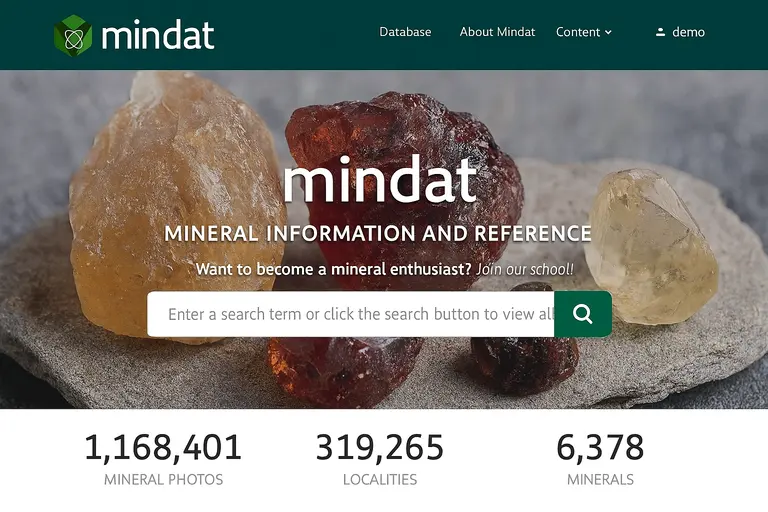
Mindat Mineral Database is the most complete online resource for minerals, rocks, and meteorites. It connects collectors, gemologists, and students through verified data, photographs, and user contributions. You can search, learn, and even add to this expanding global record of mineral knowledge.
Introduction
The Mindat Mineral Database is the world’s central resource for mineral information. It features data on minerals, rocks, and meteorites from every corner of the planet — and beyond.
Every entry is reviewed by experts and updated daily by a community that values accuracy. If you study gemstones, geology, or simply collect stones, Mindat helps you find reliable facts and connect with others who share your passion.
Curious how this vast resource works and why it matters? Let’s explore.
What You Can Learn from Mindat Mineral Database
Mindat began as a small project dedicated to mineral localities. Over time, it grew into the largest online reference for minerals and related sciences. As a result, it now supports professionals, students, and collectors around the world.
You’ll find:
- Over 300,000 mineral locality records
- Rock and meteorite data
- Verified mineral photos and crystal images
- References from scientific publications
- Links to museums and research institutions
The mission is clear — gather and share accurate mineral data for everyone. Visit the official Mindat website to explore minerals by name, locality, or composition.
Why Mindat Mineral Database Matters to You
Mindat is designed for everyone — from professionals to hobbyists.
Here’s why it’s valuable:
- Reliable data: Each entry is reviewed by specialists.
- Learning tools: Ideal for students, educators, and researchers.
- Community support: Discuss topics on its message board.
- Visual learning: Millions of mineral photographs aid identification.
If you enjoy gem stories, explore related articles on Saju Elizamma. Like those stories, Mindat bridges scientific knowledge with curiosity and passion.
How You Can Contribute
Mindat thrives on community participation. In addition, you can make it stronger through your contributions. For example, uploading mineral photos or correcting data helps thousands of users daily.
Here’s how:
- Upload mineral photos from your collection.
- Add new or lesser-known locality data.
- Suggest corrections to existing records.
- Join discussions and share experiences.
Every contribution improves the global mineral record and helps others learn. Your effort supports researchers, students, and collectors worldwide.
The People Behind Mindat Mineral Database
Mindat exists because thousands of people care about minerals. Contributors from around the world review and expand the database daily.
Professionals and enthusiasts work together — one entry at a time. Therefore, this shared commitment ensures accuracy and growth. Moreover, it builds trust within the global mineral community.
It’s one of the few online communities where amateurs directly support professional research.
Mindat Mineral Database on Rocks and Meteorites
The database now extends far beyond minerals. In fact, it includes detailed information on rocks, meteorites, and petrology. Furthermore, these records help connect Earth science with space research.
You can browse data on igneous, metamorphic, and sedimentary rocks. Meteorite collectors will find records of known falls and finds, complete with coordinates and images.
This expansion helps link mineralogy to the broader story of Earth and space science.
The Hudson Institute of Mineralogy
Mindat operates under the Hudson Institute of Mineralogy, a U.S.-based non-profit organization.
The Institute focuses on mineral discovery, study, and preservation. It also promotes public understanding of minerals through education and outreach.
This partnership keeps Mindat accurate, open, and freely available for anyone who wants to learn.
Why Mindat Keeps Growing
Mindat’s growth depends on active community involvement. Each photo, correction, and contribution adds to its value. Because of this, the open structure invites everyone to share knowledge. Eventually, that shared input strengthens the scientific record.
This open structure invites everyone to share knowledge and resources. Because of that, Mindat continues to grow as a vital educational and research tool.
If you love gems and minerals, your participation helps preserve knowledge for future generations.
FAQ
What is the Mindat Mineral Database used for?
It helps you find accurate data about minerals, rocks, and meteorites by name, locality, or image.
Is Mindat free to use?
Yes. Anyone can access the information, upload photos, or join the discussions.
Who maintains Mindat?
Volunteers, collectors, and mineralogists working with the Hudson Institute of Mineralogy.
How reliable is Mindat’s data?
Entries are reviewed by experts and verified by the community before being published.
Can I contribute my mineral photos?
Yes. Registered users are encouraged to upload and share images from their collections.
Credit
This article draws on reporting originally published by Mindat.org.
Credit to Mindat.org and the Hudson Institute of Mineralogy for sharing and maintaining the global mineral database.
This story is adapted from Mindat.org, the world’s most comprehensive mineral database and mineralogical reference website, with additional SEO and contextual research by Saju Elizamma.