Summary
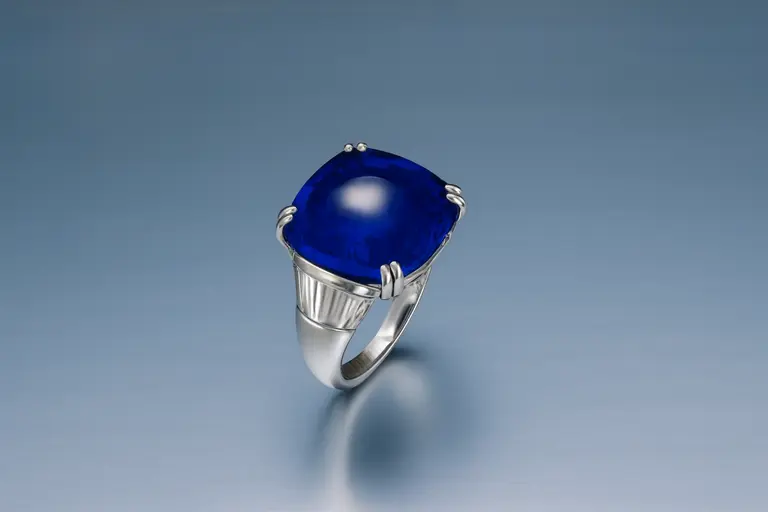
The Rockefeller Kashmir is an 18-carat sugarloaf cabochon sapphire ring by Cartier, originally gifted to Abby Aldrich Rockefeller by John D. Rockefeller Jr. This rare gem, known for its flawless clarity and deep blue tone, leads Christie’s Magnificent Jewels sale in December. The article explores its origin, craftsmanship, and why Kashmir sapphires remain the most sought-after gemstones in the world.
Introduction
Christie’s December Luxury Week features one of the rarest sapphires in private hands — the Rockefeller Kashmir.
An 18-carat dome-shaped cabochon sapphire, once owned by Abby Aldrich Rockefeller, now leads the Magnificent Jewels auction on 10 December 2025.
The ring blends American legacy and French design. Cartier, at its Art Deco peak, created the setting. As a result, it remains one of the finest examples of 1920s jewelry craftsmanship.
The Rockefeller Kashmir Sapphire and the Rockefeller Legacy
John D. Rockefeller Jr. and Abby Aldrich Rockefeller shaped one of America’s most refined private jewelry collections.
Their choices revealed a clear preference — Cartier for design excellence and Raymond Yard for personal commissions.
The Rockefeller Kashmir sapphire has stayed within the family for three generations. Over time, each owner preserved both its beauty and provenance — qualities that define high-value jewels.
In addition, you can explore related insights in Argyle Pink Diamonds: Rarity and Value, another story of color, rarity, and prestige.
Why the Rockefeller Kashmir Sapphire Is So Rare
Kashmir sapphires come from a remote Himalayan mine discovered in the late 19th century — now long depleted.
Collectors value these gems for:
- Their deep, velvety blue hue with soft inner glow
- Natural clarity without heat treatment
- Extreme rarity — especially in large sizes
When you see a Kashmir sapphire, you’re looking at the top tier of blue gemstones. Even today, their beauty surpasses that of sapphires from Burma or Sri Lanka, both of which are still admired but more common.
Meanwhile, you can learn how the purity of the alloy affects gold color and strength in Understanding 22K Gold Alloy.
Cartier and the Rockefeller Kashmir Sapphire Connection
Cartier dominated jewelry design during the Art Deco period, combining geometry with refined luxury.
The Rockefeller Kashmir ring reflects this philosophy.
Cartier’s platinum setting emphasizes the gem — clean, balanced, and timeless.
While many pieces from that era sparkle with diamonds, this ring draws focus to a single gem. Therefore, it proves that true luxury often lies in restraint.
Explore more about Cartier’s craftsmanship on the official Cartier High Jewelry page.
Why the Rockefeller Kashmir Sapphire Stands Apart
Most large cabochon sapphires contain inclusions or internal flaws.
Yet, this one stands nearly flawless.
Alexander Eblen, Senior Specialist for Jewellery at Christie’s New York, explains:
“This gem cabochon is so superb, you could facet it the other way around, and it would be virtually flawless.”
For this reason, its perfection makes it one of the finest unheated Kashmir sapphires ever seen at auction.
Consequently, the Rockefeller Kashmir represents near-geological perfection.
Christie’s Magnificent Jewels Sale Featuring the Rockefeller Kashmir Sapphire
The Rockefeller Kashmir leads Christie’s Magnificent Jewels sale on 10 December 2025 in New York, part of the annual Luxury Week.
Collectors and investors will also see:
- Historic Cartier pieces
- Rare colored diamonds
- Signed jewels from Van Cleef & Arpels, Tiffany & Co., and Raymond Yard
Furthermore, each auction sets new benchmarks for gemstone demand, provenance value, and craftsmanship appreciation.
Follow updates directly on Christie’s Official Site.
The Enduring Power of the Rockefeller Kashmir Sapphire Provenance
Gem value extends beyond clarity and carat. Provenance gives it a voice.
This sapphire connects three stories — Kashmir’s geology, Cartier’s artistry, and the Rockefeller family’s legacy.
As a result, collectors today pay more for pieces with verifiable history.
A gemstone once owned by the Rockefellers adds emotional and cultural depth beyond its intrinsic beauty.
Ultimately, would you prefer a flawless gem without history — or one that carries a century of legacy?
Lessons from the Rockefeller Kashmir Sapphire for Collectors
For collectors and gem professionals, this ring offers key insights:
- Quality lasts — exceptional stones stay valuable through generations.
- Design defines legacy — simple elegance endures longer than trend.
- Provenance elevates value — heritage attracts collectors.
- Rarity drives demand — mines close, but demand never fades.
In short, the Rockefeller Kashmir isn’t just a sapphire.
It’s a living record of human appreciation for beauty, craftsmanship, and history.
FAQ
1. What makes Kashmir sapphires the most valuable?
They have a rich cornflower-blue tone, velvety glow, and natural clarity. The original mines have long closed, making them extremely rare.
2. Why is Cartier linked to the Rockefeller collection?
The Rockefellers often commissioned pieces from Cartier during the Art Deco era for its clean, modern designs.
3. What is a sugarloaf cabochon cut?
It’s a smooth, dome-shaped cut that highlights color and purity rather than sparkle.
4. Can cabochon sapphires be flawless?
Almost never. The Rockefeller Kashmir sapphire is one of the few known examples with near-perfect clarity.
5. Where can I view it?
It will appear in Christie’s Magnificent Jewels auction during Luxury Week in New York on 10 December 2025.
Credit
This article draws on reporting originally published by Christie’s.
Credit to Christie’s for first sharing “The Rockefeller Kashmir: An extraordinary 18-carat sapphire.”
This story is adapted from Christie’s, a world-leading global auctioneer, with additional SEO and contextual research by Saju Elizamma.