Most people assume all pearls are the same. However, saltwater and freshwater pearls differ significantly. Understanding these differences can save you from costly mistakes and help you choose the right pearls for your collection or jewelry.
Natural Saltwater Pearls
Almost all natural pearls you see today are saltwater pearls. They form in oysters along ocean coasts such as the Persian Gulf, the Red Sea, Sri Lanka, and Japan. Historically, these pearls were prized for royal jewelry and ceremonial ornaments.
Saltwater pearls are known for their round shape, lustrous surface, and rarity. Their formation is slow, often taking several years, which adds to their value. Moreover, each pearl is unique, making them highly collectible.
Saltwater pearls also come in various types, such as Akoya, South Sea, and Tahitian pearls. Akoya pearls are small, perfectly round, and highly lustrous, while South Sea pearls are larger and usually golden or white. Tahitian pearls are famous for their natural dark hues, ranging from gray to black. These variations give collectors and jewelry lovers a wide range of options depending on taste and budget.
Learn more about natural pearls.
Read about CIBJO’s pearl standards.
Natural Freshwater Pearls
Natural freshwater pearls are extremely rare. They form in rivers or lakes without human intervention. Consequently, they are mostly found in museum collections or private collectors’ displays.
These pearls are usually irregular in shape, sometimes resembling small nuggets. Their rarity makes them far more valuable than most cultured freshwater pearls. Thus, encountering them in everyday jewelry stores is highly unlikely.
Interestingly, natural freshwater pearls can come in subtle colors, from white and cream to soft pink or lavender. Collectors prize them for their irregular shapes and natural beauty. Their scarcity also makes them a choice for antique or bespoke jewelry pieces.
Cultured Freshwater Pearls
The confusion begins with cultured freshwater pearls, which dominate the market today. China is the largest producer, supplying affordable and uniform pearls in large quantities.
Many buyers mistakenly call these pearls “natural freshwater pearls.” However, they are farmed. Cultured pearls are created by inserting a nucleus or tissue into a mussel, which then forms a pearl around it.
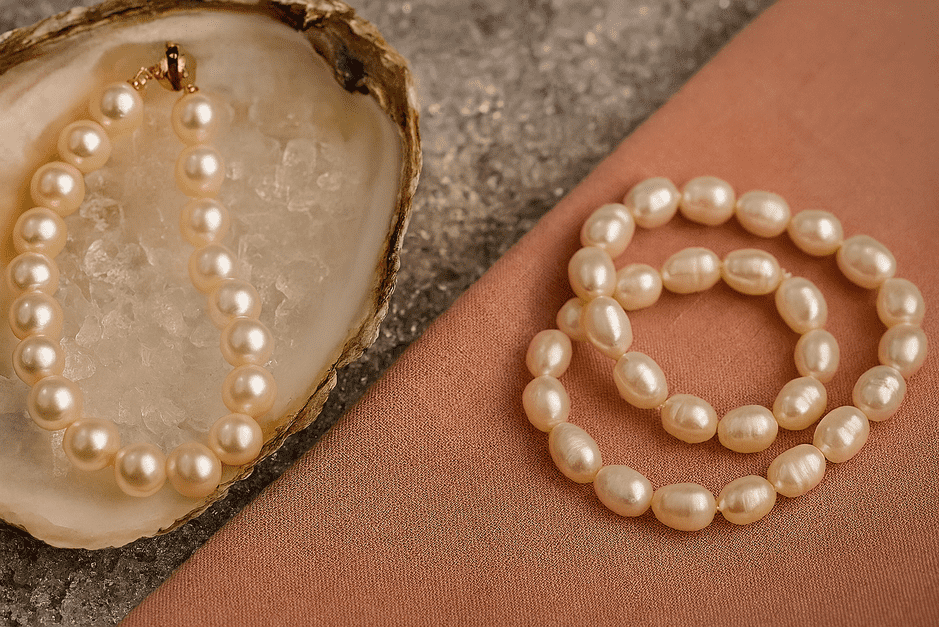
Cultured freshwater pearls are excellent for jewelry because of their consistent shapes and colors. Still, they are not as rare or valuable as natural pearls. Cultured freshwater pearls are often oval, button-shaped, or slightly irregular, which makes them versatile for necklaces, bracelets, and earrings.
Practical tip: Cultured freshwater pearls are perfect for fashion jewelry or daily wear, while natural pearls remain a long-term investment due to their rarity.
Why Saltwater and Freshwater Pearls Are Different
Saltwater pearls are mostly round, lustrous, and rare, making them highly prized in the luxury market. Natural freshwater pearls are irregular and extremely rare, often collected for their uniqueness. Cultured freshwater pearls are widely available, more affordable, and uniform in shape, but they do not carry the same rarity or historical value.
Therefore, treating saltwater and freshwater pearls as the same can lead to misunderstanding and poor purchasing decisions. Each type has its own market, value, and audience.
Why This Matters for You
If a jeweler offers a “natural freshwater pearl,” always ask about its source and certification. Genuine natural freshwater pearls are museum-grade and rarely sold in bulk. Consequently, if the price seems too good to be true, it is most likely a cultured pearl.
Understanding this distinction helps you make informed choices, whether you are buying for personal use, investment, or gifting. Recognizing the differences also protects you from marketing gimmicks that label cultured pearls as “natural” or “rare.”
Practical Tips for Buying Pearls
- Natural saltwater pearls are the main players in the natural pearl market.
- Natural freshwater pearls are rare exceptions, mostly for collectors.
- Cultured freshwater pearls are mass-market and widely available at affordable prices.
Always check for certification when buying high-value pearls. A trustworthy jeweler will provide details about origin, treatment, and authenticity. Moreover, examining the pearl’s shape, surface, and luster can help you identify its type before purchasing.
When buying pearls online, look for verified sellers and ask for high-resolution images or videos. This way, you can inspect the pearls’ surface and color before committing to a purchase.
How to Spot the Difference
- Price check – Extremely low prices usually indicate cultured pearls.
- Shape and surface – Natural pearls have unique irregularities; cultured ones are uniform.
- Certification – Always ask for an independent grading report.
Understanding these factors ensures you invest in genuine pearls and avoid confusion.
Caring for Saltwater and Freshwater Pearls
Pearls are delicate and require proper care. Always avoid exposure to harsh chemicals, perfumes, or cosmetics. After wearing, wipe them gently with a soft cloth to remove sweat and oils. Store pearls separately in a soft pouch to prevent scratches.
Moreover, freshwater pearls, especially cultured ones, are slightly softer than saltwater pearls and can wear faster if not handled carefully. Regular cleaning and proper storage prolong their luster and lifespan.
FAQs About Saltwater and Freshwater Pearls
Q1: Are freshwater pearls less valuable than saltwater pearls?
A1: Generally, yes. Natural saltwater pearls are rarer and more valuable. Cultured freshwater pearls are common and more affordable.
Q2: Can you tell natural freshwater pearls from cultured ones?
A2: Only through professional certification. Natural freshwater pearls are extremely rare and usually not sold in bulk.
Q3: Where are saltwater pearls mainly found?
A3: They come from oysters in oceans such as the Persian Gulf, Red Sea, Sri Lanka, and Japan.
Q4: Are cultured freshwater pearls bad?
A4: Not at all. They are beautiful, widely available, and great for jewelry, but they are farmed, not naturally formed.
Q5: Why are natural freshwater pearls so rare?
A5: Because they form naturally in rivers and lakes without human intervention, and the conditions for formation are very specific.
Q6: How should I care for pearls?
A6: Wipe them gently after wearing, avoid chemicals, and store them in a soft pouch away from other jewelry.
What This Means for You
Saltwater and freshwater pearls are not the same. Natural saltwater pearls dominate the luxury market, natural freshwater pearls are extremely rare, and cultured freshwater pearls are widely available for affordable jewelry. By understanding these differences, you can make informed decisions, choose authentic pearls, and avoid costly mistakes.
Remember, pearls are not just jewelry—they are history, nature, and art captured in a gem. Knowing what you buy ensures your collection is both beautiful and valuable.