Summary
Understanding natural pearls shapes helps buyers and collectors choose authentic, beautiful, and valuable pearls. Baroque, button, and drop pearls showcase individuality, while perfectly round pearls are rare and expensive.
Introduction
When buying pearls, knowing natural pearls shapes is crucial. Many buyers assume roundness equals value or beauty. However, natural pearls form organically inside mollusks, making perfectly round pearls extremely rare.
Consequently, baroque, button, and drop shapes dominate the market. These irregular forms are not flaws—they are hallmarks of authenticity. Collectors prize these shapes for their uniqueness and charm. For more information on authentic gems, visit CIBJO – World Jewellery Confederation.
Why Natural Pearls Are Rarely Round
Natural pearls grow inside living mollusks. Therefore, each pearl is unique, and exact roundness is uncommon. Controlled farming produces round cultured pearls, but natural pearls reveal nature’s artistry.
Common natural pearls shapes include:
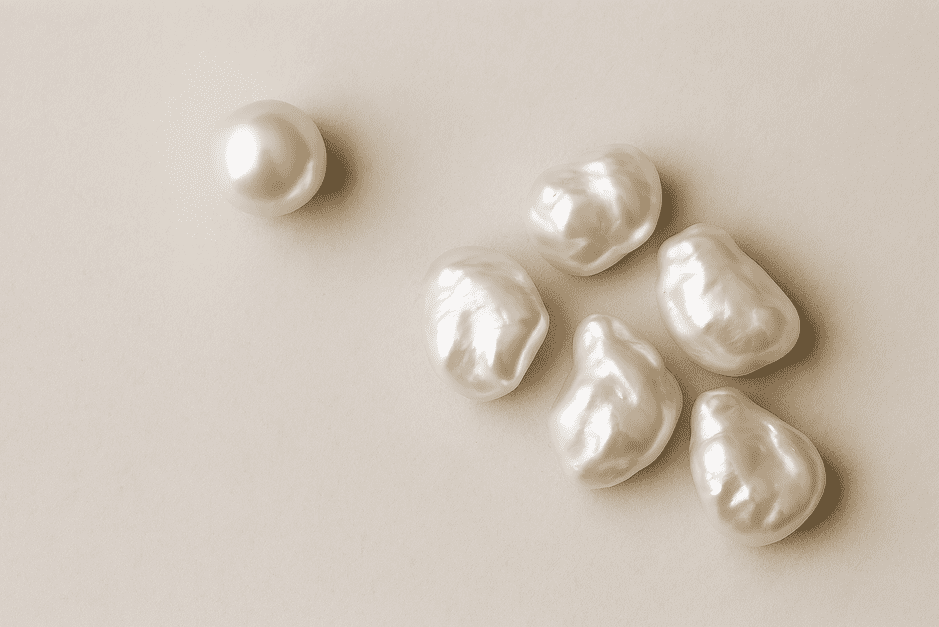
- Baroque Pearls: Irregular with striking curves, reflecting light beautifully, perfect for statement necklaces.
- Button Pearls: Slightly flattened, comfortable for earrings and rings, ideal for everyday wear.
- Drop Pearls: Teardrop-shaped, elegant for pendants and chandelier earrings.
These natural pearls shapes signify authenticity. To ensure authenticity, see our guide on BIS Hallmark and certification.
Moreover, the shape of a pearl influences jewelry design. Jewelers select baroque pearls for bold necklaces, while drop pearls are perfect for delicate pendants.
Value and Beauty of Baroque, Button, and Drop Pearls
Round natural pearls are rare and expensive. On the other hand, baroque, button, and drop pearls often provide better value while preserving authenticity.
Collectors prefer these shapes because they:
- Showcase uniqueness and individuality
- Offer natural beauty shaped by time and environment
- Represent the story of their formation inside mollusks
Additionally, non-round pearls often display richer overtones and subtle luster variations, making them more captivating than perfectly uniform pearls.
Styling Tips for Natural Pearls Shapes
- Baroque: Works best in statement necklaces, layered bracelets, or cocktail rings.
- Button: Ideal for stud earrings, simple rings, and small pendants.
- Drop: Perfect for long necklaces, chandelier earrings, and pendants that highlight elegance.
Furthermore, mixing different shapes can create visually striking combinations, adding depth and texture to your jewelry collection.
Common Misconceptions About Natural Pearls Shapes
- Misconception 1: Only round pearls are valuable. Truth: Non-round shapes often have higher authenticity and unique charm.
- Misconception 2: Irregular shapes are flawed. Truth: Irregularity is nature’s signature.
- Misconception 3: Cultured pearls are the same as natural pearls. Truth: Cultured pearls are often round due to controlled farming, while natural pearls display organic uniqueness.
Therefore, knowing natural pearl shapes helps avoid overpaying or buying the wrong type.
Caring for Different Pearl Shapes
Pearls, regardless of shape, require gentle care:
- Clean with a soft, damp cloth after wearing.
- Store separately to prevent scratches.
- Avoid contact with perfume, hairspray, or chemicals.
- For irregular shapes, check settings in rings and earrings regularly to prevent loosening.
Moreover, proper care ensures your pearls maintain their luster and longevity, whether baroque, button, or drop.
How to Choose the Right Natural Pearls Shapes
When selecting pearls:
- Recognize that round pearls are rare and costly.
- Embrace baroque, button, and drop pearls for authenticity.
- Consult trusted jewelers to verify natural origin.
Additionally, reading expert guides like GIA Pearl Education helps identify the quality and shape of natural pearls.
Ask yourself: Do you value perfection, or do you prefer the individuality and story behind natural pearls shapes?
FAQs
Q1: What are natural pearls shapes?
They are the forms pearls take naturally inside mollusks, including baroque, button, and drop.
Q2: Are round pearls always better than other shapes?
Not necessarily. Round pearls are rare and expensive. Non-round shapes often have more character, beauty, and value.
Q3: How can I tell if a pearl is natural or cultured?
Natural pearls show irregular shapes, subtle imperfections, and unique luster. Cultured pearls are more uniform and round.
Q4: Why should I consider baroque or drop pearls?
These natural pearls shapes offer individuality, beauty, and affordability while reflecting nature’s artistry.