Introduction
Howlite holds a curious, multifaceted place in the modern gemstone market. Collectors often admire its natural, porcelain-white look and distinctive grey matrix veins. At the same time, many manufacturers dye the mineral to create affordable jewellery that mimics more expensive stones. As a result, many shoppers regularly encounter dyed howlite without ever knowing its true identity. However, an imitation is not automatically a scam. Dyed howlite remains a natural mineral; the trouble begins only when sellers mislabel it as turquoise. Therefore, this guide helps everyday buyers understand how to spot the material, evaluate its quality, and shop with complete confidence. For those seeking deeper knowledge on authentication, read our practical gemstone buying guide.
Why Howlite Works So Well as an Imitation
Natural Properties of Howlite
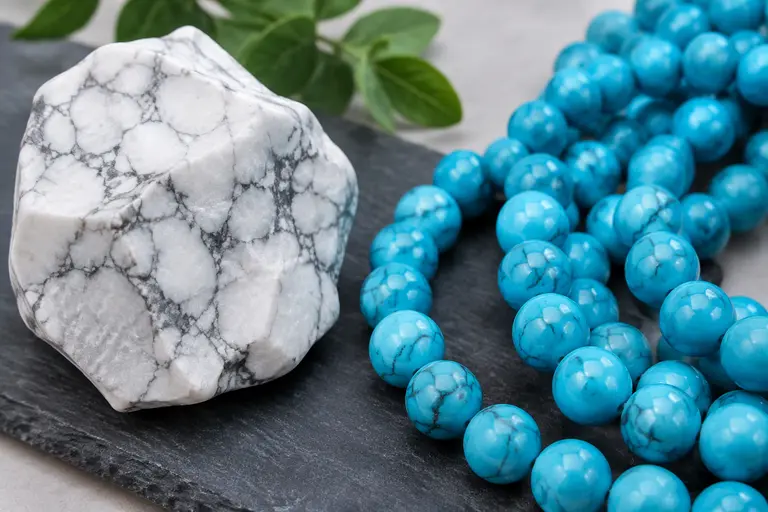
Howlite is a calcium borosilicate hydroxide mineral. Henry How first described it in Nova Scotia in 1868 and initially called it silico-boro-calcite. Later, James Dwight Dana renamed it howlite in his honour. In nature, it forms chalky white nodules with grey or black veins. Moreover, these veins sometimes closely resemble the matrix of natural turquoise. Massive howlite measures only about 3 to 3.5 on the Mohs scale of hardness. Because it is exceptionally soft and porous, workers cut, polish, and dye it with relative ease. Consequently, manufacturers frequently turn this cheap white stone into colourful beads and decorative cabochons. You can find detailed mineral data on the official Mindat howlite page.
Dyed Howlite and the Stones It Imitates
Turquoise and Naming Confusion
Turquoise is the stone that dyed howlite imitates most often. Manufacturers apply blue dye and retain the dark veins to copy the natural turquoise matrix. Some traders sell this treated material as “turquenite.” Nevertheless, that fancy trade name does not make it genuine turquoise. Furthermore, the two minerals differ significantly in chemistry. Turquoise is a hydrated copper aluminium phosphate, whereas howlite is a borate. Also, naming confusion adds to the problem. Sellers sometimes market undyed howlite as “white turquoise.” Yet, “white buffalo turquoise” can also describe a genuine, naturally white turquoise variety from Nevada. Therefore, buyers should always ask which specific mineral the seller actually means. Explore our detailed turquoise guide to learn the differences.
Imitating Other Colours
Manufacturers also dye howlite green, purple, and other vibrant shades to suit fashion trends. However, not every cheap coloured stone is howlite. Makers also use glass, resin, and other minerals as imitations. Therefore, you should never guess a stone’s identity based solely on its price or colour.
How Buyers Can Spot Dyed Howlite
Check Colour and Vein Patterns
First, examine the stone carefully in good, natural light. Natural howlite typically looks white with irregular, organic veins, while dyed pieces often look unusually bright or suspiciously even in colour distribution. Still, colour intensity alone proves nothing, because treated turquoise can also look uniform. Dye may also pool in pores and surface cracks, which offers a useful clue to an observant buyer. Consult the International Gem Society for more tips on spotting common jewellery imitations.
Inspect Drill Holes and Edges
Next, examine the drill holes and chipped edges of beads. Dye sometimes fails to reach the centre of the bead, so a pale, white interior may appear. Yet, modern dyeing processes can penetrate deeply, so a missing white core does not automatically prove a stone is natural turquoise. A 10× jeweller’s loupe makes this check easy and safe to perform.
Skip Scratch and Acetone Tests
Howlite scratches more easily than turquoise, which usually measures about 5 to 6 on the Mohs scale. However, buyers should never scratch finished jewellery, because this permanently damages the stone and its setting. Similarly, acetone can lift dye from some pieces, but it can also harm protective coatings, adhesives, and metal settings. A clean swab often proves nothing. Instead, ask a professional gemologist to test your valuable pieces. See resources from the GIA for professional standards.
Buying Turquoise Safely
First, ask the seller to name the material plainly. Is it natural turquoise, dyed howlite, or dyed magnesite? Next, ask about treatments such as stabilisation. Stabilised turquoise remains genuine turquoise, but the treatment significantly affects its market value. Then, insist on an invoice that names the true material. A fair seller writes “dyed howlite” rather than “turquoise jewellery.” Meanwhile, remember that origin claims such as “Kingman” or “Nishapur” need proof. Finally, treat unusually low prices with caution, though price alone never proves a fake. For costly stones, always request an independent laboratory report. Read our gemstone laboratory report guide.
Caring for Howlite Jewellery
Once you own howlite, you must protect it well. Because the stone is soft, store each piece separately so harder gems cannot scratch it. In addition, keep it away from perfume, cleaning products, and long soaks in water. Dyed pieces can lose colour or look patchy when exposed to harsh liquids. Therefore, wipe the jewellery gently with a soft, dry cloth after wearing it. Finally, remove it before exercise or housework, since knocks can chip it easily. Follow our jewellery care guide to keep your collection pristine.
Why Awareness Matters for Indian Buyers
Dyed howlite is not a bad product. In fact, it lets shoppers enjoy a turquoise look at a fair price. The key is honest labelling. Indeed, this transparency matters in jewellery shops, handicraft markets, online marketplaces, and gem fairs across India. Moreover, quick purchases at tourist spots and festival stalls leave little time to check items, so clear labels protect buyers most effectively. Ultimately, informed buyers enjoy affordable stones and avoid misleading claims. Explore more GIA consumer resources.
Frequently Asked Questions
Is blue howlite a genuine gemstone?
Yes. Blue howlite is natural howlite that manufacturers have coloured artificially. However, it is not turquoise, even when it looks very similar.
What is turquenite?
Turquenite is a trade name for blue-dyed howlite. Some traders also use it for dyed magnesite. Buyers should confirm the mineral name.
Is white turquoise the same as howlite?
Not always. Sellers often use that name for undyed howlite, yet genuine white turquoise also exists. Ask for the mineral name in writing.
Can dyed howlite pass for turquoise?
Yes. Its dark veins and dye absorption create a convincing imitation. Professional gemological testing separates the two materials.
Is genuine turquoise always untreated?
No. Many turquoise stones undergo stabilisation, and some receive other treatments. Sellers should always disclose every enhancement.
Can buyers identify dyed howlite without a laboratory?
Visual checks reveal warning signs, especially around drill holes. However, they cannot guarantee identification. Seek independent examination for expensive items.
Disclaimer
This article offers general education about howlite. Visual checks cannot confirm identity. Consult a qualified gemologist for valuable purchases. The author has no financial affiliation with the brands or organizations mentioned.