
Introduction
Can a gemstone reveal the history of our planet’s climate? Surprisingly, natural diamonds help scientists answer questions about Earth’s distant past. Most people admire diamonds for their sparkle, but researchers also value the tiny materials locked inside them. Indeed, these inclusions carry chemical clues about how Earth changed over geological time. Consequently, diamonds reveal the ancient climate history of Earth and its deep geological processes. Nevertheless, they do not tell the whole story, so scientists combine evidence from them with other geological records to reconstruct past environments. By studying these hidden archives, researchers map out the planet’s evolution across billions of years.
How Diamonds Reveal the Ancient Climate History of Earth
Tiny Inclusions That Help Diamonds Reveal the Ancient Climate History of Earth
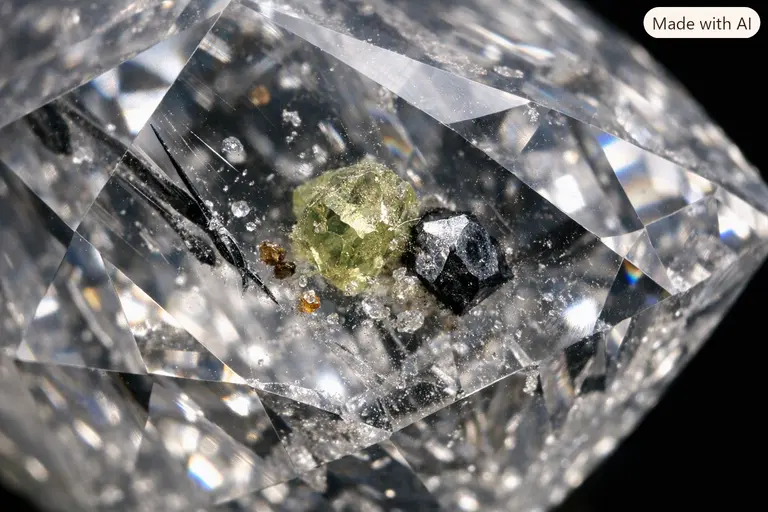
Most natural diamonds form deep inside Earth under extreme pressure and heat. While they grow, some diamonds trap tiny minerals and fluids. Because diamond resists chemical change, these inclusions often survive for billions of years. Then, scientists study their chemistry, isotopes, and age to learn what conditions existed at the time. Still, diamonds can change, so researchers check every sample carefully. Meanwhile, the Gemological Institute of America (GIA) shares helpful guides on how diamonds form. In addition, you can explore more articles on natural gemstones.
Three Discoveries Where Diamonds Reveal the Ancient Climate History of Earth
How Old Diamonds Reveal the Ancient Climate History of Earth
In 2017, researchers studied diamonds from the Orapa and Letlhakane mining areas in Botswana. Their paper, Dated eclogitic diamond growth zones reveal variable recycling of crustal carbon through time, appeared in Earth and Planetary Science Letters. First, the team measured the ages and isotopes of the diamond growth zones. Carbon comes in different forms, including carbon-12 and carbon-13. Since living things often prefer carbon-12, scientists use these variations to trace where carbon came from. As a result, the team found that older diamond zones more often held light carbon from recycled, biologically processed material. Therefore, the finding suggests that sinking rock carried surface carbon deep into the mantle. Even so, the study covers only Botswana, and it does not prove the full history of early life or oxygen.
Fibrous Diamonds and Ancient Diamonds Reveal the Ancient Climate History of Earth
Researchers also examined fibrous diamonds from Wawa, Ontario, Canada, which are at least 2.7 billion years old. These stones trap tiny amounts of helium, neon, and argon. Therefore, scientists compare ancient mantle gas with today’s mantle gas. Moreover, a conference abstract reports that these gases resemble those in today’s upper mantle, which suggests the mantle lost much of its gas early in Earth’s history. However, similar volatile levels do not prove that the ancient atmosphere matched today’s air. In fact, the atmosphere changed dramatically, especially when oxygen began to build up during the Great Oxidation Event.
Superdeep Diamonds Reveal the Ancient Climate History of Earth
A 2023 study in Nature examined superdeep diamonds from Brazil and Guinea, which formed roughly 300 to 700 kilometres below the surface. Next, researchers dated mineral inclusions in 13 of them and found ages between 450 and 650 million years. Moreover, the results tied diamond formation to ancient subduction beneath Gondwana, a supercontinent that existed long before today’s continents took shape. Furthermore, the team proposed that buoyant material carried the diamonds upward toward Gondwana’s base, where it joined the deep continental root. Thus, this process may have helped the supercontinent grow and stay stable.
What These Discoveries Mean for Ordinary People
Lessons for Gemologists Studying Diamonds and Ancient Climate History
Indeed, gemologists see inclusions as more than clarity grade features, because these tiny materials carry real scientific value. Meanwhile, mineralogists use inclusions to study how minerals form and react deep underground. Nevertheless, not every inclusion gives a reliable record. Likewise, natural stones preserve ancient evidence, while laboratory-grown stones support experiments and technology.
Lessons for Readers Tracking How Diamonds Reveal the Ancient Climate History of Earth
Climatologists combine diamond evidence with ice cores, ocean sediments, and fossils. Together, these archives show how carbon cycling, gases, and tectonic activity shape climate. For everyday readers, the key lesson involves the gap between geological time and human time. Natural change usually unfolds over millions of years. By contrast, human-driven warming happens within a few generations. Therefore, natural climate variation does not disprove modern climate change. Instead, it helps scientists understand today’s causes and consequences. Finally, the Intergovernmental Panel on Climate Change (IPCC) offers trusted assessments of human-caused warming.
Can Diamonds Help Cool the Future?
Scientists have also used computer models to test whether synthetic diamond particles in the stratosphere could reflect sunlight. However, this idea remains a proposal, not a proven solution. Furthermore, researchers must still weigh its cost, effectiveness, and risks. Moreover, reflecting sunlight would not remove carbon dioxide or stop ocean acidification. Consequently, cutting greenhouse gas emissions remains essential.
Frequently Asked Questions
Can diamonds prove that climate change happened millions of years ago?
Diamonds reveal the ancient climate history of Earth regarding carbon cycling and deep geological processes. However, scientists need other records to reconstruct specific climate changes.
Can a diamond reveal the exact temperature of an ancient ocean?
Usually not on its own. Researchers can estimate past conditions from mineral chemistry, yet they need suitable samples and supporting evidence.
Do inclusions make a diamond more valuable?
Inclusions can raise scientific importance, but they do not automatically raise jewellery value. Instead, clarity, colour, cut, carat weight, and market demand set the price.
Can diamonds predict future global warming?
No. Diamonds explain long-term geological processes. Therefore, researchers rely on observations, greenhouse gas measurements, and climate models for projections.
Disclaimer
This article provides general educational information about diamonds, geology, and climate science. Scientific interpretations may change as researchers gather new evidence. Although diamond inclusions offer valuable geological clues, they do not establish a complete history of Earth’s climate or replace modern climate research. The author has no financial affiliation with the organizations mentioned.