
Introduction
Data centers cannot run on synthetic diamonds, at least not as a primary power source for the entire facility. However, synthetic diamond cooling still plays an increasingly critical role in the growth of AI infrastructure. While some people discuss nuclear diamond batteries that generate electricity through radioactive decay, their power output stays far too small for modern server racks. Therefore, engineers cannot use diamond batteries to replace the massive electrical supplies that high-performance AI systems demand.
Instead, synthetic diamonds help data centers in a different, more practical way. Their exceptional thermal conductivity lets them pull heat away from high-power chips faster than any other material on Earth. As a result, synthetic diamond cooling could help AI hardware run cooler and perform more reliably under heavy workloads. Therefore, the real story in the tech industry today is not diamond-powered electricity, but diamond-assisted cooling. Specifically, this technology allows processors to work at higher speeds without melting, which is vital as we move further into 2026.
The Mechanics of Synthetic Diamond Cooling
AI processors generate enormous heat because they run constant, intensive calculations. Consequently, as chip power consumption rises, removing that heat becomes a major engineering bottleneck. Traditional copper heat spreaders often struggle to keep up with the newest generation of GPUs.
Synthetic diamond offers a promising fix for this thermal crisis. Specifically, high-quality Chemical Vapor Deposition (CVD) diamond conducts heat exceptionally well. For instance, Element Six currently supplies CVD diamond thermal materials with thermal conductivity between 1,000 and 2,200 W/mK, depending on the grade chosen. Therefore, diamond moves heat away from localized “hotspots” far more efficiently than copper, which only manages about 400 W/mK.
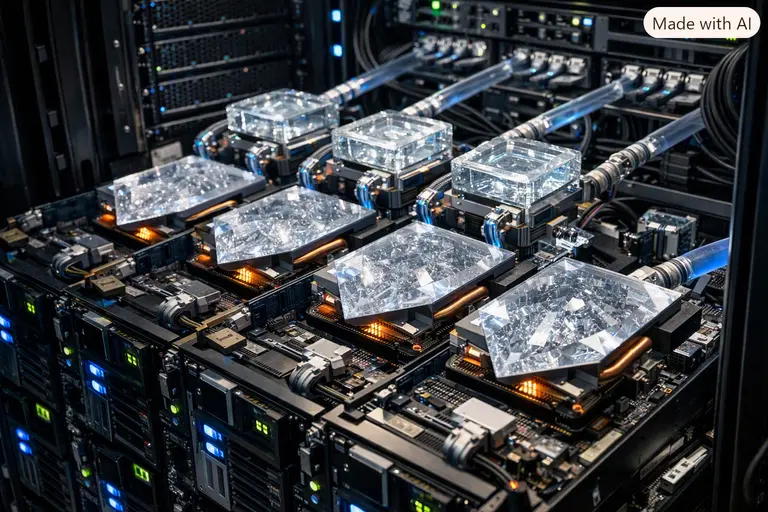
Still, diamond does not replace an entire cooling system. Instead, it improves the critical thermal path between a processing chip and the broader cooling structure. For example, a diamond heat spreader pulls heat from a small, extremely hot zone and spreads it into a larger surface area. Afterward, the main cooling system removes that heat through liquid, air, or immersion methods. Consequently, diamond becomes one vital part of a larger cooling architecture rather than a standalone solution. To learn more about how synthetic stones are graded, you can read our guide to gemstone identification.
Commercial Realities: From Lab to Server Room
This technology has recently moved beyond the experimental lab phase into real-world applications. On February 23, 2026, Akash Systems delivered the world’s first synthetic diamond cooling NVIDIA H200 GPU servers to NxtGen AI, which is India’s largest sovereign cloud provider. The company built these specialized servers using its proprietary technology, which reportedly removes heat roughly five times faster than traditional copper.
Furthermore, this deployment claims to boost effective GPU compute by up to 15 percent in high-ambient-temperature data centers. This is particularly important in regions like India, where keeping facilities cool is both expensive and energy-intensive. This deployment matters because it shows a real, commercial example of diamond thermal management working inside modern AI infrastructure. Nevertheless, it does not prove that diamond cooling has replaced liquid cooling entirely. Rather, it shows how diamond can work alongside established systems to push performance boundaries.
Key Players in the Synthetic Diamond Thermal Market
Several specialized companies now operate in this high-tech space, providing the materials needed for the next generation of servers.
Element Six and Sumitomo Electric
Element Six remains one of the best-known suppliers in the world. They produce CVD diamond heat spreaders and copper-diamond composites specifically for high-power electronics. Meanwhile, Sumitomo Electric also manufactures diamond-based thermal materials. They focus on copper-diamond products that balance high conductivity with manageable thermal expansion, which prevents chips from cracking as they heat up and cool down.
Akash Systems and Diamond Foundry
Unlike simple material suppliers, Akash Systems integrates synthetic diamond cooling directly into the computing hardware. As a result, its recent NxtGen AI deployment in India marks an important step from raw material production to a finished server product. On the other hand, Diamond Foundry focuses on large-scale diamond wafer production. Therefore, producing diamond wafers and supplying integrated cooling systems remain two very different business models.
Debunking the Power Myth: Diamond Batteries vs. Cooling
The answer to whether diamonds can power a server stays a firm “no.” It is important to distinguish diamond batteries from synthetic diamond cooling spreaders. Betavoltaic devices, often called diamond batteries, generate tiny amounts of electricity from the radioactive decay of Carbon-14.
Because their main strength is extreme longevity rather than high power, they suit tiny, low-power sensors or pacemakers. A diamond battery that lasts for decades still cannot deliver the continuous, high-wattage electricity a data center needs. Modern servers require megawatts of power to run processors, storage, and networking equipment together. Therefore, while the science of diamond batteries is fascinating, it remains irrelevant to the cooling needs of an AI cluster.
Beyond Diamond: Alternative Thermal Management Solutions
Because diamond remains costly and complex to manufacture, engineers often turn to other advanced materials. Copper still serves as a reliable, affordable heat spreader in most consumer devices, especially when used in vapor chambers. Aluminum nitride, meanwhile, conducts heat while also providing electrical insulation, which makes it useful in high-voltage semiconductor packaging.
Additionally, pyrolytic graphite spreads heat efficiently along thin, lightweight structures, while boron nitride offers similar insulating and thermal benefits. Copper-diamond composites also exist, combining both materials to balance high performance with lower manufacturability costs. Silicon carbide and gallium nitride, by contrast, belong to a separate category altogether. Engineers use them mainly for power conversion and radio frequency (RF) applications rather than simple heat spreading.
India’s Growing AI Infrastructure and Liquid Cooling
According to the Ministry of Electronics and Information Technology (MeitY), India’s data center capacity has grown more than fourfold in recent years. Specifically, capacity rose from about 375 MW in 2020 to around 1,575 MW as of August 2026. Consequently, Indian operators are increasingly adopting direct-to-chip liquid cooling and immersion cooling to manage this rapid growth.
Therefore, liquid cooling remains the more practical near-term foundation for India’s AI infrastructure. Even so, synthetic diamond cooling heat spreaders could add significant value at the chip level, especially for high-density AI training. Ultimately, India’s technological future likely combines liquid cooling, advanced packaging, and diamond heat spreaders where the economic benefits justify the cost.
FAQ: Understanding Synthetic Diamond Cooling
Can synthetic diamonds power a data center?
No. Diamond batteries generate far too little electricity for modern data centers. They are designed for small, low-power devices like medical implants or remote sensors.
How does synthetic diamond cool a computer chip?
It acts as a “heat spreader.” Because diamond has the highest thermal conductivity of any known material, it pulls heat away from the processor much faster than copper or aluminum.
Is this technology only for AI servers?
Currently, yes, because it is expensive. AI chips generate so much heat that the performance gains justify the cost of the synthetic diamond. Most home computers do not need this level of cooling.
Is synthetic diamond cooling better than liquid cooling?
They work together. Diamond moves heat from the chip to the surface, and then a liquid cooling system carries that heat away from the server rack and out of the building.
Why is India a leader in this technology?
India has a massive demand for AI cloud services. Local providers like NxtGen AI are early adopters of synthetic diamond cooling to gain a competitive edge in server efficiency and performance.
Disclaimer
This article serves general educational purposes only. Diamond thermal-management performance depends on material grade, device design, and overall cooling architecture. Company-reported performance figures, including efficiency gains, should not be treated as independent industry benchmarks. Readers should consult qualified engineering or data-center professionals before making technical or investment decisions. The author has no financial affiliation with the brands or organizations mentioned.