Introduction to Forensic Gemology in India
India cuts, polishes, and trades more gemstones than almost any other country in the world. However, when a stolen ruby ends up in court, or an insurer questions a jewelry claim, the system often faces significant hurdles. Specifically, Forensic Gemology in India—the science of using gem testing to solve legal and insurance disputes—remains largely underdeveloped. As a result, ordinary people, insurers, and the judiciary struggle to obtain reliable answers when gemstone fraud or theft occurs. Understanding why this gap exists helps us see the necessary steps for improvement. You should also read our guide on gemstone buying mistakes to understand how proper documentation protects you before a legal issue even arises.
Defining Forensic Gemology in India
Forensic gemology applies rigorous gem science to real-world legal problems. For instance, it answers critical questions: Is this diamond genuine? Did the jeweler swap this stone before the owner filed the claim? Is this specific sapphire the same one that customs seized last month?
In contrast, regular gem certification focuses primarily on the trade. It tells a buyer the market value and the grade of a stone. A report on Forensic Gemology in India, however, must go much further. It documents every step of the examination, explains every scientific test in detail, and presents conclusions that a judge or insurance investigator can actually understand. In short, the difference is not just technical; it involves the intended audience and the burden of proof required in a courtroom. To explore the global standards of such research, you can refer to the Gemological Institute of America.
Why Indian Gemstone Forensics Fall Short
India hosts dozens of high-quality gem labs in cities like Mumbai and Jaipur. These facilities do excellent work for traders and consumers. Nevertheless, they mostly follow commercial grading standards rather than legal or forensic ones.
Documentation in Forensic Gemology in India
For instance, most commercial lab reports do not track who handled the stone or the exact time of the transfer. They do not always explain their testing methods in plain language for non-experts. Consequently, a certificate that works perfectly in a jewelry shop may completely fail in a courtroom. The judge needs a “chain of custody,” and the current system simply does not deliver it. Furthermore, India’s updated evidence law, the Bharatiya Sakshya Adhiniyam, 2023, carries forward general provisions for expert opinions. However, it still lacks specific reliability criteria for scientific testimony in the gemstone sector. Therefore, even talented gem experts can struggle to meet courtroom standards because the law does not define exactly what makes gemological evidence “admissible.”
Fragmented Standards in Indian Forensic Labs
Another major reason Forensic Gemology in India lags is the absence of unified national standards. While India does have laboratory accreditation through the National Accreditation Board for Testing and Calibration Laboratories (NABL), very few gem labs apply these standards specifically to forensic cases.
Because of this fragmentation, two different labs can examine the same stone and describe it differently. This is especially true when determining the geographic origin or subtle heat treatments. In a legal setting, that inconsistency immediately raises reasonable doubt. Additionally, police stations and customs offices each handle gem evidence in their own unique way. Without a shared protocol for sealing or storing evidence, investigators might accidentally mishandle a stone before an expert even sees it. For more information on how metal quality affects these items, check our guide on Understanding BIS Hallmark.
Shortage of Forensic Gemology Experts in India
Perhaps the deepest problem is the shortage of professionals who can bridge all the relevant fields. A proper expert in Forensic Gemology in India needs to combine four distinct skills:
- Gem Science: Identifying stones and detecting synthetics using advanced spectroscopy.
- Legal Knowledge: Understanding evidence rules and expert reporting requirements.
- Insurance Awareness: Recognizing fraud patterns and claim manipulation.
- Communication: Explaining complex scientific findings clearly to non-scientists.
India has world-class gemologists and lawyers working separately. However, very few individuals bring all four skills together in a structured way. As a result, most gem-related legal cases depend on ad hoc teamwork where critical details often get lost. Currently, no formal training pipeline exists in India to produce this type of well-rounded forensic professional.
Improving Forensic Gemology in India
Fortunately, the industry can solve these problems through targeted reforms. First, India should encourage more labs to adopt forensic-grade accreditation. Standard operating procedures would give courts a consistent baseline to trust. Second, gemology institutes can introduce short courses in legal basics and evidence handling. Meanwhile, law schools should introduce gemstone case studies to help future lawyers understand these technical challenges.
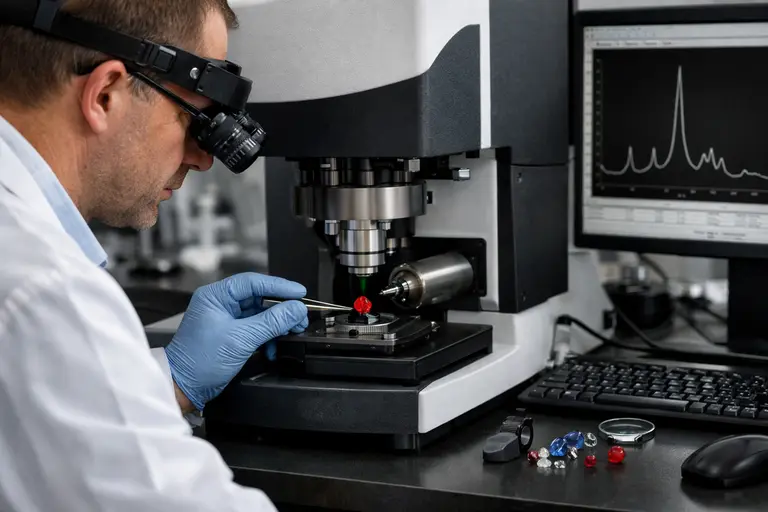
Third, labs require better digital tracking tools. Non-destructive testing methods, like Raman spectroscopy, reveal synthetic origins without damaging the evidence. Moreover, when paired with digital logs, these systems make evidence much harder to tamper with. Finally, the judiciary and insurance companies must actively demand forensic-grade services. When insurers require stronger documentation for high-value claims, they create the market demand needed for labs to upgrade their services. As a result, ordinary policyholders will benefit from faster and fairer claim decisions.
FAQ: Forensic Gemology in India Common Questions
What does a forensic gemologist do differently?
A forensic gemologist focuses on the legal “chain of custody” and detailed documentation, whereas a regular gemologist focuses on market grading and value.
Why can’t I use a standard lab report in court?
Standard reports often lack the procedural details required by law. Specifically, they may not prove that the stone tested is the exact stone involved in the dispute.
Is gemstone fraud common in India?
While the majority of the trade is honest, the lack of Forensic Gemology in India makes it easier for bad actors to swap stones or misrepresent synthetic gems in insurance claims.
How can I protect my jewelry for insurance purposes?
You should always insist on a highly detailed report that includes microscopic photos and specific internal inclusions. This creates a “fingerprint” for your stone.
Where can I find forensic gemology experts?
You can look for labs with NABL accreditation or consult with specialized legal firms that handle high-value asset disputes.
Disclaimer
This article is for general information only. It does not provide legal, insurance, or professional gemological advice. Please consult a qualified lawyer, insurer, or certified gemologist before taking any action related to a specific case or claim.