Introduction to FP Journe Watches
Understanding the rise of FP Journe Watches tells a fascinating story about luxury, creativity, and independent spirit. Most watches you see in stores today come from large companies that rely on hundreds of external suppliers and mass assembly lines. François-Paul Journe, however, does the opposite. Instead of outsourcing his components, he makes almost everything himself in his own workshop in Geneva, Switzerland. His brand motto—Invenit et Fecit—is Latin for “Invented and Made.” In other words, that phrase is not a marketing gimmick; it is a literal description of his work. Consequently, this guide explores how this unique philosophy changed the watchmaking world. You should also read our guide on gemstone buying mistakes to understand how high-quality material standards apply to any luxury investment.
What Makes FP Journe Watches Unique?
To understand FP Journe Watches, think of it this way. When you buy a car, most manufacturers assemble parts that dozens of different companies make. FP Journe, however, acts as the equivalent of a carmaker who designs the engine and presses the body panels all under one roof. Specifically, about 95% of every watch component comes from his own workshop, including the dials and cases.
Furthermore, a single watchmaker builds each watch from start to finish. There is no assembly line, and no single worker tightens one screw all day. As a result, this approach is genuinely rare, even among the most expensive watch brands in the world. In addition, the brand produces fewer than 900 watches per year. Therefore, that extreme scarcity creates long waiting lists and massive demand from global collectors. To see more about industry production scales, you can visit WatchPro for industry news.
Why Are the Movements Made of Gold?
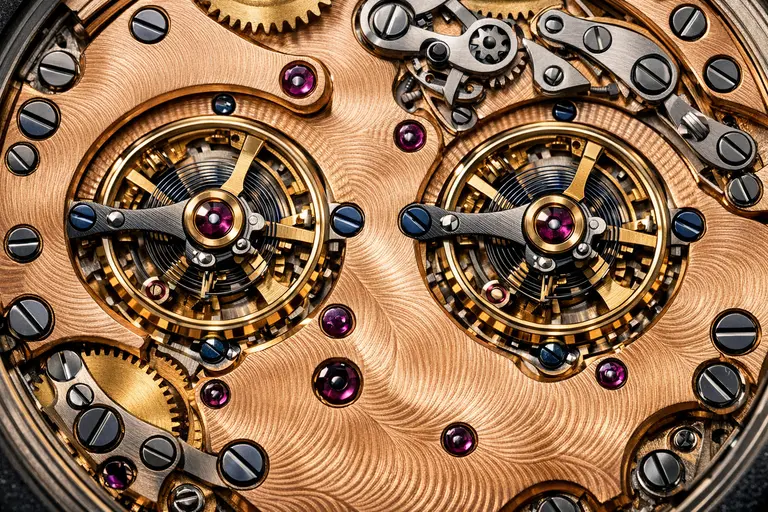
Here is something that surprises most people about FP Journe Watches. Since 2004, Journe has crafted every mechanical movement—the engine inside the watch—from 18k rose gold. Almost every other watchmaker, even very expensive ones, uses brass instead.
So why does this material choice matter? First, rose gold is more stable and less reactive to temperature changes than brass. Second, it resists magnetism far better than standard alloys. Third, it adds real material value to the watch. As a result, a movement made of gold holds its worth differently than one made of metal alloy. In short, this is one of the clearest ways the brand separates itself from every competitor on the market. Consequently, collectors value these gold movements as the signature of the brand.
How the Brand Sells Directly to Clients
The brand runs eleven boutiques around the world—in cities like Tokyo, New York, and Dubai. That is it. For instance, you will find no department store counters, no authorized dealers, and no online shop. In other words, you visit one of those boutiques, or you do not purchase a new watch.
Moreover, certain special models, called “Black Label” watches, are not open to the general public at all. The brand reserves these exclusively for loyal, long-standing clients. These pieces feature black lacquer dials set in platinum cases. Consequently, this loyalty reward system encourages long-term relationships rather than one-off purchases. Beyond that, the brand carries a clever early history. In its founding days, Journe ran a subscription model where collectors paid for their watches up front. This money funded manufacturing and, as a result, built a tight community of early supporters.
Innovation: The Chronomètre à Résonance
One of Journe’s most famous creations—the Chronomètre à Résonance—uses a natural physics phenomenon to keep better time. Specifically, the watch houses two completely separate timekeeping mechanisms placed just 0.4mm apart.
The Science of Resonance
Because they sit so close together, they influence each other through tiny vibrations. This works in the same way that two pendulum clocks hung on the same wall will eventually start swinging in sync. If one mechanism speeds up, the other slows down to compensate. Therefore, they balance each other out automatically. In practice, this makes the watch far more resistant to shocks and movement. For example, any external disturbance that would throw a regular watch off time gets cancelled out by this self-correcting pair. For accessible watch journalism, refer to Hodinkee.
Gravity and the Tourbillon Souverain
A tourbillon is a device inside a watch that fights the effect of gravity on accuracy. Journe’s Tourbillon Souverain was the first wristwatch in history to pair a tourbillon with a constant-force device—something called a remontoir d’égalité.
Perfectly Measured Energy
In plain terms, a tiny secondary spring sits between the main power source and the timekeeping mechanism. Every single second, this spring releases exactly the same amount of energy. Consequently, the watch runs at the same rate whether Journe wound it an hour ago or nearly drained its power reserve. Furthermore, a useful side effect is that the seconds hand ticks once per second, cleanly and precisely. As a result, reading the exact time becomes easier and more accurate for the wearer.
FAQ: FP Journe Watches for Collectors
Do I need to be rich to appreciate FP Journe?
Absolutely not. In fact, understanding what makes these watches special—the physics, the craftsmanship, the history—costs nothing at all. Moreover, most people who follow the brand closely will never own one, and that is completely fine.
Why are FP Journe Watches so expensive?
The price reflects the fact that Journe makes almost everything inside by hand, using highly skilled people, in tiny quantities. In other words, you are paying for hundreds of hours of skilled human labour.
Can I find one pre-owned?
Yes. Through the Patrimoine programme, the brand officially buys back its own discontinued watches, restores them, and resells them with a full warranty. This protects the buyer’s investment over the long term.
How many watches are made each year?
The brand produces between 800 and 900 mechanical watches annually across all models. For comparison, Rolex produces around a million watches in the same period.
Where is the brand located?
The main workshop and headquarters are located in Geneva, Switzerland, where François-Paul Journe continues to lead the design and production process personally.
Disclaimer
This article is for informational and educational purposes only. It does not constitute financial, investment, or legal advice. The production figures, boutique count, and pricing information cited in this article reflect publicly available sources and verified data accurate at the time of writing (April 2026). Because FP Journe is a privately held company that does not officially publish all operational data, some figures may vary across sources. Watch values fluctuate, and past performance in the secondary market does not guarantee future results. The outbound links included in this article are provided for reference only. We are not affiliated with, sponsored by, or endorsed by FP Journe, Hodinkee, or WatchPro. Always conduct your own independent research before making any significant purchase decision.