Introduction
Giant Clam Pearls rank among the rarest natural gems on Earth. Most people have never heard of them; yet some of the biggest pearls that explorers found came from giant clams rather than oysters. Whether you spotted one at a specialty market or found a curious listing online, you must understand what makes these gems unique. Specifically, this guide breaks down their origins, identification, and legal status in plain language. By learning the proper gemological terms, you can speak confidently about these oceanic rarities. Furthermore, you should read our guide on gemstone buying mistakes to ensure you avoid common traps when investing in natural treasures.
Where Do Giant Clam Pearls Come From?
Giant Clam Pearls form inside the Tridacna species—most commonly the Tridacna gigas, which is the largest shelled animal in the world. These massive clams live in the warm, clear, shallow waters of the Indo-Pacific region, including the Philippines and Indonesia. When a small irritant, such as a parasite, gets trapped inside the mantle tissue, the clam wraps layer upon layer of material around it. Over time, this biological process creates a pearl.
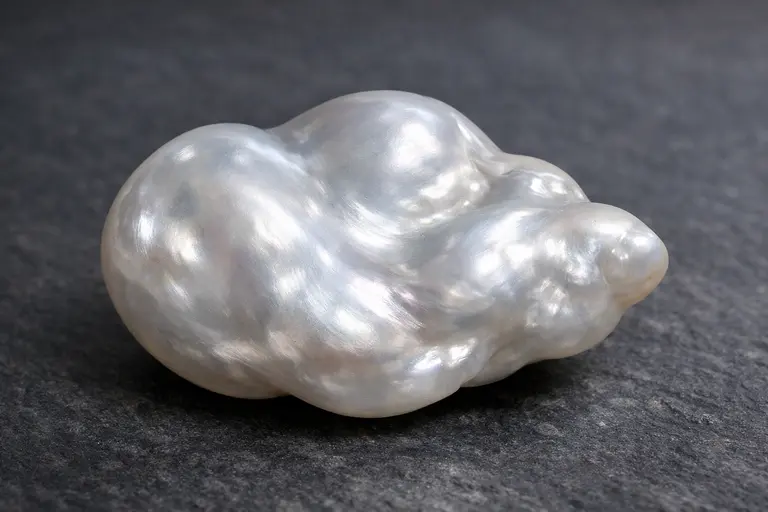
Because oyster farmers do not cultivate these gems the way they grow oyster pearls, every single one forms entirely by accident in the wild. Consequently, they are incredibly rare. While most appear as irregular, lumpy shapes—known to gemologists as “baroque”—some reach staggering sizes. For instance, the 75-pound “Pearl of Puerto” holds a world record for its massive scale. These giants share the same porcelain-like surface as the smaller specimens you might find for sale today. To learn more about the biology of these massive mollusks, visit the official CITES website.
How to Identify a Real Giant Clam Pearl
Identification remains the most challenging step for many buyers because fakes are everywhere. Therefore, learning to distinguish a real pearl from an imitation is essential before you hand over any money.
First, you must examine the surface. A real Giant Clam Pearl does not have the mirror-like glow of a saltwater oyster pearl. Instead, it has a smooth, matte-to-glossy surface that looks and feels like fine ceramic. Experts describe this as a “porcelaneous” surface. Oyster pearls get their shimmer from nacre; however, giant clams do not produce nacre at all. For this reason, gemologists call them “non-nacreous,” which refers to their lack of iridescent shimmer.
Understanding Flame Structure
The best specimens display what gemologists call a “flame structure.” This is a soft, moving shimmer on the surface that looks like flowing silk or slow-rolling flames when you tilt the pearl in the light. The arrangement of microscopic aragonite crystals inside the pearl produces this beautiful effect. A strong flame structure acts as a primary sign of quality and adds significant value to the stone. For professional testing standards, you can refer to the Gemological Institute of America.
Spotting Fakes and Shell Carvings
Most cheap listings for Giant Clam Pearls online are actually polished pieces that sellers cut straight from the clamshell. To spot these, watch for horizontal layering or banding that looks like wood grain. That represents the shell’s natural growth structure, not a true pearl. Additionally, be wary of shapes that perfectly follow the wavy ridges of a clamshell. If you want absolute certainty, ask for a certificate from a laboratory that gemologists recognize. Labs confirm authenticity by X-raying the specimen to check the growth layers inside.
The Value and Legality of Giant Clam Pearls
Before purchasing, consider the legal implications of trading in protected species. CITES Appendix II—an international wildlife protection agreement—regulates the trade of giant clams. In plain terms, international law controls the trade of giant clam products across country borders. Furthermore, harvesting live giant clams is outright illegal in many countries, including the Philippines.
Always ask the seller for origin documents to prove the seller obtained the gem legally. Beyond legality, four factors drive the market value:
- Size: Larger pearls command significantly higher prices.
- Color: Pure white commands the highest value, followed by cream or light tan.
- Shape: Symmetrical or rounded shapes are rarer and more expensive.
- Flame Strength: A vivid, clearly visible flame pattern is the signature of a top-tier specimen.
Caring for Non-Nacreous Gems
You should handle Giant Clam Pearls with extreme care because they consist primarily of calcium carbonate. This mineral is relatively soft and porous. Consequently, exposure to acids, perfumes, or hairspray can permanently damage the surface. Moreover, you should store them separately from harder gemstones like diamonds to prevent scratches. To clean them, use only a soft, damp cloth and avoid ultrasonic cleaners or harsh chemicals. The author intends this article to help collectors preserve these rare treasures for decades.
FAQ: Giant Clam Pearls
Are Giant Clam Pearls valuable?
Value varies widely depending on quality. Record-breaking specimens sell for millions, but small, baroque-shaped pearls are affordable collectibles for enthusiast gem hunters.
Can I buy a Giant Clam Pearl legally?
Yes, but you must ensure the source is documented. Because they are protected under CITES Appendix II, you should verify that the pearl was obtained legally and sustainably.
What is the “flame structure”?
It is a shimmering optical effect caused by microscopic aragonite crystals. It looks like slow-rolling flames on the surface of the pearl and significantly increases its desirability.
How do I tell a shell carving from a real pearl?
Shell carvings usually show parallel banding that looks like wood grain. Real Giant Clam Pearls have a porcelain-like surface and, ideally, a silken flame structure.
Why don’t they shimmer like white oyster pearls?
They are non-nacreous gems. Unlike oysters, giant clams do not produce nacre (mother-of-pearl). Instead, they produce a porcelaneous material that looks like fine ceramic.
Disclaimer
The author intends this article for educational purposes only. It does not constitute legal or financial advice. Trade regulations change over time; always consult a licensed gemologist and verify current CITES regulations before purchasing.