
Introduction
If you love Indian jewelry, you have probably come across the term Meenakari (Enameling). However, not all Meenakari is the same. Banarasi Gulabi Meenakari is a rare and legally protected craft that artisans in Varanasi, Uttar Pradesh, have practiced for over 400 years.
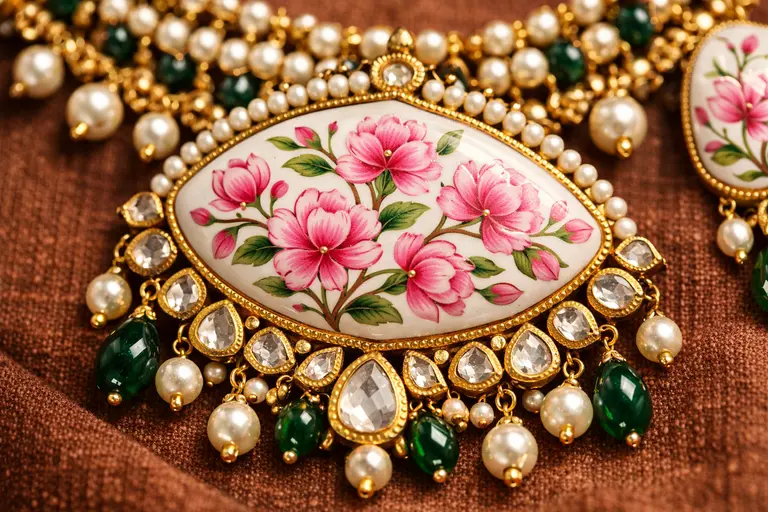
The word Gulabi means “Pink” in Hindi, and that soft pink-on-white enamel finish is what makes this jewelry unlike anything else in India. Moreover, since it carries an official Geographical Indication (GI) Tag, buying a genuine piece means you are directly supporting a living cultural heritage. As an expert in Indian jewelry arts, I find the chemistry behind this craft as fascinating as the history. In this guide, I will explain everything you need to know—from its origins to the chemistry of the color, and how to spot a fake.
The Origin of Banarasi Gulabi Meenakari
To begin with, the art of Meenakari arrived in India during the Mughal era in the 16th and 17th centuries. Persian enamelers, who had mastered the craft under Safavid rule, brought their skills to the royal courts. Initially, artisans used this technique purely for practical reasons: to decorate the reverse side of gemstone-studded Kundan jewelry. This prevented the raw gold and sharp gem edges from scratching the wearer’s skin.
Over time, the craft migrated to the narrow bylanes of Varanasi—particularly around Gai Ghat and the Bhaironath area. While Jaipur and Delhi also practice Meenakari, their artisans typically use bold reds, greens, and blues. The Varanasi school, by contrast, mastered a delicate pink palette on an opaque white base—a style found nowhere else in the world. Furthermore, in 2015, the Indian government officially granted Banarasi Gulabi Meenakari GI Tag No. 397. Additionally, it is part of Uttar Pradesh’s One District One Product (ODOP) initiative. Read more about regional crafts in my Agates of Cambay guide.
The Chemistry of Banarasi Gulabi Meenakari
As a Gemologist, I must highlight the science behind the art. Creating the “Gulabi” (Pink) color is an act of alchemy. First, artisans create the opaque white base by fusing glass powder with metal oxides at extreme heat (around 850°C).
Next, to create the pink paint, they do not use standard dyes. Instead, they use Gold Oxide (or highly diluted rose gold alloys) mixed with glass powder and pomegranate seed water. When this mixture is fired in the kiln, the gold particles react to create a luminous, permanent pink color. Therefore, when you buy Banarasi Gulabi Meenakari, you are literally buying glass that has been painted with gold. Compare this fragile beauty to the glass fusion techniques in Thewa Jewelry.
How to Identify Authentic Banarasi Gulabi Meenakari
Knowing what to look for saves you from paying genuine prices for imitation work. Altogether, three key markers help you distinguish the real craft.
1. The Base Metal
Artisans traditionally worked on 24K Gold. Today, most craftspeople use 925 Sterling Silver, Pure Silver, or Copper, as their bright surfaces enhance the pink enamel beautifully.
2. Texture and Feel
Real Meenakari enamel is Vitreous (glass-like) and fused at high temperatures. Consequently, it feels slightly raised and carries a natural, cold gloss. Interestingly, the shine actually improves with regular wear and skin contact.
3. Handmade Nuances
Finally, look for handmade nuances. Authentic pieces show tiny, natural variations in motif size and spacing. These slight irregularities confirm that a human hand, not a machine stamp, created the piece.
Spotting Fakes of Banarasi Gulabi Meenakari
Unfortunately, the market is riddled with many imitations. Therefore, keep these warning signs in mind:
- Chipping Color: Scratch the enamel gently with a fingernail. If the color flakes or chips like paint, the piece uses industrial epoxy resin or paint, not fused glass enamel.
- The Weight: Genuine silver, gold, and copper pieces have noticeable weight. Conversely, plastic or fiber-based imitations feel hollow.
- Screen-Printed Patterns: Some sellers use screen printing to mimic the look. As a result, the design will look uniformly perfect—too perfect for authentic handwork.
If you are worried about fakes, read my general guide on Gemstone Buying Mistakes.
Popular Designs in Banarasi Gulabi Meenakari
Once you know what to look for, you will find an impressive range of designs.
- Hathi Muh Kada: A rounded bangle featuring two face-to-face elephant heads, symbolizing wisdom.
- Kundan-Meena Sets: These elaborate necklaces feature Polki Diamonds set in Kundan work on the front, while the reverse side carries the rich pink enamel.
- Contemporary Styles: In addition to traditional forms, modern artisans now create chokers and delicate Chandbalis (crescent earrings) where the enamel itself takes center stage.
Smart Buying Tips for Banarasi Gulabi Meenakari
Follow these practical steps to ensure you get the real thing.
- Buy from verified sources. Trusted outlets include the Central Cottage Industries Emporium and Indyhaat. Locally in Varanasi, Chetmani Gems & Jewels is highly regarded.
- Contact award-winning artisans directly. The family firm of Krishna Kumar Singh (National Award Winner) operates from Lal Ghat, Varanasi (+91-9454476828). Additionally, Kunj Bihari Singh, a key applicant for the GI registration, is based at Gai Ghat.
- Ask for GI documentation. Reputable sellers mention GI No. 397 on their products or certificates.
- Care for your piece properly. Store it in an airtight box. Crucially, avoid exposing it to perfumes or dropping it, as the glass enamel can crack upon hard impact.
Conclusion: The Pink Jewel of India
In summary, Banarasi Gulabi Meenakari is a triumph of patience and chemistry. It proves that India’s jewelry heritage is not just about the weight of the gold, but the artistry applied to its surface. Ultimately, by purchasing an authentic piece, you ensure that the kilns of Varanasi keep firing for another 400 years.
FAQ: Banarasi Gulabi Meenakari
What makes Banarasi Gulabi Meenakari different from Jaipur Meenakari?
Jaipur Meenakari uses vibrant reds, greens, and blues, typically on a gold base. By contrast, Gulabi Meenakari from Varanasi uses only soft pink shades on an opaque white enamel base—a style unique to this region and legally protected by GI Tag No. 397.
Is silver Banarasi Gulabi Meenakari authentic?
Yes. Although the craft originally used solid gold for royalty, modern artisans widely use Silver and Copper because their surfaces enhance the pink enamel just as effectively, making the art accessible.
How do I verify that a piece is GI-certified?
Ask the seller for documentation referencing GI No. 397. You can also cross-check by buying from registered artisans listed on the Varanasi District official portal.
Can I buy Banarasi Gulabi Meenakari online safely?
Yes. Indyhaat and Swadesh are reliable online platforms that source directly from verified artisans. For custom bridal pieces, contacting artisans directly via WhatsApp is also a common and safe practice.
Does Meenakari jewellery require special maintenance?
Keep your piece dry and away from perfumes. Most importantly, treat it like glass. Do not drop it on a hard floor, as the enamel can chip or shatter just like a gemstone would.
Disclaimer
This article is for informational purposes only. Artisan contact details, prices, and platform availability may change over time. Always verify information directly with sellers or through official government portals before making a purchase. The author does not endorse any specific seller or platform and receives no commercial benefit from any links mentioned in this article. GI tag details are based on publicly available records from the Intellectual Property India registry and the Varanasi District Administration.