Introduction
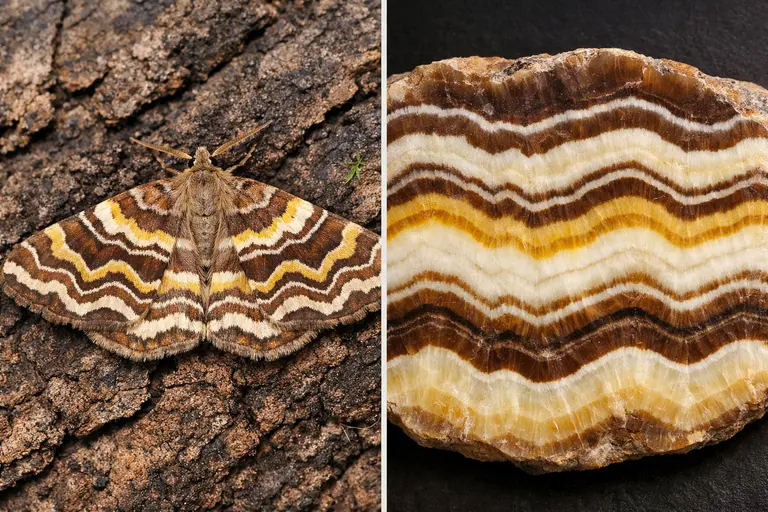
Nature loves to repeat itself. Across entirely different kingdoms—the biological and the geological—strikingly similar patterns emerge, as if following an invisible blueprint. One of the most remarkable examples is the visual connection between the Lobogonodes Moth and Banded Calcite mineral slabs. At first glance, both display interlocking bands of brown, white, red, and yellow that intersect like a woven tapestry.
Although evolution shapes the moth’s wings and geological sedimentation creates the mineral’s layers, the two end up looking astonishingly alike. As a Gemologist who studies the natural world, I find this resemblance fascinating. It has practical implications for jewelry design, mineral collecting, and biomimicry research. In this article, we will examine the similarities between these two natural objects, their origins, and how collectors can best appreciate them. If you love visual comparisons, read my guide on the Pease Blossom Moth and Purple Fluorite.
Color Similarities: The Shared Palette
First, let’s consider the colors. The visual overlap between the Lobogonodes Moth and Banded Calcite is genuinely striking.
The Moth’s Wings
Lobogonodes moths, primarily found across Southeast Asia, display brown wings adorned with numerous transverse lines. Specifically, they feature distinct black triangular markings and subtle reddish or yellowish tones along the wing margins. These tones vary slightly between species but consistently produce a layered, cross-banded appearance.
The Mineral’s Layers
On the other hand, Banded Calcite slabs present creamy whites and pale yellows at one end of the spectrum, then transition through deep oranges, rich reds, and warm browns at the other. Collectors and lapidaries often compare the effect to natural marble or woven fabric. In fact, this is precisely the same language entomologists use when describing Lobogonodes wing patterns. Notably, researchers have pointed to Ecliptopera rectilinea (a related moth) as a particularly close visual parallel. Both exhibit crisp, parallel lines that produce a textile-like rhythm.
Origin of Lobogonodes Moth and Banded Calcite
Next, it is important to understand how each object develops, because the processes could not be more different.
Evolutionary Camouflage
Lobogonodes moths belong to the family Geometridae. Here, natural selection drives the creation of their wing patterns. Over millions of years, moths that blended into bark, lichen, and leaf litter survived longer and reproduced more successfully. Consequently, their markings evolved into complex transverse banding that camouflages the moth (Cryptic Coloration).
Hydrothermal Drip
Banded Calcite, however, forms through an entirely geological process inside caves or hot springs. Mineral-rich groundwater slowly percolates through limestone cavities. As this water moves and drips (forming Stalactites and Stalagmites), it deposits successive thin layers of Calcium Carbonate (CaCO₃). Crucially, impurities in the water—particularly Iron Oxide—stain each layer a different color. In short, evolution optimizes for survival in the moth, while chemistry optimizes for mineral stability in the calcite.
Identifying Lobogonodes Moth and Banded Calcite
Whether you examine a pinned moth or assess a mineral slab, accurate identification requires knowing the right features.
Identifying the Moth
To identify Lobogonodes moths, look for:
- Brownish wings covered in multiple transverse lines.
- A distinctive discoidal dot near the wing center.
- A geographic range centered on Southeast Asia (including India).
Identifying the Mineral
To identify Banded Calcite, apply these gemological tests:
- Hardness: It is very soft (Mohs 3). A copper coin easily scratches the surface.
- Acid Test: It exhibits vigorous fizzing when you apply a drop of dilute hydrochloric acid.
- The “Onyx” Scam: Trade names include “Onyx Marble” or “Mexican Onyx.” As an expert, I must warn you: these are misnomers. True Onyx is a Silica mineral (Mohs 7). Banded Calcite is much softer. Consult the Mindat calcite database for deeper mineralogical verification.
Jewelry Uses: Lobogonodes Moth and Banded Calcite
Because of its vibrant banding, Banded Calcite attracts jewelry designers worldwide. However, the stone’s softness demands thoughtful design choices.
Designers most commonly cut it into cabochons, carved beads, and polished slabs for inlay work. Because Calcite sits at only Mohs 3, designers wisely avoid daily-wear rings, where abrasion would quickly dull the surface. Instead, pendants, earrings, and brooches dominate the market, since these pieces experience less contact with hard surfaces. Furthermore, Sterling Silver settings complement the warm tones especially well. This design logic applies to other soft stones I discussed in the Ammolite Gemstone Guide.
Buying Guide for Lobogonodes Moth and Banded Calcite
If you are building a collection of Lobogonodes Moth and Banded Calcite aesthetics, keep the following guidance in mind.
- Care and Handling: Store Banded Calcite separately from harder stones (like Quartz). Avoid all acid-based household cleaners—even mild vinegar can melt the surface. Wipe with a damp cloth only.
- Quality Selection: The most desirable specimens display high contrast between adjacent bands. Seek out stones where white bands stand sharply against dark red bands (often marketed as “Pork Stone”).
- Lighting Conditions: Always evaluate Banded Calcite under backlighting. Yellow and honey-toned varieties become remarkably translucent when lit from behind, glowing like a stained-glass window. Read my Gemstone Buying Mistakes guide for more tips.
Conclusion: The Master Weaver
Ultimately, the visual kinship between Lobogonodes Moth and Banded Calcite offers a compelling reminder that nature operates through recurring principles.
Evolution and geology, working independently over vast timescales, arrive at the same tapestry of brown, white, red, and yellow banding. In summary, whether you collect minerals, design jewelry, or simply admire nature’s artistry, these two stand as twin testaments to the elegance of natural patternmaking.
FAQ: Lobogonodes Moth and Banded Calcite
Why do Lobogonodes Moth and Banded Calcite look alike?
Both display parallel banding in similar earthy tones—brown, white, red, and yellow. The moth’s lines result from millions of years of natural selection for camouflage, while the mineral’s bands form through layered calcium carbonate deposition in caves.
Is Banded Calcite the same as Onyx?
No. Trade names like “Mexican Onyx” are scams. True Onyx is a hard variety of Chalcedony (Mohs 6.5–7). Banded Calcite is very soft (Mohs 3) and reacts to acids.
Can I wear Banded Calcite jewelry every day?
Daily-wear rings are not advisable because the stone scratches easily and loses its polish. Pendants and earrings are far more suitable, as they rarely contact hard surfaces.
Where can I find Lobogonodes moths?
These moths primarily inhabit tropical and subtropical forests across Southeast Asia, including India, Sri Lanka, Malaysia, and the Philippines.
What is the best Banded Calcite variety for collectors?
Red-Banded Calcite is the most prized variety due to its vivid color contrast. Honey-banded calcite ranks second, largely because of its exceptional translucency when backlit. Both benefit from display under LED spotlights.