Introduction
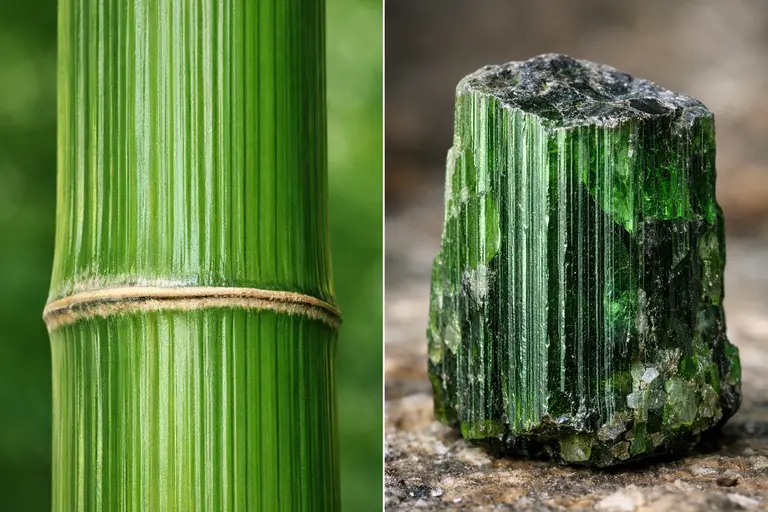
Nature often repeats its design language across vastly different materials. Few examples illustrate this more vividly than the comparison of Bamboo and Green Tourmaline. At first glance, a stalk of vertically striated Bamboo (Bambusa vulgaris) and a rough crystal of Green Tourmaline (Verdelite) appear strikingly similar. Both display bold, parallel linear patterns running along their vertical axes.
However, one grows from tropical soil into the sky, while the other forms deep within the earth’s crust over millions of years. Together, they offer jewelry designers and gemstone enthusiasts a fascinating study in nature’s tendency to echo its own aesthetic solutions. As a Gemologist, I use these visual clues every day. The “lines” on a rough stone tell me exactly what it is before I even pick up a loupe. In this article, we will explore the key similarities between these two materials, examine their distinct origins, and discuss how experts identify each one.
Visual Similarities in Bamboo and Green Tourmaline
Despite their entirely different compositions, both materials share a remarkable set of visual and structural characteristics.
The Vertical Striations
First and foremost, both exhibit distinct, parallel, longitudinal striations that run the full length of the material. This linear texture creates an immediate visual kinship that designers and collectors find deeply appealing. Furthermore, Green Tourmaline naturally forms elongated, prismatic crystals. These crystals closely mimic the upright growth habit of a bamboo stalk.
The Geometry of Growth
In terms of cross-sectional shape, Tourmaline crystals typically display a rounded-triangular profile. Meanwhile, Bamboo features circular internodes. Nevertheless, both structures rely on these specialized internal geometries to deliver impressive strength along their vertical axis. Finally, coloration ties these two materials together. Bamboo often features yellow-green culms with dark green stripes. Similarly, Green Tourmaline ranges from soft mint tones to vivid, dark forest greens. If you love green gems, compare this to my guide on Synthetic Emeralds in Watches.
Origin: Where Bamboo and Green Tourmaline Form
Transitioning from visuals to roots, the origins of these two materials could not be more different.
The Forest Giant
Bamboo thrives in tropical and subtropical climates. For instance, in Kerala, the forests of Wayanad and Idukki are filled with towering bamboo groves. As a member of the Poaceae (grass) family, bamboo grows remarkably fast—some species shoot up several feet per day! Consequently, this makes it one of the most renewable plant-based materials on earth.
The Deep Earth Crystal
In contrast, Green Tourmaline forms deep underground within Pegmatites (coarse-grained igneous rocks). This crystallization process takes millions of years and requires specific geochemical conditions rich in Iron and Lithium. Today, miners extract significant deposits of Green Tourmaline from Brazil, Afghanistan, Nigeria, and Mozambique. Therefore, the rarity and geological age of Tourmaline naturally contribute to its value as a precious gemstone. Read more about Pegmatites in my article.
Identification: How Experts Tell Them Apart
Although they share visual traits in their raw form, experts identify them through entirely different methods.
For Bamboo, specialists identify it by its fibrous, plant-based structure, its hollow nodes, and the presence of culm sheaths. These organic characteristics make bamboo easy to distinguish.
For Green Tourmaline, however, gemological testing is required. Gemologists classify it within the Trigonal crystal system. It has a Mohs hardness of 7 to 7.5, which makes it harder than quartz. One of Tourmaline’s most diagnostic optical properties is its strong Pleochroism. This means the gem appears light green from one angle and very dark green (almost black) from another. Under magnification, gemologists also look for characteristic “Thread-like” liquid-filled tubes that confirm Tourmaline’s identity.
Cutting Bamboo and Green Tourmaline on the C-Axis
As an expert, I must highlight a crucial challenge when working with Bamboo and Green Tourmaline. Both have a “Grain” or an “Axis.”
- In Bamboo: You must cut with the grain to prevent the wood from splintering.
- In Tourmaline: The cutter must navigate the “C-Axis” (the long vertical axis). Because of its strong Pleochroism, looking straight down the C-Axis is usually very dark, sometimes pitch black. Therefore, a master lapidary will facet the stone perpendicular to the C-axis to show the brightest, most vibrant green color. A poorly cut Tourmaline will look like a dark, dead piece of glass. For more on cutting, read my Colored Stone Grading guide.
Care and Limitations of Bamboo and Green Tourmaline
Both materials carry specific limitations that owners must address.
Bamboo, despite its strength, remains susceptible to moisture, fungi, and powderpost beetles. Designers who use bamboo in jewelry must apply proper protective coatings (like lacquer or resin) and store pieces carefully to prolong their lifespan.
Green Tourmaline, while generally durable, can be sensitive to sudden thermal shock (extreme temperature changes). Natural fissures within heavily included stones can create weak points. Consequently, jewelers should always choose protective mounting styles (like bezel settings) when working with included stones. This advice applies to many gems, as noted in my Gemstone Buying Mistakes post.
Conclusion on Bamboo and Green Tourmaline
In summary, the comparison of Bamboo and Green Tourmaline reveals that nature is the ultimate architect. Whether building a plant to reach the sun or a crystal to survive the pressure of the earth, the solution is the same: Strong, vertical, parallel lines. Ultimately, recognizing these patterns bridges the gap between botany and gemology, enriching our appreciation of both.
FAQ: Bamboo and Green Tourmaline
What makes Green Tourmaline look like Bamboo?
Green Tourmaline forms elongated prismatic crystals with parallel vertical striations along their surface. This specific growth pattern closely mirrors the grooved culm structure of a bamboo stalk.
Is Green Tourmaline a good substitute for Emerald in jewelry?
Yes. Green Tourmaline offers comparable color saturation to Emerald, and it is generally more durable and less included (flawed) than most commercial Emeralds. Its price point is also typically lower.
Does heat treatment affect the value of Green Tourmaline?
Heat treatment is a widely accepted practice used to lighten excessively dark green stones. Generally, it does not significantly reduce the value, though untreated stones of exceptional color and clarity always command a premium among collectors.
Can Bamboo jewelry last as long as Gemstone jewelry?
No. While bamboo is strong, it is organic matter. Even with proper sealing, it remains susceptible to environmental factors—particularly humidity and physical impact—much more so than a mineral gemstone.
What is Pleochroism in Tourmaline?
It is an optical phenomenon where the stone shows different colors (or different shades of green) depending on which angle you view it from. This dictates how the gem cutter must orient the rough stone.