Introduction
Nature rarely repeats itself—but when it does, the result is breathtaking. The comparison of Sunset Moth vs Rainbow Hematite provides a dazzling kaleidoscope of metallic hues that change with every angle of light. One originates from the living world of biology, while the other emerges deep from the Earth’s mineral kingdom.
Together, they offer a fascinating case study in how nature engineers breathtaking color through physics rather than pigment. As a Gemologist who studies optics, I find this overlap mesmerizing. They both use an optical illusion called “Thin Film Interference” (the same effect that makes a soap bubble colorful). In this article, we will explore their origins, color science, and how collectors and jewelry designers utilize them. Whether you are a naturalist or a gemstone collector, understanding these two subjects deepens your appreciation of both.
Color Similarities: A Shared Iridescent Spectrum
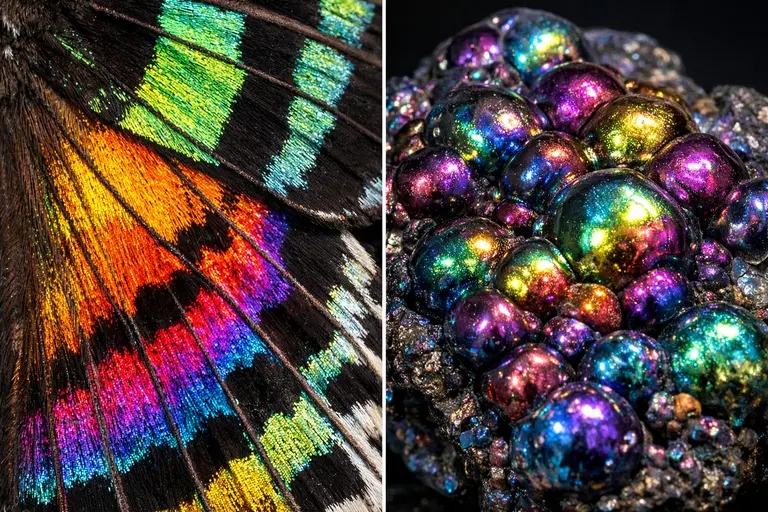
At first glance, the Madagascan Sunset Moth and Rainbow Hematite appear to come from completely different worlds. Nevertheless, they share a remarkably similar visual language. Both display an iridescent spectrum of metallic reds, blues, greens, yellows, and purples that shift dynamically depending on the angle of light. Furthermore, both exhibit a high-gloss, almost “liquid-metal” sheen that gives them a jewel-like intensity.
Most importantly, neither relies on chemical pigments to produce this effect. Instead, both owe their spectacular colors to the physical interaction of light with highly organized microscopic structures. Scientists call this Structural Coloration. Light waves interfere, reflect, and diffract to produce vivid colors that pigments simply cannot replicate. As a result, both subjects produce colors that appear to glow from within. Compare this optical trick to the one I discussed in Pease Blossom Moth and Purple Fluorite.
Origin of Sunset Moth vs Rainbow Hematite
How do they achieve this look? The mechanics differ wildly.
The Madagascan Sunset Moth
The Madagascan Sunset Moth (Chrysiridia rhipheus) produces its extraordinary colors through alternating microscopic layers of cuticle and air within the wing scales. Specifically, these scales carry a highly curved, complex architecture that bends and splits light like a glass prism. Consequently, the black areas of the wings contain actual melanin pigment, while all the vivid colors around them result purely from the physics of light. Therefore, there is no dye, no paint—only nanostructure.
Rainbow Hematite
Rainbow Hematite, in contrast, produces its colors through mineralogy. This variety of Iron Oxide (Fe₂O₃) develops a highly periodic microstructure of nanorods (measuring just 200 to 300 nanometers) on its surface. These nanorods function as a natural diffraction grating, scattering visible light. Therefore, the rainbow effect moves across the surface like an oily film on water. Interestingly, despite its colorful exterior, Rainbow Hematite always leaves a rust-red streak when scratched on a porcelain tile—a key diagnostic trait.
Identifying Sunset Moth vs Rainbow Hematite
Correctly identifying both the moth and the mineral requires specific knowledge.
Spotting the Sunset Moth vs Rainbow Hematite
You can identify the Madagascan Sunset Moth by its large wingspan (7 to 9 cm), making it one of the most visually impressive moths in the world. Look for prominent black patches interspersed with vivid iridescent bands, along with a distinct fringe of white scales along the wing edges. Because each moth is unique, no two specimens ever look precisely alike.
The Mineral
Rainbow Hematite typically forms Botryoidal (grape-like) clusters. The base material appears dark grey or black with a metallic luster, while the rainbow iridescence sits strictly on the surface. To confirm identification, perform a streak test. It always leaves a rust-red streak. If it does not, it might be a coated synthetic rock. For more on identifying minerals, check my Gemstone Buying Mistakes guide.
Jewelry Designs for Sunset Moth vs Rainbow Hematite
Both of these materials have found their way into the jewelry world, but they require very different handling.
Sunset Moth in Jewelry
Artisans frequently incorporate Sunset Moth wings into wearable pieces. Because the wings are incredibly fragile, designers must encase whole wings or fragments in clear resin. This transparent resin protects the delicate scales while allowing the structural colors to shine through fully. Additionally, artisans pair these resin pieces with Sterling Silver settings, which enhances the cool metallic tones of the wings.
Rainbow Hematite in Jewelry
Rainbow Hematite suits bold, contemporary jewelry design. Lapidaries carve polished cabochons for heavy rings and statement pendants. Unlike the light-as-air moth wing, Hematite is very dense and heavy. Moreover, its dark base color makes it a versatile pairing for both silver and gold settings. However, jewelers must be careful during polishing, as over-polishing can strip away the thin iridescent layer! Read about other fragile gems in my Ammolite Gemstone guide.
Conclusion on Sunset Moth vs Rainbow Hematite
Ultimately, the Sunset Moth vs Rainbow Hematite comparison demonstrates that nature speaks a consistent color language. One produces its colors to survive and mate; the other accumulates them through geological time and mineral deposition. Nevertheless, both arrive at the same sophisticated palette. In summary, whether you are drawn to the living wing or the heavy iron stone, understanding their origins deepens your appreciation for the physics of beauty.
FAQ: Guide to Sunset Moth vs Rainbow Hematite
Are the colors of the Madagascan Sunset Moth created by pigments?
No. The vibrant colors are structural, not pigment-based. Alternating layers of cuticle and air within the wing scales produce optical interference. Only the black areas contain actual pigment (melanin).
What causes Rainbow Hematite to display iridescent colors?
A surface layer of tightly packed iron oxide nanorods acts as a natural diffraction grating. Consequently, these nanorods split and scatter visible light into its spectral components, producing the oily rainbow sheen.
Which is more fragile: Sunset Moth vs Rainbow Hematite?
Both require careful handling, but for different reasons. Moth wing scales are extremely fragile and will turn to dust if crushed. Rainbow Hematite is a heavy rock, but its colorful surface layer chips and scratches very easily.
How can I tell if Rainbow Hematite is genuine or artificially coated?
Perform a streak test by rubbing the specimen on unglazed porcelain. Genuine hematite always leaves a rust-red streak. Additionally, natural iridescence covers the specimen broadly and looks integrated into the surface, rather than looking like a flaking sticker.
Can I use Sunset Moth wings in jewelry?
Yes. Artisans commonly encase wing fragments in clear epoxy resin to create pendants. The resin protects the delicate scales and preserves the structural colors over time without crushing them.