Author’s Note
This article is written for jewelry showroom owners, managers, and staff in Kottayam and Cochin who serve a diverse customer base. It draws on practical observations from retail experience. The communities mentioned—Muslim and Brahmin Jewelry Buyers—are referenced solely in a retail training context. No generalization applies universally, and nothing here carries any social or religious judgment. The goal is better service.
Introduction
Kerala’s gold jewelry market is one of the most active in India. Modern showrooms in Kottayam and Cochin serve a rich mix of communities. Specifically, Muslim and Brahmin Jewelry Buyers play a central role in purchases for weddings, festivals, and investments. However, many showroom staff still rely on assumptions instead of listening. In this post, I will explain what these buyers actually expect, how store teams should respond, and why Kottayam and Cochin each need a slightly different training focus. If you haven’t already, please read Part 1 of this series: Jewelry Retail Etiquette in Kerala: Christian & Nair.
What Muslim and Brahmin Jewelry Buyers Actually Want
Research on Kerala’s gold market consistently shows that buyers across all communities focus on four core factors. First, they check the purity and BIS Standard hallmarking of the gold. Second, they assess the reputation of the jeweler. Third, they look at design variety. Fourth, they compare prices, making charges (VA), and buyback policies.
In practice, Muslim and Brahmin Jewelry Buyers share these same core priorities. Nevertheless, individual families look for designs that fit their specific traditions.
The Muslim Buyer Profile
In regions like Malabar (and increasingly in Kochi), Muslim weddings involve significant volumes of gold. For instance, families often buy multiple layers of necklaces (like the Pathakkam or Jhimki). Because the volume is high, these buyers are intensely focused on Exchange Value and Buyback Policies. They view gold as a highly liquid asset.
The Brahmin Buyer Profile
Conversely, Brahmin buyers often lean toward traditional, heritage-heavy designs. They frequently seek out Temple Jewelry South India styles, such as the Manga Mala or Kasumala, for religious ceremonies and weddings. Furthermore, these purchases are often viewed as permanent heirlooms rather than liquid assets to be traded frequently.
Therefore, staff must listen carefully rather than assume based on appearance. Moreover, women often lead the final purchase decision. Staff should address women directly and avoid speaking only to male companions.
How Staff Should Respond to Muslim and Brahmin Jewelry Buyers
Across Kerala, buyers generally prefer branded outlets because these showrooms offer certified quality and professional service. At the same time, many customers still visit smaller local jewelers for familiarity. As a result, service quality becomes the ultimate differentiator.
In reality, staff behavior falls into three broad patterns:
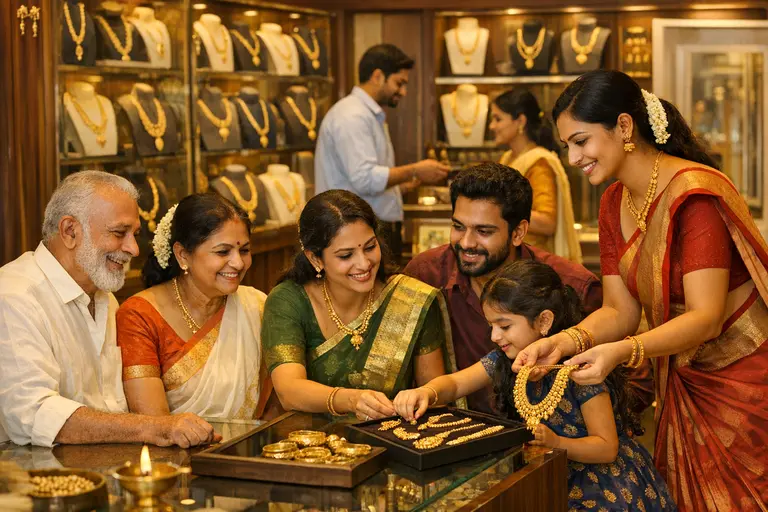
- Good: Staff greets customers politely, offers seating (as discussed in my Creative Hospitality guide), explains making charges clearly, and shows multiple designs without applying pressure.
- Bad: Staff rush decisions, speak only to one family member, or skip explaining the buyback policy.
- Unacceptable: Staff make personal remarks, display impatience, or joke about religion, caste, diet, or lifestyle choices.
Above all, managers should use these scenarios in role-play workshops to build respectful habits across the entire team.
Training for Muslim and Brahmin Jewelry Buyers in Kottayam vs Cochin
Although core service principles remain the same everywhere, the shopping culture in Kottayam and Cochin differs in important ways.
Kottayam: The Word-of-Mouth Hub
In Kottayam, many buyers know local jewelers personally. Consequently, word-of-mouth carries enormous weight. Families regularly discuss their experiences in neighborhood groups. As a result, a single negative interaction can spread quickly, while a positive experience anchors long-term loyalty. Staff training here should emphasize patience with detailed questions.
Cochin: The Cosmopolitan Center
In Cochin, by contrast, buyers encounter large, branded showrooms (like Lulu Mall). They typically expect more formal service, polished ambiance, and efficient handling. Therefore, training in Kochi outlets should stress speed, clear brand communication, and the ability to handle busy crowds without dropping service quality. Read more about urban buying habits in Luxury Watch Collectors India.
Dos and Don’ts for Muslim and Brahmin Jewelry Buyers
Dos:
- Always explain purity, making charges, and GST on every bill, because transparency builds immediate trust.
- Ask about the occasion (wedding, festival, or investment) and suggest designs that match.
- Treat questions about exchange, polish, and discounts as completely normal. Answer them clearly.
Don’ts:
- Do not assume a customer’s budget, taste, or negotiating style based on their community, clothing, or surname.
- Do not make comments or jokes about religion, caste, or diet, because these topics are sensitive and highly unprofessional.
- Do not rush buyers. Major life occasions carry deep emotional and financial significance. For more on negotiation, see my Jewelry Sales Secrets guide.
Conclusion on Serving Muslim and Brahmin Jewelry Buyers
In summary, whether you are serving Muslim and Brahmin Jewelry Buyers or any other community, the core currency of the jewelry trade is not gold; it is Trust. Ultimately, a customer who feels respected will return for generations.
FAQ: Muslim and Brahmin Jewelry Buyers
Do studies separate Muslim and Brahmin Jewelry Buyers?
No. Available research mainly analyzes factors such as purity, brand image, and price across broader segments. As a result, retailers should focus on universal service excellence rather than community-specific assumptions.
Are women major decision-makers for gold purchases in Kerala?
Yes. Studies consistently show that women make decisions for investment gold and wedding jewelry, particularly in urban Kerala. Therefore, showroom staff should always engage female buyers directly.
What matters most to Muslim and Brahmin Jewelry Buyers?
Purity, design variety, brand reputation, and price consistently rank as major factors. Additionally, buyers place extra value on personal familiarity and long-term relationships.
How should retailers handle community sensitivities?
Retailers should treat all communities with the same courtesy. Avoid stereotyping and focus on clear product information. This approach aligns with what actually drives purchasing decisions.
Why should training differ between Kottayam and Cochin?
Kottayam relies heavily on familiarity and word-of-mouth, while Cochin features a fast-paced, branded-store environment. Consequently, the service speed and style should adapt to the city.
Disclaimer
This article draws on general consumer research on Kerala’s gold jewellery market and does not represent formal survey data specific to any religious or cultural community. Observations about buyer preferences reflect broad retail practice and field experience. Individual preferences vary widely within every community, and readers should treat all examples as general guidance rather than definitive descriptions of any group.