Introduction
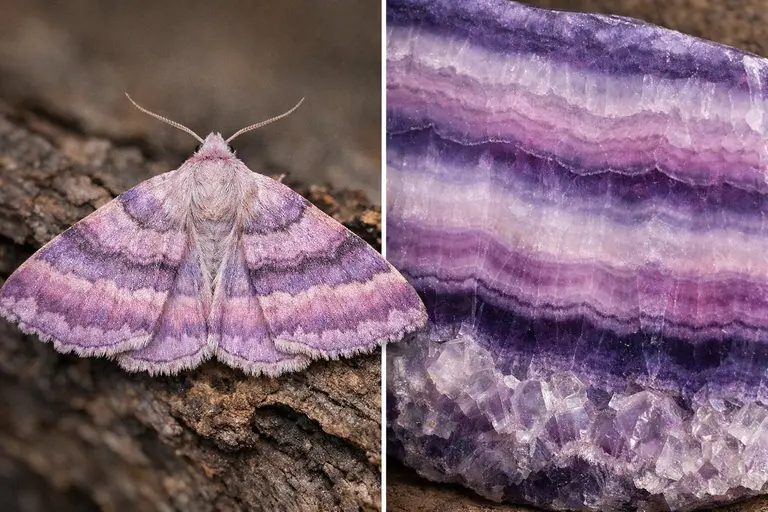
Nature often repeats its own designs across entirely different kingdoms. Few examples illustrate this better than the Pease Blossom Moth and Purple Fluorite. At first glance, the delicate wings of the moth (Periphanes delphinii) and a sliced piece of deep violet fluorite look strikingly similar. Both display a sophisticated blend of royal violet, magenta-pink, lavender, and creamy white.
Furthermore, both use dark contrasting tones to frame those softer hues. As a Gemologist who admires the intricate patterns of the natural world, I find this overlap fascinating. In this article, we will explore why these two very different natural objects share a color palette. We will look at where those colors come from, how to identify each, and what collectors should know. Whether you are a jewelry lover in Kerala or a wildlife enthusiast, understanding this connection reveals the poetry of nature.
Color of the Pease Blossom Moth and Purple Fluorite
To begin with, the color resemblance between the insect and the mineral is genuinely striking. Both share a core palette of deep purple, lavender, and pink, often anchored by dark brown or near-black contrasting zones.
The Wings of the Moth
The Pease Blossom moth carries distinctive pinkish-purple blotches—including a kidney-shaped mark—set against a grey-brown base. These blotches have soft, powdery edges that closely resemble the cloudy, matte banding visible in high-quality Purple Fluorite slabs. In addition, the angular, geometric quality of the moth’s wing markings mirrors the sharp cleavage lines that appear in a polished fluorite slice.
The Bands of the Stone
Similarly, the creamy white patches on the moth’s forewing echo the pale inclusion zones common in Fluorite. In short, if you placed a close-up photograph of each side by side, many observers would struggle to identify which is organic and which is geological. You can compare this visual trickery to the patterns I discussed in Moss Agate and Cabbage Thoran.
Origins of the Pease Blossom Moth and Purple Fluorite
Although the colors look similar, their origins could not be more different.
Organic Pigment and Survival
The Pease Blossom moth produces its colors through biological pigmentation within the wing scales. Specifically, the purplish-pink tones serve a camouflage function—a survival strategy known as Cryptic Coloration. The moth uses these hues to blend in with damaged, blooming vegetation such as Larkspur. As a result, its entire color palette reflects millions of years of evolutionary pressure rather than mere aesthetics.
Geological Radiation and Time
Purple Fluorite, on the other hand, develops its color through a completely inorganic process. Trace amounts of Yttrium and rare earth elements enter the crystal lattice of fluorite (Calcium Fluoride) during formation in hydrothermal veins. Moreover, exposure to natural background radiation over geological time distorts the crystal’s electron structure (creating “Color Centers”). Therefore, while the moth wears its colors to survive, the fluorite acquires its colors passively, shaped by chemistry and deep time. Read more about how radiation changes color in my Diamonds as Quantum Super-Materials guide.
Identifying the Pease Blossom Moth and Purple Fluorite
Correctly identifying both the moth and the mineral is straightforward once you know the key markers.
Spotting the Moth
The Pease Blossom moth has a small forewing spanning only 14–15 mm. Its distinguishing features include pinkish-purple blotches on a grey-brown base. Although it is technically nocturnal, it can appear in gardens during the summer months across Europe. Note that the similar Peach Blossom moth is sometimes confused with it; however, the Peach Blossom displays a browner base rather than the purple-violet tones of the true Pease Blossom.
Spotting the Gem
Purple Fluorite, meanwhile, rates at a hardness of 4 on the Mohs scale—meaning a steel knife blade will scratch it easily. It also shows perfect octahedral cleavage, leaving straight angular lines when fractured. Under a loupe, a characteristic Vitreous (glassy) luster is clearly visible. Additionally, many specimens display white crystalline veins running through the purple base, further echoing the pale wing patches of the moth.
Jewelry Designs Inspired by the Palette
Because this color palette is so naturally versatile, jewelry designers frequently draw on the Pease Blossom Moth and Purple Fluorite color story.
Due to fluorite’s relative softness, designers recommend using it primarily in pendants and brooches rather than rings (which endure daily abrasion). Wire-wrapped designs in sterling silver work especially well. The wrapping protects the stone’s edges while showcasing its natural color banding. Furthermore, jewelers often combine the purple and green color zones found in Rainbow Fluorite to evoke natural flora. This is similar to the floral jewelry designs I mentioned in Manipur Lotus Silk and Indian Jewelry.
Consumer Tips: Buying Purple Fluorite Wisely
Whether you are a jewelry buyer or a mineral collector, several important points apply before you purchase Purple Fluorite.
- Handle with care: Fluorite is highly brittle. Always store specimens wrapped in soft cloth.
- Test for UV fluorescence: The word “Fluorescence” actually comes from Fluorite! Many purple fluorites glow blue or violet under Ultraviolet light—a useful authenticity check.
- Protect from sunlight: Crucially, some natural purple fluorites fade gradually under prolonged direct sunlight. Display pieces away from windows.
- Watch for fakes: Dyed quartz and glass are commonly sold as fluorite. Remember, genuine fluorite scratches easily with a knife, while quartz does not.
Conclusion on the Pease Blossom Moth and Purple Fluorite
Ultimately, the Pease Blossom Moth and Purple Fluorite demonstrate that nature speaks a consistent color language across vastly different scales. One produces its colors to survive; the other accumulates them through geological time. Nevertheless, both arrive at the same sophisticated palette of violet, lavender, pink, and cream. In summary, whether you are drawn to the living wing or the polished stone, understanding their origins deepens your appreciation for both.
FAQ: Pease Blossom Moth and Purple Fluorite
What is the Pease Blossom moth?
The Pease Blossom moth (Periphanes delphinii) is a small nocturnal moth recognized by its distinctive pinkish-purple wing blotches. Its name reflects its resemblance to the blooms of the pea plant.
Why does Purple Fluorite lose its color over time?
Purple Fluorite can fade under prolonged direct sunlight. The color results from defects in the crystal lattice (Color Centers). High-intensity UV radiation from the sun gradually repairs those defects, causing the purple to lighten.
Is Purple Fluorite suitable for everyday jewelry?
No. With a Mohs hardness of only 4, it scratches easily and is prone to chipping. It works best in pendants or brooches that receive minimal daily abrasion, rather than engagement rings.
How can I tell if Purple Fluorite is real?
Scratch the stone with a steel knife blade in an inconspicuous spot—genuine fluorite scratches easily, while quartz does not. Additionally, many genuine specimens fluoresce blue-violet under a UV blacklight.
What plants does the Pease Blossom moth feed on?
The larvae feed primarily on Larkspur (Delphinium) and Monk’s-hood. The moth’s purple and pink wing colors provide camouflage among the blooms of these specific plants.