Introduction
In the history of gemology, few people have fundamentally changed the world. Undoubtedly, Kokichi Mikimoto was one of them. Mikimoto Pearls stand as one of the most respected names in luxury jewelry. Founded in 1893 in Toba, Japan, the brand pioneered the art of culturing pearls and forever changed the global jewelry industry.
Today, Mikimoto continues to set the standard for pearl quality, craftsmanship, and elegance. As a Gemologist who has studied the difference between natural and cultured gems (like the Mississippi Pearls), I revere the Mikimoto brand for its strict quality control. In this guide, we will explore the brand’s history, its proprietary grading standards, and the authenticity markers you need to know. Therefore, whether you are a first-time buyer or a seasoned collector in India, understanding this brand will help you make a confident purchase.
The Origin of Mikimoto Pearls: The Pearl King
To begin with, we must look at the founder. Undeniably, Kokichi Mikimoto, widely known as the “Pearl King,” founded his company with a mission to protect oysters from extinction. Tragically, at the time, the overharvesting of natural pearls by divers was severely depleting oyster populations worldwide. As a result, Mikimoto dedicated himself to developing a sustainable alternative: the Cultured Pearl.
In 1893, he successfully cultured the world’s first semi-spherical pearl (a Mabe pearl). Remarkably, by 1905, he had refined his technique to produce perfectly round cultured pearls—a breakthrough that transformed the jewelry world. Then, in 1921, a massive controversy erupted. Consequently, Mikimoto had to defend his pearls at the “Paris Trial,” where European jewelers accused him of selling “fakes.” Ultimately, he won the case with the backing of scientists, proving that a cultured pearl has the same chemical makeup as a natural one. You can learn more about the history of cultured pearls through the Gemological Institute of America (GIA).
The Mikimoto Business Model: Top 5% Only
Currently, Mikimoto operates as a fully integrated luxury brand, much like the Rolex Business Model. Effectively, the company manages design, production, quality grading, and retail sales under one roof.
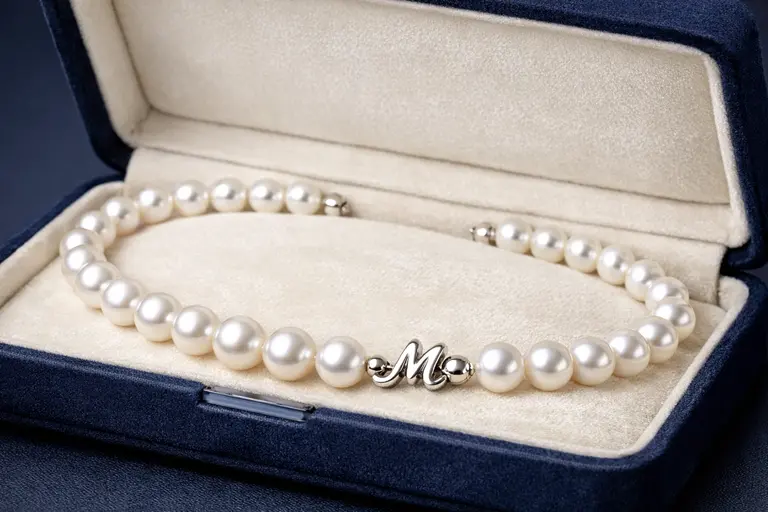
Furthermore, the brand applies a proprietary grading system. They evaluate each pearl for Luster, Surface Quality, Color, Shape, and Size. Remarkably, only the top 5% of each Akoya pearl harvest meets Mikimoto’s strict standards. Why Akoya? Biologically, the Japanese Akoya oyster (Pinctada fucata martensii) lives in cold water, which causes the nacre to crystallize slowly, creating the highest, mirror-like luster of any pearl species. Therefore, every piece that goes into the iconic navy blue box reflects the highest grade available.
How to Identify Genuine Mikimoto Pearls
Because of their high price, authenticating a Mikimoto piece requires attention to specific details.
The Hallmarks
First, look for the engraved “M” signature, which often appears inside an oyster outline. Typically, you will find this mark on clasps, earring posts, and ring interiors. Additionally, many necklaces feature a small dangling “M-circle” logo charm attached to the strand.
The Tooth Test
Beyond markings, you can perform the famous “Tooth Test.” Simply rub the pearl gently against the edge of your tooth. Actually, a real pearl feels slightly gritty or sandy (like sandpaper). Conversely, a plastic or glass imitation feels completely smooth. Genuine Mikimoto Pearls also display a deep, mirror-like luster with virtually no visible blemishes and feel noticeably heavy due to their dense nacre.
Treatments Used on Mikimoto Pearls
Understanding treatments is vital for any gem buyer. Mikimoto applies only safe and industry-accepted treatments.
Specifically, they use a process called “Pinking.” Typically, after gentle cleaning and surface polishing, almost all Akoya pearls undergo a mild tinting process. In fact, this traditional process subtly improves the pearl’s color, giving it a desirable “Rosy” overtone that flatters human skin tones. Importantly, this has been a standard part of the industry for decades and is completely stable. However, Mikimoto strictly rejects pearls with thin nacre or serious surface blemishes. Crucially, they do not use heavy dyes or radiation. Read more about treatments in my Gemstone Buying Mistakes guide.
Spotting Mikimoto Imitations
Unfortunately, the high desirability of Mikimoto Pearls has given rise to many convincing fakes. Historically, manufacturers commonly produce imitations using glass spheres coated in fish-scale essence to mimic luster.
How to spot a fake:
- Too Perfect: Typically, fake pearls display a perfectly smooth surface with no natural variation.
- Color Matching: The color is often unnaturally uniform throughout the strand. Real pearls have slight variations.
- The Drill Hole: The coating around the drill holes of fake pearls often shows peeling or flaking. If you are uncertain, consult a certified gemologist.
Consumer Tips for Buying Mikimoto Pearls
Finally, buying Mikimoto Pearls is a long-term investment. Always purchase directly from a Mikimoto salon or an authorized retailer to avoid counterfeits. Confirm that the piece includes its official grading certificate.
Care and Maintenance
After purchase, care for your pearls properly. Crucially, keep them away from perfumes, hairspray, and harsh chemicals, as these acids eat away the nacre. Put your pearls on after you apply makeup. Always store pearls separately from other jewelry to prevent surface scratches from diamonds or gold. Additionally, have pearl necklaces professionally restrung on high-quality silk thread (with knots between each pearl) whenever the cord shows signs of stretching.
FAQ: Mikimoto Pearls Explained
What makes Mikimoto pearls different from other cultured pearls?
Mikimoto uses only the top 5% of each Japanese Akoya harvest. This exceptionally strict selection process results in pearls with superior luster, perfectly round shapes, and flawless surfaces compared to generic competitors.
How do I know if my Mikimoto pearls are authentic?
Look for the engraved “M” signature inside a clamshell outline on the clasp. Furthermore, genuine pieces always come with brand documentation.
Can Mikimoto pearls be repaired or restrung?
Yes. Fortunately, Mikimoto and authorized jewelers offer professional restringing services. Ideally, you should have them restrung every 1 to 2 years if worn frequently, to prevent the silk thread from breaking.
Do Mikimoto pearls hold their value?
Yes. Well-maintained Mikimoto pieces typically retain 50–80% of their original retail value on the secondary market. Ultimately, the brand’s reputation contributes heavily to its strong resale performance.
Are Mikimoto pearls treated?
Yes, basically, they apply standard, accepted industry treatments such as cleaning, bleaching, and mild “Pinking” (tinting). However, they never use low-quality treatments to hide flaws.