Introduction
If you want to Sell More Jewelry in 2026, you must understand that the Indian market is one of the most competitive in the world. From the busy lanes of Zaveri Bazaar to the glittering showrooms of Kochi, every jeweler fights for the same customer. Traditionally, most sales staff believe that talking more helps close a deal. They think a barrage of facts proves their expertise. However, research and experience in Indian retail tell a very different story.
In fact, the secret to success if you want to Sell More Jewelry in 2026 is to talk less and listen more. Furthermore, today’s Indian customer is highly informed. She researches diamond clarity and Gold Purity on her phone before she even steps into your store. She does not need a lecture. Instead, she needs you to understand her. In this article, I will show you exactly how to shift your approach, use the “Power of the Pause,” and boost your sales.
The Mistake That Won’t Sell More Jewelry in 2026
First, let us understand why this bad habit exists. Many Indian jewellery sales training programmes teach staff to present “Features.” They train the team to recite carat weight, colour grade, and BIS Standard hallmark details like a robot. As a result, staff walk up to a customer and immediately begin a monologue.
Consequently, the customer feels overwhelmed. She asks for time to think and leaves without buying. According to consumer research from the GIA, buyers make emotional decisions first and justify them with facts later. Therefore, when you bombard a customer with data upfront, you interrupt her emotional connection with the piece. Instead, you must let her feel the jewellery before you explain it.
The Power of the Pause
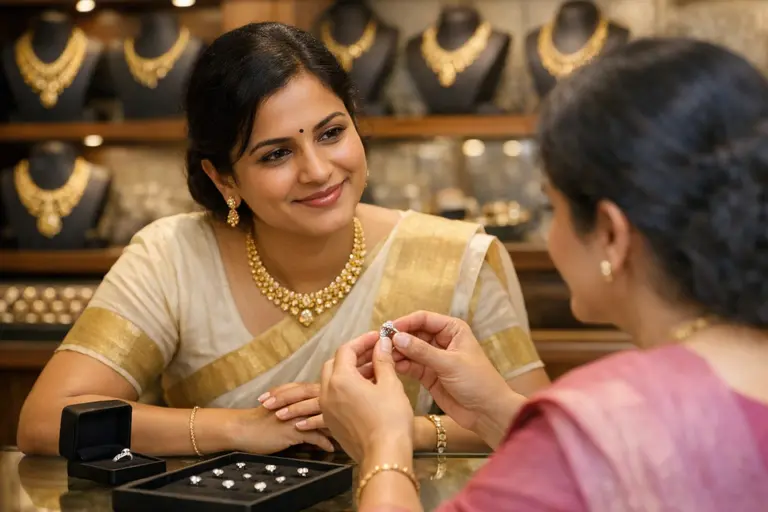
Moreover, silence is a powerful sales tool that most Indian jewellers underuse. When a customer picks up a heavy Temple Jewelry South India necklace, many salespeople immediately start explaining the stone quality. Instead, try staying quiet for five to ten seconds. Let her look. Let her imagine wearing it at the wedding. This small pause builds desire far more effectively than any technical description.
Additionally, the pause gives you information. Watch her eyes. Notice which piece she holds longer. As a result, you learn what matters to her—aesthetics, weight, craftsmanship, or stone size—without asking a single question. This insight helps you recommend the right pieces to Sell More Jewelry in 2026.
Ask Better Questions to Sell More Jewelry in 2026
However, talking less does not mean staying silent forever. Instead, it means replacing statements with questions. The best jewellery salespeople use the 80/20 Rule: Listen 80% of the time, talk 20% of the time.
For example, ask short, open-ended questions:
- “Is this piece for a special occasion?”
- “What style does she usually prefer?”
These questions do two things simultaneously—they make the customer feel valued, and they give you the data you need. Furthermore, understanding the occasion matters deeply. A woman buying jewellery for her daughter’s wedding has very different priorities compared to someone buying a daily-wear pendant. Therefore, once you understand the occasion, you stop showing irrelevant pieces.
Presenting Diamonds Without Over-Explaining
When it comes to diamonds, many jewellers fall into the trap of explaining too much too soon. Instead, first show the piece in good light and let the customer react. Then, only after she responds, mention one or two key facts.
For example, if she says, “This diamond looks so brilliant,” that is the perfect moment to mention the cut grade. Say: “Yes, this is an Excellent cut, which is why it catches light so beautifully.” This approach connects the technical fact to her personal experience. Consequently, the feature becomes meaningful rather than just a data point on a Rapaport sheet.
Build Trust to Sell More Jewelry in 2026
Additionally, storytelling is one of the most underused tools to Sell More Jewelry in 2026. Every piece has a story. For instance, a Thewa Jewelry pendant carries centuries of royal heritage. A Kashmiri Saffron and Padparadscha colored sapphire speaks of rarity and passion.
When you share these stories, you elevate the jewellery from a product to an experience. Moreover, stories travel. A customer who buys a piece because of its story will share that story with her friends. Therefore, storytelling drives both the immediate sale and long-term word-of-mouth marketing.
Conclusion: How to Sell More Jewelry in 2026
In summary, the jewellery industry in India is evolving rapidly. The customers of 2026 do not want a salesperson who recites specifications. Instead, they want a trusted guide who understands their needs and lets the jewellery do the talking. Ultimately, train your team to pause, listen, ask, and observe. You will Sell More Jewelry in 2026 not by talking louder, but by saying exactly the right thing at exactly the right moment.
FAQ: How to Sell More Jewelry in 2026
Why do Indian customers prefer a less pushy sales approach?
Indian customers, especially urban millennials, are well-researched before they visit a store. Crucially, they want to feel respected and empowered, not sold to. A listen-first approach builds trust.
Does talking less really help close sales faster?
Yes. When salespeople listen instead of pitching, they identify the customer’s real need quickly. Consequently, they recommend fewer but more relevant pieces, shortening the sales cycle.
How do I train my staff to Sell More Jewelry in 2026?
Start with role-play exercises. Give staff a set of five open-ended questions and practice them daily. Additionally, teach staff to observe body language and use silence as a tool.
What role does storytelling play?
Coloured stones carry strong cultural significance in India. Sharing the origin, rarity, and heritage of a stone creates an emotional connection that a grading report alone cannot achieve.
How can small Indian jewellers compete with large chains?
Small jewellers can offer something large chains often cannot: personalized, unhurried attention. By training staff to listen actively and tell compelling stories, independent jewelers build deep, generational loyalty.