Introduction
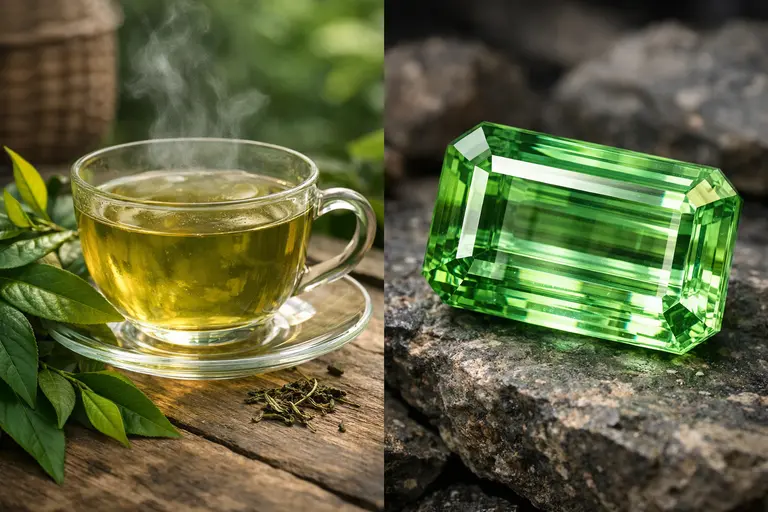
In the natural world, origin dictates destiny. Kangra Green Tea and Hiddenite (Green Spodumene) appear to belong to entirely different worlds. One fills a teacup in the Himalayas; the other adorns a jeweler’s showcase in a luxury boutique. Yet both share a striking connection: they owe their rare green identity to the specific geochemistry of their native terrain.
Furthermore, both products command premium prices precisely because their quality cannot be replicated elsewhere. As a Gemologist who appreciates a healthy, natural diet, I find the parallels between the soil that feeds a plant and the rock that feeds a crystal truly fascinating. In this article, we will explore how these two extraordinary green treasures compare across origin, identification, and treatments. Ultimately, understanding these nuances protects you from costly fakes.
Origins of Kangra Green Tea and Hiddenite
First and foremost, both products are inseparable from the land that produces them.
The Himalayan Tea
Kangra Green Tea grows on the high-altitude slopes of the Kangra Valley in Himachal Pradesh, India. Typically, these estates sit between 900 and 1,400 meters above sea level. Specifically, the valley’s combination of glacial meltwater, loamy acidic soil, and cool misty mornings slows the growth of the tea bush. As a direct result, the leaves accumulate a high concentration of catechins and polyphenols. Therefore, it develops a distinctive woody-floral aroma that flat-land teas simply cannot replicate.
The Pegmatite Gem
Similarly, Hiddenite forms deep within lithium-rich granitic pegmatites. These coarse-grained igneous rocks act as nature’s pressure cookers for rare minerals. Geologists first documented Hiddenite in North Carolina, USA, in the 1880s. What makes this gemstone genuinely exceptional is the presence of Chromium. Crucially, Chromium substitutes for Aluminum in the crystal lattice and, in doing so, produces a vivid emerald-green color. Because chromium-bearing pegmatites are exceedingly uncommon, true Hiddenite remains one of the rarest colored gemstones on Earth. Read more about how origins affect value in my Kashmiri Saffron and Padparadscha guide.
Identifying Kangra Green Tea and Hiddenite
Knowing how to identify both products protects consumers from costly mistakes.
Spotting Genuine Tea
Authentic Kangra Green Tea carries several hallmarks. Visually, the dry leaves are narrow, tightly rolled, and uniformly silver-tipped. When you brew the tea correctly, it produces a pale golden-green liquor. Unlike blended commodity teas, genuine Kangra leaves a lingering sweetness on the palate rather than a bitter aftertaste.
Spotting Genuine Gemstones
In the gemstone world, gemologists use several tools to identify true Hiddenite. The stone belongs to the monoclinic crystal system and displays strong Pleochroism. This means it shows different shades of green depending on the viewing direction. Additionally, a qualified gemologist will use a spectroscope to detect the characteristic Chromium absorption bands. Without chromium, the mineral is simply “Green Spodumene” (worth very little). Consequently, this distinction matters enormously for valuation. Compare this optical trick to the pleochroism I discussed in the Bangalore Blue Grapes vs Iolite.
Treatments: Kangra Green Tea and Hiddenite
Both Kangra Green Tea and Hiddenite undergo specific processing steps that directly affect their final quality.
Processing the Leaves
For Kangra tea, producers follow the “Orthodox Method.” First, they hand-pluck the two-leaf-and-a-bud flush. Next, they immediately apply pan-firing or steaming to halt enzymatic oxidation. This step locks in the green color. Producers who skip this step risk creating a brownish, bitter leaf.
Irradiating the Stone
In contrast, treatment practices for Hiddenite are highly controversial. Although fine specimens reach the market naturally, some cutters submit pale rough to Gamma Irradiation to intensify the green hue. Unfortunately, this induced color is often “fugitive.” In other words, prolonged exposure to direct sunlight will fade the enhanced color within months. For this reason, Hiddenite is often called an “Evening Stone.” To avoid buying fading gems, read my expert Gemstone Buying Mistakes guide.
Imitations in the Market
Because both products carry premium price tags, unscrupulous sellers actively introduce imitations.
In the tea trade, the most common adulteration includes blending genuine Kangra leaves with cheaper Assam teas. Moreover, some add artificial green colorants. The most reliable safeguard is the Geographical Indication (GI) Tag, which the Indian government awarded to Kangra tea.
Meanwhile, the Hiddenite market faces equally significant substitution problems. Sellers frequently offer green glass, synthetic Spinel, or iron-colored Green Spodumene as “Hiddenite.” Because iron-colored Spodumene looks visually similar under ordinary lighting, the untrained eye cannot distinguish between the two. Ultimately, only a certified laboratory report from the GIA or IGI can definitively separate them.
Conclusion on Kangra Green Tea and Hiddenite
In summary, the comparison of Kangra Green Tea and Hiddenite teaches us that nature’s finest greens require the perfect recipe of soil, minerals, and time. Whether you are sipping a cup of antioxidant-rich tea or admiring a brilliant-cut gemstone, you are experiencing the pure essence of the Earth.
FAQ: Kangra Green Tea and Hiddenite
What makes Kangra Green Tea different from other Indian teas?
Kangra Green Tea grows at a high altitude in a Himalayan microclimate. Consequently, it concentrates catechins and creates a woody-floral character absent in lowland Indian teas.
Is all green Spodumene considered Hiddenite?
No. Gemologists reserve the name “Hiddenite” strictly for Chromium-bearing Spodumene. Green Spodumene colored by Iron lacks the chromium spectrum and is a far less valuable mineral.
Can irradiated Hiddenite color fade permanently?
Yes. Irradiation-induced color in Spodumene is highly fugitive. Therefore, sustained exposure to natural sunlight will cause the green to fade. Natural, untreated Hiddenite retains its color indefinitely.
How do I confirm that a Kangra Green Tea purchase is authentic?
Look for the official GI Tag on the packaging. Additionally, purchase from single-estate sources, as they offer full traceability from the garden to your cup.
Where can I test a Hiddenite stone?
Submit the stone to an internationally accredited gem laboratory such as the GIA or the Gemmological Institute of India (GII). They will confirm the chromium content and check for irradiation treatments.