Introduction
When sourcing diamonds for fine jewelry, two global powerhouses stand out above the rest. Surat vs 47th Street Diamond Trading represents the two beating hearts of the industry. Specifically, Surat (India) dominates as the world’s manufacturing epicenter, processing about 90% of the global supply. In contrast, 47th Street (New York) buzzes as a high-end retail and wholesale haven for the West.
For a gemologist in Kerala or an international buyer, understanding the difference is vital. Ideally, one offers the lowest price (Surat), while the other offers the fastest liquidity (New York). In this guide, I will explore the dealer perks, tax implications, and practical advice for consumers. Whether you are sourcing loose stones for a bridal set or looking for investment-grade gems, navigating these hubs requires local knowledge.
The Experience: Surat vs 47th Street Diamond Trading
Moving from production to polish, the vibes of the two centers are worlds apart.
Surat: The Engine Room
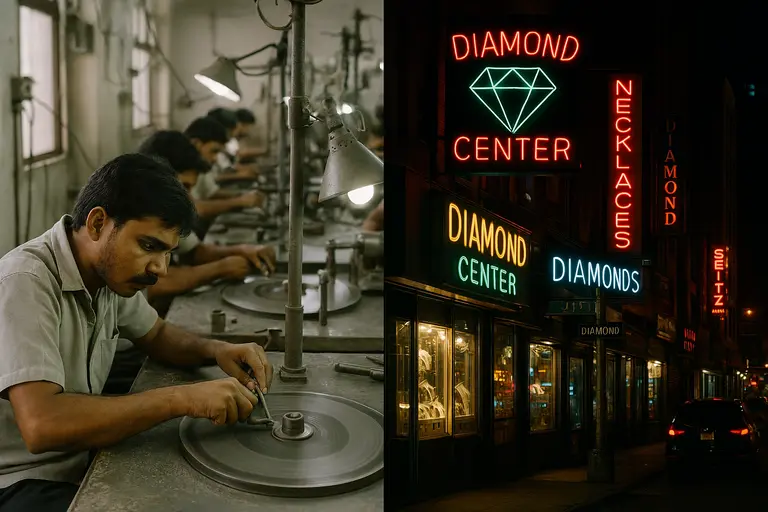
In Surat, the focus revolves around manufacturing. Unquestionably, as India’s diamond capital, it boasts the new Surat Diamond Bourse (SDB), the world’s largest office building. However, the real action often happens on the streets of Mahidharpura, where traders inspect stones in natural sunlight on the roadside. Here, Business-to-Business (B2B) deals thrive. Typically, traders negotiate bulk volumes of loose stones (Star and Melee sizes) at razor-sharp prices. For instance, a Kerala jeweler could bulk-buy small diamonds here for North vs South Indian Jewelry designs, slashing costs by 20-30%.
47th Street: The Showcase
On the other hand, 47th Street in New York pulses with retail energy. Geographically, sandwiched between 5th and 6th Avenues, this single block hosts over 2,600 independent dealers. Unlike Surat’s industrial feel, 47th Street delivers a sensory rush. Usually, transactions move fast, built on trust and the famous Yiddish phrase “Mazal” (Luck/Agreement). According to the New York Diamond Dealers Club, this ecosystem handles billions in annual trade. Thus, Surat suits the patient-volume buyer, while New York suits the urgent-luxury buyer.
Dealer Benefits in Surat vs 47th Street Diamond Trading
For dealers, each market unlocks unique advantages.
Surat Advantages
- Cost: Primarily, dealers tap into low labor costs. Indian cutters earn fractions of New York wages.
- Volume: Access to the “Primary Source.” Amazingly, you can instantly buy thousands of carats of a specific sieve size.
- Support: The GJEPC (Gem & Jewellery Export Promotion Council) supports this with incentives like Special Economic Zones (SEZs).
47th Street Advantages
- Visibility: Undoubtedly, high foot traffic from wealthy tourists and locals exposes inventory to end-users immediately.
- Services: Clustered services—like on-site GIA labs, laser inscription, and setting—allow a dealer to finish a ring in hours.
- Networking: The ability to “Memo” goods (borrow stock) from neighbors allows dealers to sell stones they don’t own.
In essence, Surat empowers cost-driven manufacturers, while 47th Street boosts service-oriented retailers.
Taxes in Surat vs 47th Street Diamond Trading
Taxes add another layer, influencing net costs.
India (Surat)
Surat operates under India’s framework. Currently, rough diamond imports face low duties (around 5%) to boost processing. However, polished sales attract 3% GST. For Indian dealers, this favors value addition—polish a rough stone and export it tax-free. Crucially, recent government moves to ban terms like “LGD” on invoices apply here. Read my update on the BIS Standard for Diamonds.
USA (New York)
Shifting to 47th Street, U.S. rules emphasize compliance. New York State Sales Tax hits 8.875% on retail sales. Yet the district’s self-regulated ethos ensures ethical standards. Legally, dealers must navigate FTC guidelines. Consumers should factor in currency fluctuations; a dollar-weakened deal from Surat might undercut NY markups significantly. Overall, Surat’s tax structure rewards exporters, while 47th Street demands retail savvy.
The Trust Systems: Jangad vs. Memo
As an expert, I must highlight the “Credit” systems that keep these markets moving. In reality, both operate on immense trust, but the terms differ.
- Surat (Jangad): Goods are given on an “Approval Note” (Jangad). It is a legal document in India. Trust is often community-based (Palanpuri Jain or Kathiawadi Patel networks).
- New York (Memo): Technically, goods are given on a “Memorandum.” It is a consignment agreement. Trust is based on the Diamond Dealers Club (DDC) arbitration.
Therefore, breaking trust in either market results in immediate blacklisting globally. You can compare this to the trust networks in the Angadia System.
Consumer Tips for Surat vs 47th Street Diamond Trading
Consumers gain most by matching needs to markets.
- Buy in Surat if: You want loose stones, specifically small diamonds (Melee) or Solitaires, and you have a trusted broker. You can save 20-40%.
- Buy in New York if: You want a specific “Fancy Cut” (Oval, Pear) or a vintage piece. Often, the selection of unique cuts is higher in NY.
Fortunately, quality matches both ways. Demand Rapaport vs IDEX Diamond Prices benchmarks and GIA certificates everywhere. Pro tip: For Indian buyers, use digital tools to track shipments.
Conclusion on Surat vs 47th Street Diamond Trading
In summary, the Surat vs 47th Street Diamond Trading comparison reveals the lifecycle of a diamond. It is likely cut in Surat and sold in New York. Ultimately, these two cities are partners, not rivals. Whether you are walking the dusty roads of Mahidharpura or the pavement of Manhattan, you are walking on the same carbon dreams.
FAQ: Surat vs 47th Street Diamond Trading
Which is cheaper in Surat vs 47th Street Diamond Trading?
Surat, hands down. Due to manufacturing scale and lower overheads, you cut out the shipping and import costs to the US. Expect 20-30% better rates on certified stones.
Are taxes higher on 47th Street?
Yes. Sadly, for a retail buyer, the NY Sales Tax (approx 8.875%) significantly inflates the price compared to buying in Surat (3% GST) or Dubai (5% VAT).
Is Surat safe for tourists?
Generally, yes, but it is a B2B hub. Certainly, the new Surat Diamond Bourse is secure, but the street markets require a local guide to navigate safely and avoid being overcharged.
How do I ensure quality in both markets?
Insist on GIA or AGS certificates. Above all, never buy a stone based on the dealer’s word alone. Check the laser inscription on the girdle against the report.
What is the “Mazal” in New York?
Literally, it is a Hebrew word meaning “Luck/Destiny.” In 47th Street (and Antwerp), saying “Mazal” and shaking hands seals a deal bindingly, often before any paperwork is signed.