
Introduction
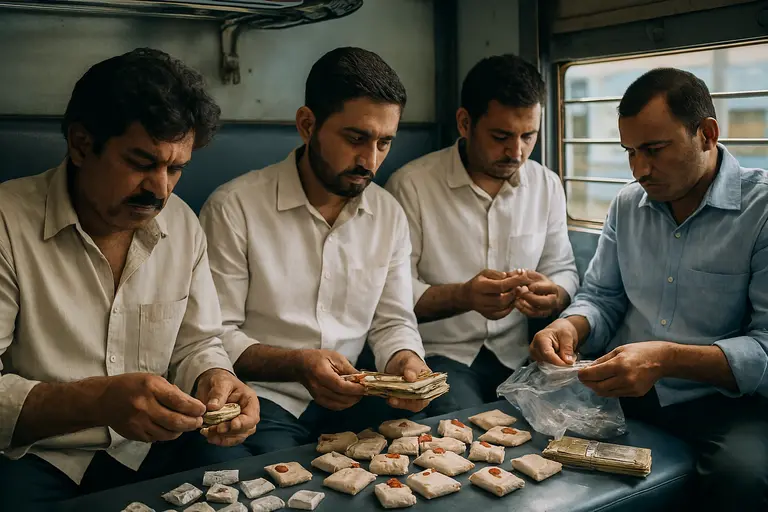
In the high-tech world of 2026, where digital transfers happen in milliseconds, the Indian diamond industry still relies on a system that is centuries old. The Angadia System stands as a remarkable testament to India’s rich mercantile history. Originating centuries ago, this traditional courier and banking network has served merchants for generations. Primarily, it facilitates the secure transport of cash, rough diamonds, gold jewelry, and documents.
In particular, it thrives in the “Golden Corridor” between Gujarat (Surat/Ahmedabad) and Mumbai. As trade boomed during the British Raj, Angadias became indispensable. Today, they continue to operate in the shadows of modern finance, blending absolute trust with ruthless efficiency. In this article, I will explore their origins, their secret codes (like the ₹10 note), and their enduring relevance in the diamond hubs of Zaveri Bazaar and Varachha Road.
Origins of the Angadia System
Long before formal banks dominated, the Angadia System emerged in the Kathiawar (Saurashtra) region of Gujarat. Specifically, towns like Surendranagar, Jamnagar, and Bhavnagar birthed this network. According to historical accounts, the system dates back to the era when traders needed to move goods safely across bandit-infested roads.
During the British Raj, the system gained momentum. For instance, the cotton trade exploded, demanding fast, reliable transport of valuables to Mumbai ports. Later, the diamond industry took center stage. Gujarati, Marwari, and Malbari merchants relied on Angadias to bypass slow, bureaucratic formal channels. Consequently, these carriers evolved into a highly organized force. Moreover, this era solidified their role. They became the backbone for informal banking, operating on unspoken codes of honor known as Zuban (Word of Mouth).
Purpose of the Angadia System: Speed and Trust
At its core, the Angadia System addressed a simple need: swift delivery. Merchants, especially diamond traders in Surat, needed to shuttle high-value rough stones to Mumbai for export within 12 hours. Unlike banks or corporate couriers, which require insurance paperwork and delays, Angadias offer speed.
For example, they handle massive volumes daily, powering industries that formal systems couldn’t match. The network draws from tight-knit communities. Primarily, specific families from the Patel and Prajapati communities run these firms. Trust forms the foundation—passed down through generations. Additionally, their prevalence shines in key hubs. In Mumbai, about 200 firms bustle in areas like Opera House and Zaveri Bazaar. Similarly, Surat’s Diamond Bourse relies on them.
How the Angadia System Operates: The “Secret Code”
Angadias function through a blend of simplicity and ingenuity. Transactions often skip paperwork entirely. Instead, they rely on mutual trust and clever verification.
The ₹10 Note Trick
For instance, senders and receivers verify identity using the serial number on a low-denomination currency note, like a ₹10 or ₹20 bill. The sender gives the note to the Angadia. The receiver sends a photo of the same note via WhatsApp (or describes the number). This “secret code system” confirms authenticity without ID cards.
The Logistics: The Gujarat Mail
Logistically, they prioritize safety in numbers. Typically, carriers board overnight trains such as the iconic Gujarat Mail or the Karnavati Express. They travel in groups, sometimes booking entire coaches to create a moving fortress. Meanwhile, fees are incredibly low. For non-cash items like diamond packets, fees start at around ₹200 to ₹500. For cash, commissions range from 0.2% to 0.5%—far cheaper than bank transfer fees.
Angadia vs. Hawala: The Distinction
As an expert, I must clarify a common misconception. People often confuse Angadia with Hawala. They are different.
- Angadia: Involves the Physical Movement of goods. A diamond packet physically travels from Surat to Mumbai. It is a courier service.
- Hawala: Involves No Physical Movement. You pay an agent in Dubai, and his partner pays your contact in Kerala. It is a financial settlement system.
Therefore, while both are informal, Angadia is primarily a logistics network for the gem trade. If you are interested in gem trade logistics, read my guide on the Tucson Gem Show vs Netherlands Flower Auction.
Legal Status of the Angadia System
While not illegal per se, the Angadia System operates in a grey area. It is unregulated by the RBI or SEBI. Authorities, including Income Tax officials, often probe it for links to unaccounted cash (Black Money). High cash flows raise concerns, prompting raids.
Yet adaptation is underway. Organizations like the Bharat Diamond Bourse (BDB) now urge formalization. They recommend invoices and Jangadh (consignment notes) for all shipments. Consequently, many Angadia firms now demand KYC documents to build legitimacy. Digital tracking tools are also emerging, blending tradition with technology.
Conclusion on the Angadia System
Despite challenges, the Angadia System endures. They handle billions of dollars in textiles and gems annually. Without them, the cost of Indian diamonds would rise, and the speed of trade would slow. Ultimately, they prove that in India, Trust is a currency more valuable than Gold.
FAQ: The Angadia System
What is the Angadia System?
It is a traditional, trust-based courier service originating in Gujarat. It is used primarily to transport diamonds, gold, jewelry, and cash between traders in Mumbai and Gujarat.
Is the Angadia System legal?
Technically, yes. Being a courier is legal. However, carrying unaccounted cash is illegal. The system faces scrutiny when used to transport “Black Money,” but the transport of invoiced goods is perfectly legal.
How do they ensure security?
They travel in groups on specific trains, often accompanied by private security or police escorts paid for by the trade associations. Moreover, the tight-knit community structure ensures that theft by an employee is rare, as it would shame their entire family.
What fees do Angadias charge?
Fees are very low. Small packets cost a flat rate (₹200-500). Cash transfers charge a commission of 0.2% to 0.5%. This low cost is why traders prefer them over insured logistics companies like Brinks.
Where did Angadias originate?
They began in the Kathiawar region of Gujarat over 100 years ago, initially to serve the cotton trade during the British Raj, before pivoting to diamonds.
Author Bio
P.J. Joseph, also known as Saju Elizamma, Gemstone & Gold Consultant serving Kerala, Tamil Nadu, and Karnataka.