Introduction
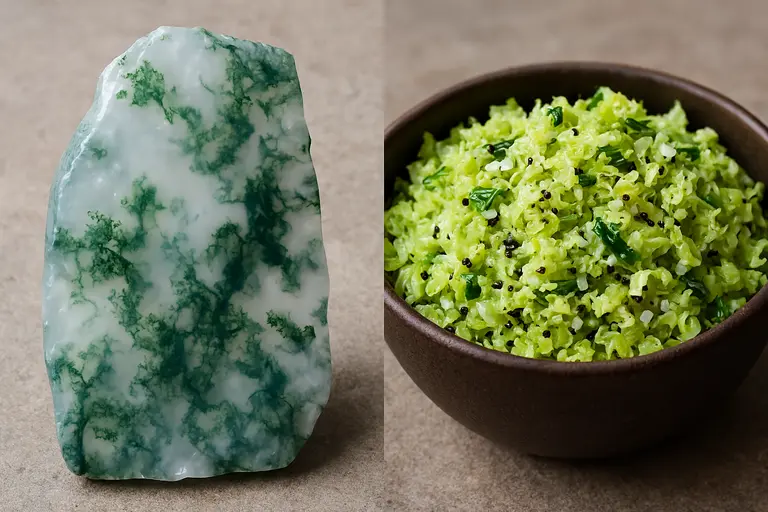
When we look at the textures of Moss Agate and Cabbage Thoran, we find a delightful visual parallel between the mineral kingdom and the Kerala kitchen. Nature often repeats its best designs. However, for those familiar with Kerala cuisine, the visual resemblance points to something much tastier: Kerala Cabbage Thoran.
Specifically, the mix of finely shredded green inclusions suspended in a milky-white base looks exactly like our beloved stir-fry of cabbage and grated coconut. Moss Agate and Cabbage Thoran share a striking visual texture—a chaotic, beautiful blend of green and white. As a Gemologist who loves his food, I find this parallel delightful. In this article, we will explore the geology behind the stone, the heritage of the dish, and why India is the global home of this “Mini Forest Gem.”
Visual Link: Moss Agate and Cabbage Thoran
At first glance, seeing a slice of high-quality Indian Moss Agate explains why this comparison feels so intuitive. The stone’s green, leafy inclusions float delicately within its translucent body. This creates a textured appearance that mimics the stir-fried medley of a Thoran.
The “Coconut” Base
In the dish, the white element is freshly grated Coconut. In the gem, the white element is Chalcedony. Technically, this is a microcrystalline quartz that provides a soft, milky backdrop. As a result, light filters through it, highlighting the contrast much like sunlight hitting the glistening coconut flecks in your lunch.
The “Cabbage” Inclusions
Meanwhile, the “Cabbage-like” greens in the stone stem from Dendritic Inclusions. Unlike the vegetable, which is organic, these are branching, tree-like mineral growths. For instance, minerals like Hornblende or Chlorite grow inside the silica gel as it hardens, creating fern-like patterns. Therefore, just as a home cook in Kottayam might vary Thoran with fresh curry leaves, nature varies the stone with different mineral oxides. No two batches are ever alike.
Indian Origins of Moss Agate and Cabbage Thoran
Transitioning from the kitchen to the mine, we find another Indian connection. Did you know that roughly 75% of the world’s Moss Agate comes from India?
Specifically, it originates from the Deccan Traps—a massive volcanic plateau formed 66 million years ago. Here, silica-rich fluids seeped into cracks in the cooling lava. Over millennia, elements like Iron and Manganese crystallized randomly, giving the stone its signature look. Consequently, when you hold a piece of Moss Agate, you are holding a piece of Indian geology. Other sources include the US and Brazil, but Indian specimens often boast the richest greens. If you are interested in Indian mineral wealth, read my guide on Panna Diamond Mining.
The “Green” in Moss Agate and Cabbage Thoran
As an expert, I must clarify a common myth. Despite the name, there is no actual biological moss inside the stone. Unlike Amber (which can trap real insects), Moss Agate is purely inorganic. The “Green” is Chlorite, Chrome, or Iron Oxide. However, the resemblance is so uncanny that ancient cultures believed it would help farmers grow better crops.
Similarly, in Kerala culture, greens (vegetables) symbolize health and growth. Thus, Moss Agate and Cabbage Thoran both represent the vitality of nature—one feeds the body, the other feeds the spirit. For more on the benefits of greens, check my Healthy Living and Diet page.
Jewelry and Cultural Significance
Beyond aesthetics, Moss Agate carries deep resonance. Because it is translucent, it allows for “Backlighting.” Imagine holding a slice of the stone up to the sun; it looks like a misty forest glen in the Western Ghats. This property makes it ideal for custom jewelry designs.
Ideally, it is cut into large, flat Cabochons (smooth domes) rather than faceted stones. Why? Facets would chop up the beautiful internal picture. A smooth surface acts like a window into the stone. In Kerala jewelry, pairing a green Moss Agate pendant with a traditional Kasavu Saree (Off-white and Gold) creates a stunning, earthy aesthetic.
Value and Care
Finally, let’s talk about ownership. Moss Agate is affordable, usually ranging from $5 to $50 per stone, depending on the pattern. However, “Landscape” stones (which look like a perfect painting of a tree or river) can command premium prices from collectors.
Durability: It has a Mohs Hardness of 6.5–7. Therefore, it is durable enough for daily wear. Maintenance: Clean it with warm, soapy water. Avoid ultrasonic cleaners, as the vibrations can disturb the delicate inclusions. You can read more about caring for stones in my Jewelry Sales Secrets guide.
Conclusion on Moss Agate and Cabbage Thoran
In summary, the link between Moss Agate and Cabbage Thoran is a celebration of texture. One is a masterpiece of geology; the other is a masterpiece of gastronomy. Ultimately, both remind us that the most beautiful things in life are often a mix of simple elements: Green and White.
FAQ: Moss Agate and Cabbage Thoran
Does Moss Agate resemble Kerala Cabbage Thoran?
Yes! The specific visual texture of green mineral inclusions (Chlorite) suspended in milky white Chalcedony mimics the look of shredded green cabbage mixed with grated coconut.
What is Moss Agate made of?
It consists of Silicon Dioxide (Chalcedony Quartz) with dendritic inclusions of minerals like Hornblende, Chlorite, or Iron Oxide. It contains no actual plant matter.
Where is most Moss Agate found?
Approximately 75% of the global supply comes from India, specifically the volcanic rocks of the Deccan Traps in Maharashtra.
Is Moss Agate valuable?
It is generally affordable and accessible. However, stones with distinct “Scenic” patterns (that look like trees or landscapes) are highly prized by collectors.
Can I wear Moss Agate daily?
Absolutely. It is a tough stone (Hardness 7). It makes excellent rings and pendants, perfect for those who want an earthy, natural look.
Author Bio
P.J. Joseph, also known as Saju Elizamma, Gemstone & Gold Consultant serving Kerala, Tamil Nadu, and Karnataka.