Introduction
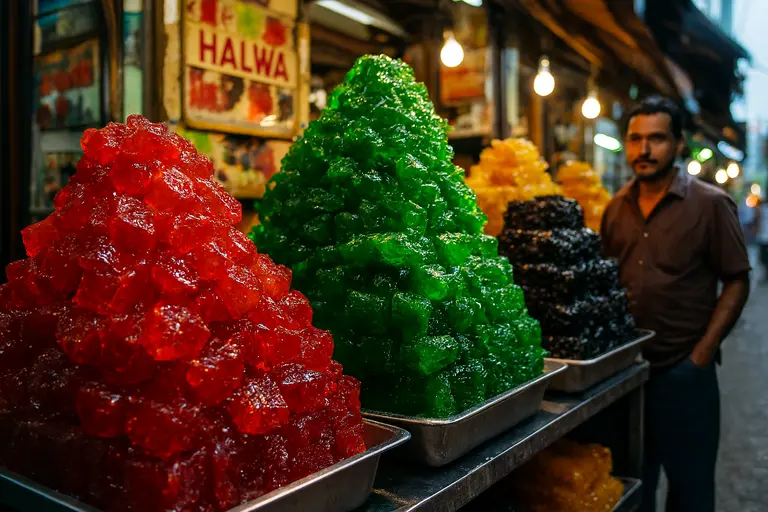
If you walk down S.M. Street (Sweet Meat Street) in Kozhikode, Kerala, you are greeted by a sight that rivals any jewelry showroom. Here, towering stacks of translucent, colorful blocks gleam under the lights. Kozhikode Halwa and Colored Stones captivate the eye with the same allure. At first glance, these seem worlds apart: one is a sweet delicacy made of flour and coconut oil, the other is a mineral treasure from the earth.
However, they share striking similarities in visual appeal, texture, and history. As a Gemologist with over 40 years of experience, I have long admired how the artisans of Calicut treat their Halwa with the same precision that a lapidary treats a rough gem. In this article, we will delve into their vibrant colors, “inclusions,” and the trade roots that bind them. Let’s uncover these fascinating connections step by step.
The Color Palette of Kozhikode Halwa and Colored Stones
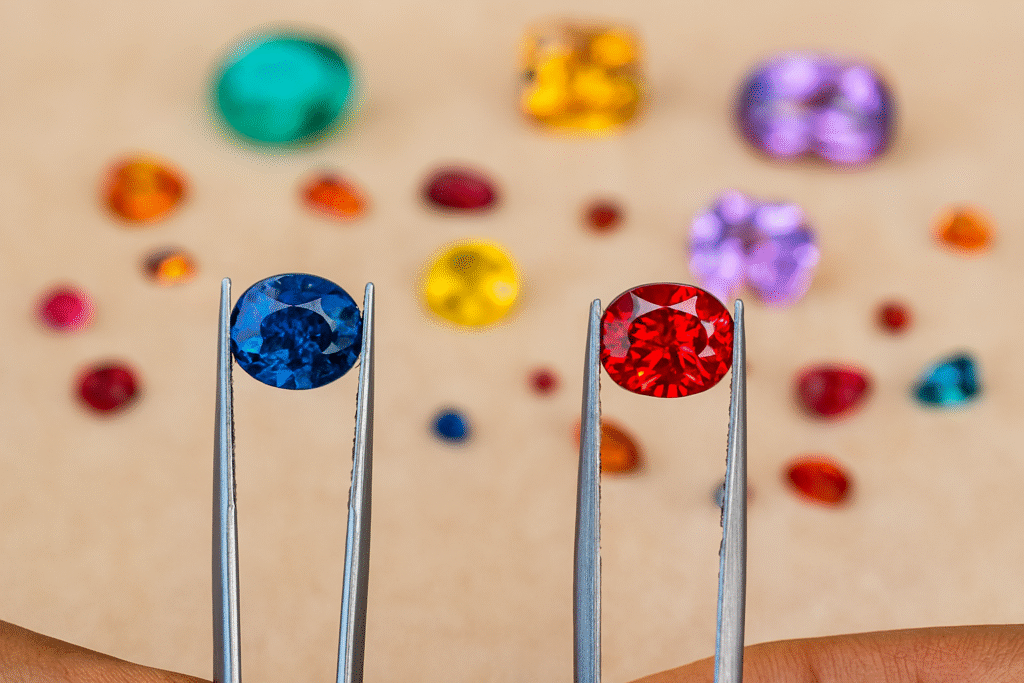
First, consider the shared rainbow of hues. Remarkably, Kozhikode Halwa bursts with vivid colors, much like a parcel of polished Sapphires, Rubies, and Emeralds.
The Red and Orange
The most iconic Halwa is the fiery red or orange variety. Visually, this mirrors the Mandarin Fruit vs Mandarin Garnet comparison I wrote about recently. Specifically, the electric orange of the Halwa matches the “Fanta” glow of a Spessartine Garnet.
The Green and Black
In addition, the lush Green Halwa (often flavored with pistachio or chemicals) mimics the glow of a Peridot or Emerald. Meanwhile, the famous Black Halwa (made with jaggery/rice) has the deep, opaque mystery of Black Onyx or Tourmaline Colors. Consequently, walking past a shopfront in Kozhikode feels like walking past a gem dealer’s window in Jaipur. The colors trigger the same “desire” in the brain.
Texture of Kozhikode Halwa and Colored Stones
Next, examine their physical forms through a gemologist’s loupe. High-quality Kozhikode Halwa gleams with a glossy sheen. In gemology, we call this Luster.
- Gemstones: Often have a Vitreous (Glass-like) luster.
- Halwa: Has a Greasy or Resinous luster due to the generous use of pure Coconut Oil.
Furthermore, the way Halwa is cut mimics gem cutting. For instance, the massive blocks are sliced into neat rectangular or quadrangular slabs. Crucially, this mimics the “Rough” stone being sawed into “Pre-forms” before faceting. In fact, biting into a fresh piece reveals a soft, jelly-like chew—resilient yet yielding. This texture reminds me of the “toughness” of Nephrite Jade, which I discussed in Nephrite vs Jadeite Jade.
Inclusions: Cashews vs. Crystals
Additionally, let’s talk about clarity. In the gem world, we look for Inclusions—foreign materials trapped inside the stone.
- In Gems: We see Rutile needles, gas bubbles, or other crystals (like in Multiphase Gems and Maldives).
- In Halwa: We see Cashews, Pistachios, or Raisins suspended in the jelly.
Functionally, these nuts act as natural veins. Just as a “Rutilated Quartz” is prized for the golden threads inside, a “Dry Fruit Halwa” is prized for the crunch of the nuts inside the soft matrix. As a result, each piece tells a story of its ingredients. Therefore, in both worlds, the “Inclusion” adds value and character.
Durability of Kozhikode Halwa and Colored Stones
Beyond looks, both excel in endurance. Kozhikode Halwa and Colored Stones are built to last. The Halwa boasts an impressive shelf life without refrigeration. Remarkably, due to the high sugar and oil content (preservatives), it stays fresh for weeks or months.
Similarly, colored stones endure eternally, resisting time’s wear. In addition, the Halwa’s rubbery texture holds shape steadily. Heat, humidity, or jostling during travel barely affect it. This resilience echoes the durability of gems. Historically, this quality fueled trade. Arab sailors packed Halwa for long sea voyages across the Arabian Sea, just as they carried lightweight gem parcels for trade. Thus, both represent the perfection of preservation.
The S.M. Street Connection: A Trade Hub
Finally, their stories intertwine through history. S.M. Street (Sweet Meat Street) in Kozhikode’s heart buzzed as a colonial-era hub. Here, Arab, Portuguese, and local traders exchanged spices, textiles, and sweets. Likely, gemstones traded hands here too, given Malabar’s role in the ancient gem routes linking Tanzania’s Cloves and Tanzanite to the East.
In essence, S.M. Street symbolizes fusion—where sweets and stones meet prosperity. Today, it remains a heritage site. If you visit, you are walking on the same ground where merchants have bartered for 500 years. For travel tips, check Kerala’s Gold, Food, and Film.
Conclusion on Kozhikode Halwa and Colored Stones
In summary, Kozhikode Halwa and Colored Stones unite through color, form, and legacy. One feeds the stomach; the other adorns the body. Ultimately, both are “Gems” of Kerala. Next time you visit Kozhikode, buy a kilo of Black Halwa. Hold it up to the light. You might just see the sparkle of a dark garnet.
FAQ: Kozhikode Halwa and Colored Stones
What makes Kozhikode Halwa unique?
Principally, it stands out for its unique “elastic” texture and the use of pure Coconut Oil, which gives it a distinctive aroma and preservation quality unlike the Ghee-based halwas of North India.
How do colored stones relate to Kerala’s history?
Kerala, especially the Malabar coast, was a pivotal trade route. Roman gold coins and colored gems were exchanged here for spices and sweets like Halwa.
Which gemstone matches Black Halwa?
Black Onyx or Black Tourmaline. Both share the deep, opaque, glossy black appearance of the jaggery-based halwa.
Where can I buy authentic Kozhikode Halwa?
Head to S.M. Street (Mittayi Theru) in Kozhikode. Iconic shops like Zains or Sankaran Bakery offer the most authentic, fresh varieties.
Is Halwa similar to Amber?
Yes, visually. The orange/yellow halwa has the same translucency and warm glow as Frankincense vs Amber. Indeed, both look like captured sunlight.
Author Bio
P.J. Joseph, also known as Saju Elizamma, Gemstone & Gold Consultant serving Kerala, Tamil Nadu, and Karnataka.