Introduction
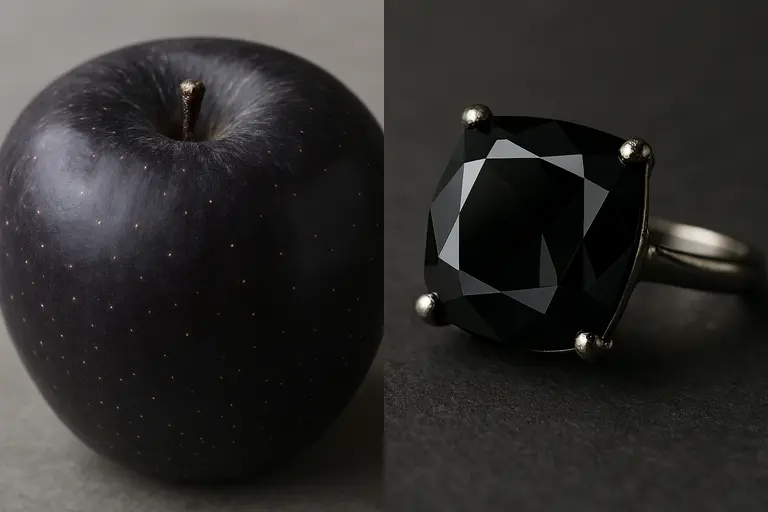
In the luxury market, names hold power. The Black Diamond Apple vs Black Diamond Gem comparison is a perfect example of how a name can elevate a simple fruit to the status of a jewel. Undeniably, at first glance, both boast an enigmatic dark allure that sets them apart in their worlds—one in the high-altitude orchards of Tibet, the other in the deep mines of Brazil.
However, these parallels are purely visual and market-driven. There are no biological ties between the fruit and the mineral. As a Gemologist with over 40 years of experience, I see this as a fascinating study in branding and rarity. In this article, we will explore their shared traits, dive into key differences, and uncover the clever marketing behind the apple’s name. By the end, you will understand why both command premium prices in 2026.
Similarities: Black Diamond Apple vs Black Diamond Gem
Primarily, the similarities revolve around their captivating aesthetics and elite status. For instance, both standout for their profound darkness, which immediately draws the eye in a sea of ordinary reds and whites.
The Dark Aesthetic
First, consider their appearance. The apple’s skin gleams in deep, almost obsidian purple hues. Similarly, black diamonds—often called Carbonados—exhibit an intense, velvety black that is unique among carbon crystals. This visual drama makes both feel otherworldly.
Luster and Shine
Next, luster plays a pivotal role. Remarkably, the Black Diamond Apple shines with a natural wax polish, resembling a gem fresh from the lapidary wheel. In contrast, a cut Black Diamond reflects light with a subtle “Adamantine” to metallic sheen due to its polycrystalline structure. Consequently, admirers often describe the apple as “jewel-like,” blurring the lines between produce and precious stone.
Extreme Rarity
Furthermore, exclusivity binds them.
- The Apple: In reality, the apple thrives only in Tibet’s Nyingchi region (3,500m altitude). Harvests are limited.
- The Gem: Meanwhile, the gem forms under extreme pressures, possibly even from ancient meteorite impacts. As a result, both appeal to collectors who seek the unattainable. A single apple can cost $7 to $20, making it a gift, not a snack. If you enjoy comparing rare foods, read my guide on Pearl Meat.
Differences: Black Diamond Apple vs Black Diamond Gem
Despite surface resemblances, fundamental differences highlight their distinct natures.
1. Nature and Composition
Biologically, the Black Diamond Apple is an edible, organic fruit (a variant of the Hua Niu apple). Conversely, the Black Diamond Gem is inorganic. It is pure Carbon with graphite inclusions that turn it black. While one rots in a few weeks, the other lasts forever.
2. Hardness
Gemologically, this is the biggest gap. Naturally, the apple is soft and crisp. The diamond ranks 10 on the Mohs Scale—the hardest material on earth. Therefore, you can eat one, but the other can cut glass. For more on hardness, check my Colored Stone Grading guide.
3. Origin Story
Fundamentally, Apples require the sun. The dark skin comes from Anthocyanins produced to protect the fruit from high UV radiation in the Himalayas. In contrast, Diamonds require darkness. They form deep in the mantle or arrive via asteroids. Thus, one is a child of the light; the other is a child of the dark.
The Marketing Magic Behind the Name
Ultimately, the “Black Diamond” label for the apple is a brilliant marketing ploy. Cleverly, Tibetan growers capitalized on their gem-like visuals to target luxury markets in China and India. This strategy mirrors how jewelers’ brand fancy-colored diamonds (“Chocolate” or “Champagne”) for emotional appeal.
Essentially, by evoking the prestige of the Black Diamond, the apple justifies sky-high prices. In digital marketing terms, it is SEO gold. Searches for “Black Diamond Apple” spike curiosity, driving traffic much like my blog posts on Mandarin Fruit vs Mandarin Garnet. From my experience, such metaphors boost engagement. Pairing gems with cuisine creates viral stories.
Investment Value: Eaten vs. Worn
Finally, let’s talk value. But can you invest in a Black Diamond Apple? No. It is a perishable luxury. It is an “Experience.” Can you invest in a Black Diamond Gem? Yes. While they don’t appreciate as fast as pink or blue diamonds, large Carbonados are rare and valuable. Therefore, if you want to leave a legacy, buy the stone. If you want to impress a dinner guest, buy the apple.
If you are interested in luxury assets, read my analysis of the Rolex Business Model.
Conclusion on Black Diamond Apple vs Black Diamond Gem
In summary, the Black Diamond Apple vs Black Diamond Gem comparison reveals our obsession with the rare and the dark. Nature creates beauty in mysterious ways—sometimes in a crystal lattice, sometimes in a fruit skin. Ultimately, both are treasures. One feeds the body for a moment; the other adorns the body for a lifetime.
FAQ: Black Diamond Apple vs Gem
What makes Black Diamond Apples so expensive?
They grow exclusively in Tibet’s challenging high-altitude climate. The limited supply and the difficulty of transport drive prices up to $20 per fruit in luxury markets.
Are Black Diamonds real diamonds?
Yes. They are natural carbon crystals, often polycrystalline (Carbonado). Unlike clear diamonds, their opacity comes from graphite inclusions. They are tougher than regular diamonds.
Can you eat Black Diamond Apples?
Absolutely. Fortuitously, their dark skin is edible and rich in antioxidants. Inside, the flesh is crisp and sweet, just like a regular Red Delicious or Hua Niu apple.
How do Black Diamonds form?
Interestingly, many geologists believe Carbonados originated from extraterrestrial sources (supernovae explosions) billions of years ago, unlike typical diamonds formed in the Earth’s mantle.
Is there a biological link?
No. In reality, the similarity is purely visual and linguistic. Marketing teams chose the name “Black Diamond” to signify rarity and hardness of the apple’s skin.
Author Bio
P.J. Joseph, also known as Saju Elizamma, Gemstone & Gold Consultant serving Kerala, Tamil Nadu, and Karnataka.