Introduction
In the vast landscape of Indian adornment, Thewa Jewelry stands alone. Unlike the heavy Kundan or Polki of Jaipur, Thewa is delicate, translucent, and shrouded in mystery. Indeed, this traditional art form, hailing exclusively from Pratapgarh, Rajasthan, masterfully blends 23-karat gold with vibrant, multi-colored glass.
Moreover, it tells intricate stories through designs so fine they look like lace. As a Gemologist, I am fascinated by the technique. Actually, it is not “setting” a stone; it is fusing gold into the very surface of a glass “gem.” In this article, we will explore its origins, the secretive crafting process, and why this 400-year-old art remains a treasure in 2026.
Historical Origins of Thewa Jewelry
The story of Thewa Jewelry begins in 1707 in the small princely state of Pratapgarh. Historically, a master craftsman named Nathu Ji Soni pioneered this craft. Because of his skill, Maharaja Sumant Singh honored him with the title “Raj Soni,” meaning Royal Goldsmith.
Consequently, the technique became a closely guarded family secret. In fact, it was so secretive that fathers passed it only to their sons. They never taught the craft to their daughters because they would marry into other families and might reveal the secret. As a result, for centuries, Thewa Jewelry was produced only by one clan in one town.
Royal patronage elevated its status. Soon, Rajput and Mughal rulers cherished these pieces. Later, during the Victorian era, British women bought them as souvenirs, sparking international fame. You can read more about the region’s history in my guide to Traditional Rajasthani Jewellery.
The Intricate Crafting Process of Thewa Jewelry
Creating Thewa Jewelry demands immense patience. A single piece often takes over a month to complete. Unlike casting, which is fast, this is a meticulous manual process.
Step 1: The Gold Sheet
First, artisans prepare the gold. Artisans hammer pure 23K gold into wafer-thin foils (Warqs). Why 23K? Because 24K is too soft and 22K is too hard. 23K is the perfect balance for malleability.
Step 2: The Etching (Thar)
Next comes the “Thar” stage. Using tiny chisels, craftsmen carve intricate designs into the gold foil. Specifically, they remove the negative space to form a lace-like Jaali pattern. Precision is key; unfortunately, one slip ruins the entire sheet.
Fusing Thewa Jewelry
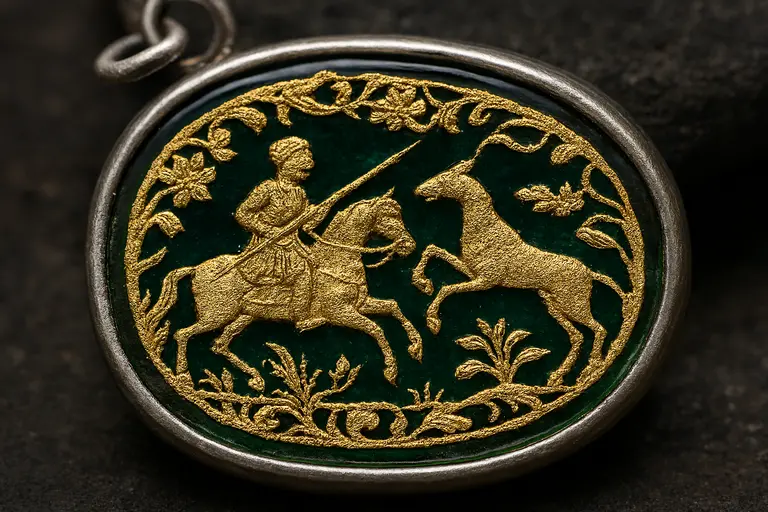
Then, the magic happens. The gold filigree is placed on a piece of colored glass—often deep Ruby Red, Emerald Green, or Sapphire Blue. In a crucible, intense heat fuses them permanently. Crucially, they use no glue or adhesive; the bond is molecular.
Step 4: The Setting
Finally, the fused unit is mounted into a silver or gold bezel. The maker places shiny foil underneath the glass to reflect light through the color. This process sets Thewa Jewelry apart from modern enameling.
Narrative Motifs in Thewa Jewelry
Thewa Jewelry excels in storytelling. Because the gold sheet is like a canvas, artisans depict detailed scenes.
- Mythology: For instance, Lord Krishna dancing with Gopis, or the Ram Parivar.
- Royal Life: Hunting expeditions (Shikargah) showing warriors on horseback.
- Nature: Similarly, Peacocks with feathers unfurled and twisting floral vines.
In Kerala, we value narrative jewelry in our Temple traditions. Similarly, Thewa serves as a wearable epic. For comparison, check how motifs are used in Temple Jewelry South India.
An Expert Warning: Fragility and Care
As a Gem Expert, I must offer a word of caution. Remember, Thewa Jewelry is essentially Glass Art. Unlike a solid gold bangle, which can take a beating, Thewa is fragile.
Therefore, follow these rules:
- Do not bend it: The glass base will crack.
- Avoid Chemicals: Eventually, perfumes and sprays can dull the glass’s luster.
- Storage: Store it wrapped in soft cotton, separate from other jewelry to prevent scratching.
Comparing this to other fragile beauties, treat it with the same care you would give the Aranmula Kannadi Magic mirror.
Global Recognition of Thewa Jewelry
Significantly, Thewa earned a Geographical Indication (GI) Tag in 2011. This ties authenticity strictly to Pratapgarh, Rajasthan. Therefore, if someone tries to sell you “Thewa” made in Mumbai or Jaipur, be skeptical. It might be imitation work.
Today, masterpieces shine worldwide. Notably, the Metropolitan Museum of Art in New York and the V&A Museum in London hold antique Thewa treasures. Contemporary efforts by artisans like Raghav Raj Soni (a 6th-generation master) and brands like SONKANCH are keeping the legacy alive online.
Conclusion: A Canvas of Gold
In summary, Thewa Jewelry is more than just an accessory; it is a painting made of gold and glass. Undeniably, it captures the vibrancy of Rajasthan in a way that solid gold cannot. For the collector, it is an investment in a dying art form. For the fashion lover, it is a statement piece that bridges the 18th and 21st centuries.
FAQ: Thewa Jewelry Essentials
What makes Thewa Jewelry unique?
It fuses pure 23K gold foil onto colored glass using heat, without any glue. This creates a seamless, intricate pattern that looks like lace floating on a gem.
How long does it take to make one piece?
Typically, it takes over a month. The process of hand-chiseling the gold foil (making the Jaali) is extremely time-consuming and requires master-level skill.
Is Thewa only from Rajasthan?
Yes. The craft is geographically protected by a GI Tag assigned to Pratapgarh. Authentic Thewa comes only from the families in this specific region.
Can I wear Thewa daily?
No. It is best suited for special occasions. Because the base is glass, it can crack if dropped or hit against a hard surface. Treat it like a cocktail ring or a statement necklace.
How much does Thewa cost?
Actually, prices range from ₹50,000 for small pendants to several Lakhs for intricate necklaces. Primarily, the price depends on the intricacy of the goldwork, not just the weight of the metal.
Author Bio
P.J. Joseph, also known as Saju Elizamma, Gemstone & Gold Consultant serving Kerala, Tamil Nadu, and Karnataka.