Introduction
In the world of gemstones, few words carry as much weight as “Jade.” For thousands of years, cultures across Asia and the Americas used this word to describe any tough green stone suitable for carving. However, modern gemology now recognizes a crucial distinction. Nephrite vs Jadeite Jade refers to two scientifically and commercially distinct minerals.
While they share the same cultural name, they differ in chemistry, value, and origin. As a Gemologist, I often see buyers confused. Unfortunately, they buy a $50 Nephrite bangle thinking it is the same material as a $50,000 Jadeite bangle. In this article, I will break down these differences. Therefore, whether you are a collector or a jeweler, understanding this split will save you from costly mistakes.
What Is Jade? The Scientific Split
To begin with, let’s clarify the chemistry. Until 1863, the world thought Jade was one stone. Eventually, French mineralogist Alexis Damour discovered they were different species.
- Nephrite: A Calcium Magnesium Iron Silicate. It belongs to the Amphibole mineral group.
- Jadeite: A Sodium Aluminum Silicate. It belongs to the Pyroxene mineral group.
Consequently, while both are metamorphic rocks, they behave differently under the cutter’s wheel. You can read more about gem classification in my Colored Stone Grading guide.
Physical Differences: Nephrite vs Jadeite Jade
Although they can look similar to the untrained eye, distinct traits set them apart.
1. Luster of Nephrite vs Jadeite Jade
This is the easiest tell.
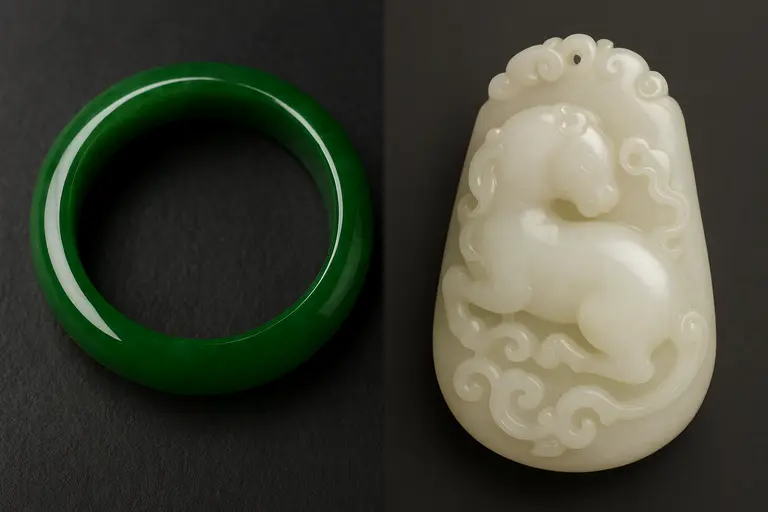
- Nephrite: Has a Waxy or oily luster. The structure is made of interlocking fibers (felt-like), giving it a soft, soapy look.
- Jadeite: Has a Vitreous (Glassy) luster. It looks hard, bright, and shiny like a diamond or sapphire. The structure is granular (interlocking crystals).
2. Hardness of Nephrite vs Jadeite Jade
Jadeite is Harder: It scores 6.5–7.0 on the Mohs scale. It takes a higher polish. Nephrite is Tougher: It scores 6.0–6.5 but is structurally tougher than steel because of its woven fibers. Surprisingly, you can hit Nephrite with a hammer, and it often won’t break. Therefore, Nephrite is preferred for intricate carvings, while Jadeite is preferred for jewelry.
3. Color Range
- Nephrite: Typically spinach green, grey-green, black, or creamy white (“Mutton Fat”). The colors are usually muted.
- Jadeite: Offers a vivid spectrum. It comes in neon “Imperial” Green, Lavender, Red, Yellow, and Ice White. The colors are electric and saturated.
4. The “Sound” Test
In Chinese markets, this is a standard test for bangles. If you gently tap a genuine Jadeite bangle with a coin, it emits a high-pitched, long-ringing “ting.” In contrast, Nephrite produces a lower, duller “clunk.” You can read about other market habits in my Indian vs Chinese Jewelry comparison.
Grading Nephrite vs Jadeite Jade: The ABC System
In practice, Jadeite is graded using a strict “ABC” System. Nephrite is rarely treated this way.
- Type A (Natural): Untreated, except for surface waxing. This is investment grade.
- Type B (Bleached): Acid-washed to remove brown stains and impregnated with polymer resin. Unfortunately, it looks good but is brittle.
- Type C (Dyed): Artificially colored. Realistically, it has zero investment value.
- Type B+C: Both polymer-filled and dyed. This is essentially “costume jewelry.”
As a buyer, always demand a lab report stating “Type A” or “Natural Fei Cui.” If you are worried about fakes, check my Gemstone Buying Mistakes guide.
Sources of Nephrite vs Jadeite Jade
Geographically, the stones come from different worlds.
Jadeite Sources
Primarily, the world’s gem-quality Jadeite comes from Myanmar (Burma). Admittedly, small deposits exist in Guatemala and Japan, but the “Imperial Green” that commands millions at auction is almost exclusively Burmese.
Nephrite Sources
On the other hand, Nephrite is widespread. Notable deposits also exist in China (Hotan), Canada (British Columbia), Russia, and New Zealand (where it is called Pounamu). Interestingly, in China, “Mutton Fat” white Nephrite from Hotan is often valued higher than diamonds due to historical significance.
The Digital Shift
Moreover, consumption is changing. Currently, China remains the largest market. Recent reports indicate strong growth supported by Livestream Selling on apps like Douyin. Younger Gen-Z consumers are buying affordable Nephrite pendants online, while older investors stick to high-end Jadeite bangles.
Conclusion on Nephrite vs Jadeite Jade
Ultimately, the choice between Nephrite vs Jadeite Jade depends on your taste and budget.
- Choose Nephrite if you love history, carving, and earthy tones. It is the stone of the scholar.
- Choose Jadeite if you love brilliance, vivid color, and high-value investment. It is the stone of the emperor.
In summary, both are “Jade,” but they tell two very different stories.
FAQ: Nephrite vs Jadeite Jade
Are Nephrite and Jadeite both considered Jade?
Yes. “Jade” is a legal trade name for both minerals. However, you should always ask the seller to specify which one it is, as the price difference is massive.
Which is more valuable: Nephrite or Jadeite?
Generally, Jadeite. In fact, top-quality “Imperial” Jadeite is one of the most expensive gems per carat in the world. However, historical white “Mutton Fat” Nephrite can also command extremely high prices in China.
How can a buyer tell them apart visually?
Look at the luster. Jadeite shines like glass. Nephrite shines like grease or wax. Furthermore, Jadeite often has a texture that looks like salt grains, while Nephrite looks fibrous.
Is all Jade treated?
No. But a significant portion of affordable Jadeite is Type B or C. Always ask for a guarantee of “Type A” if you are paying a significant price.
Is Jade popular with young people?
Yes. It is seeing a revival. Modern designers are setting Jade in trendy gold mounts, moving away from the traditional “heavy” styles of the past.
Author Bio
P.J. Joseph, also known as Saju Elizamma, Gemstone & Gold Consultant serving Kerala, Tamil Nadu, and Karnataka.