
Introduction
Indian textiles and jewelry together tell a rich story of regional identity, craftsmanship, and evolving aesthetics. Among the most iconic handwoven traditions, Banarasi vs Kanjivaram Sarees stand out as two distinct yet equally revered silk legacies. One hails from the sacred ghats of Varanasi, the other from the temple town of Kanchipuram.
At the same time, a fascinating shift is happening in the jewelry world. While textiles remain distinct, jewelry designers across North and South India are moving toward a shared language, especially in the realm of colored stones. In this article, I will first explain the technical differences between these two saree giants. After that, I will show how jewelry designers—from Jaipur to Kerala—are blending these traditions to create a new “Pan-Indian” aesthetic for 2026.
Banarasi Saree: Fluid Luxury from Varanasi
To begin with, Banarasi sarees originate from Varanasi in Uttar Pradesh. Over time, they have become synonymous with North Indian bridal finery. But what makes them physically different?
The Silk and Drape
From a technical perspective, Banarasi weavers typically use fine mulberry silk yarn. Consequently, the fabric is lighter and has a fluid drape. It falls gracefully on the body, creating a soft, shimmering surface often compared to “moonlight on water.” This delicate movement is why many brides prefer Banarasi for long receptions where comfort is key.
The Mughal Motifs
In terms of design, Banarasi motifs strongly reflect Mughal influence. Therefore, you frequently see:
- Bel: Flowing floral vines and creepers.
- Kalga: The Paisley motif.
- Jhallar: Ornamental fringes.
Unlike printed fabrics, these are woven using the Kadhua (brocade) technique. Each motif is woven separately, so there are no loose threads on the back. As a result, the saree looks rich yet refined. If you are pairing this with jewelry, look for North vs South Indian Jewelry styles like Polki.
Kanjivaram Saree: Sculpted Grandeur
In contrast, Kanjivaram (or Kanchipuram) sarees hail from Tamil Nadu, the “Silk City” of the South. While Banarasi emphasizes fluidity, Kanjivaram emphasizes structure.
The “Sculpted Metal” Look
Kanjivaram weavers use a thicker, 3-ply mulberry silk yarn dipped in rice water. As a result, the saree feels heavier and holds its shape. When pleated, it looks like “sculpted metal.” This characteristic makes it ideal for South Indian brides who want a commanding presence.
The Temple Motifs
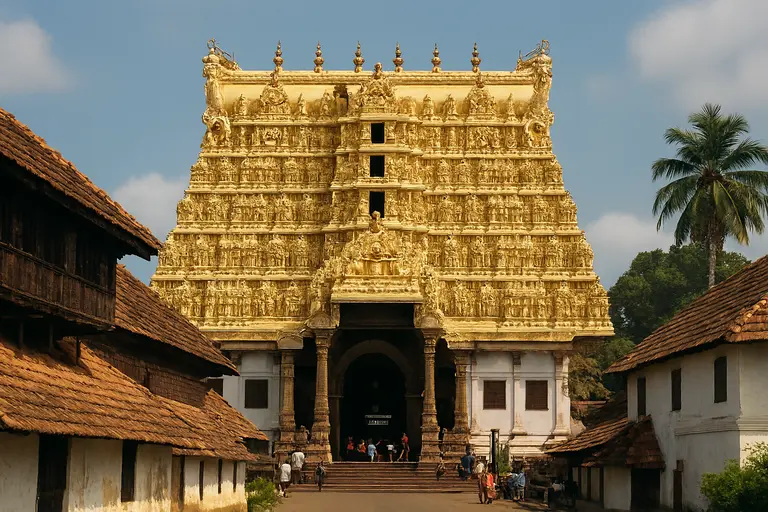
Visually, the motifs pay homage to Dravidian architecture. Therefore, typical designs include:
- Gopuram: Temple towers along the border.
- Yali: Mythological lion-elephants.
- Rudraksbam: Sacred beads.
Another important difference lies in the Korvai technique. The body and border are woven separately and interlocked. This creates a sharp contrast line that is incredibly durable. Moreover, the Zari used is traditionally real Silver dipped in Gold, adding immense value. You can read about the value of gold assets in my Gold Purity: Kerala vs Tamil Nadu guide.
Key Differences: Banarasi vs Kanjivaram Sarees
When we compare Banarasi vs Kanjivaram Sarees, the distinctions are clear.
- Origin: Varanasi (North) vs. Kanchipuram (South).
- Texture: Fluid and Soft vs. Structured and Heavy.
- Motifs: Floral/Mughal vs. Temple/Geometric.
- Weave: Continuous Brocade vs. Interlocked Korvai.
Thus, although both symbolize luxury, they express two very different aesthetics. One flows like the Ganges; the other stands firm like a Gopuram.
Jewelry Trends for Banarasi vs Kanjivaram Sarees
While the sarees remain distinct, the jewelry worn with them is evolving. In 2026, designers are blending North and South.
The Rise of “Polki” in the South
Historically, Polki (uncut diamond) and Kundan were strictly North Indian. However, modern South Indian brides wearing Kanjivarams are now accessorizing with heavy Polki chokers. The contrast of the “Glassy” Polki against the “Matte” Kanjivaram silk is stunning. Consequently, brands like Pothys Swarna Mahal are launching dedicated Polki lines.
The Rise of “Temple” in the North
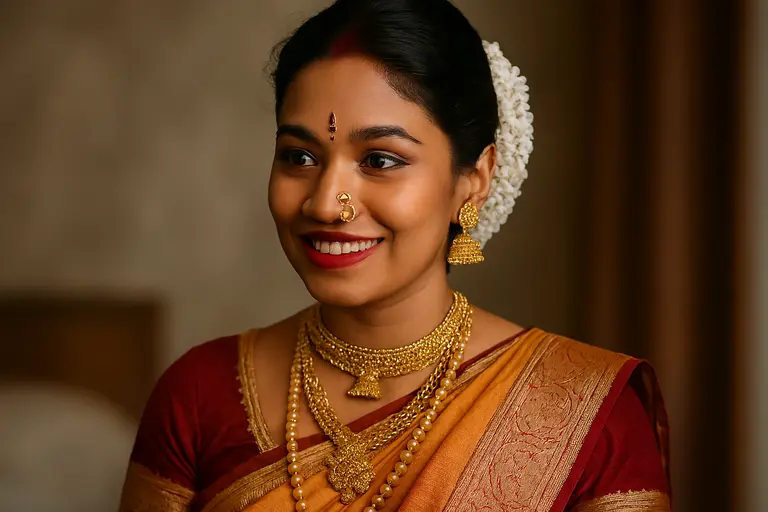
At the same time, North Indian designers are embracing South Indian iconography. We now see Temple Borders and Coin Necklaces (Kasumala) being made in Jaipur workshops, often using lighter 18K gold. Therefore, regional craft vocabularies are no longer isolated; they are dialoguing.
Colored Stones with Banarasi vs Kanjivaram Sarees
Finally, one trend unites them all: Colored Stones. Instead of plain gold, both regions are highlighting vibrant Rubies, Emeralds, and Spinels. For example, a Banarasi saree in Red looks magnificent with a Stuller’s Signature Red ruby necklace. A Green Kanjivaram pairs perfectly with Emeralds. Consequently, even as settings change, the cultural meaning of the stones remains constant.
Conclusion on Banarasi vs Kanjivaram Sarees
Ultimately, the choice between Banarasi vs Kanjivaram Sarees is a matter of personal style. Do you want to float, or do you want to stand tall? But regarding jewelry, you no longer have to choose sides. The new Indian aesthetic is a fusion. Wear your Kanjivaram with Polki. Wear your Banarasi with Temple Gold. In summary, true style is about breaking the rules while respecting the heritage.
FAQ: Banarasi vs Kanjivaram Sarees
Weddings: Banarasi vs Kanjivaram Sarees?
Both are excellent. Banarasi is better for receptions where you need to move and dance. Kanjivaram is better for the main Muhurtham ceremony where you need a structured, traditional look.
Identifying Genuine Banarasi vs Kanjivaram Sarees
Look for the Silk Mark label. Also, check the reverse side of the border. If it is a genuine Korvai weave, you will feel a distinct knotty ridge where the border joins the body.
Is Banarasi zari real gold?
Historically, yes. Today, only premium “Real Zari” sarees use silver threads dipped in gold. Most commercial sarees use “Tested Zari” (copper/synthetic) to keep prices down. Always ask the weaver.
Polki Styling for Banarasi vs Kanjivaram Sarees
Absolutely. This is the biggest trend of 2026. The uncut diamonds add a modern glamour that contrasts beautifully with the traditional silk texture.
Author Bio
P.J. Joseph, also known as Saju Elizamma, Gemstone & Gold Consultant serving Kerala, Tamil Nadu, and Karnataka.