Introduction
The Titan Nebula Jalsa represents a groundbreaking achievement in Indian watchmaking. For decades, we associated Titan with reliable, affordable timepieces. However, the script has flipped in 2025. This ultra-luxury, limited-edition mechanical wristwatch from Titan’s premium sub-brand, Nebula, showcases exceptional craftsmanship that rivals Swiss giants.
Moreover, it features an in-house flying tourbillon movement and a hand-painted marble dial. Importantly, this is not a smartwatch; it is a pure horological art piece. As a result, it stands as Titan’s most expensive timepiece ever, priced at ₹40.5 lakhs (approx. $45,000 USD). In this article, I will analyze the Titan Nebula Jalsa from a collector’s perspective—examining the gems, the mechanics, and whether it is a smart buy for the Indian investor.
The Titan Nebula Jalsa Dial: A Miniature Masterpiece
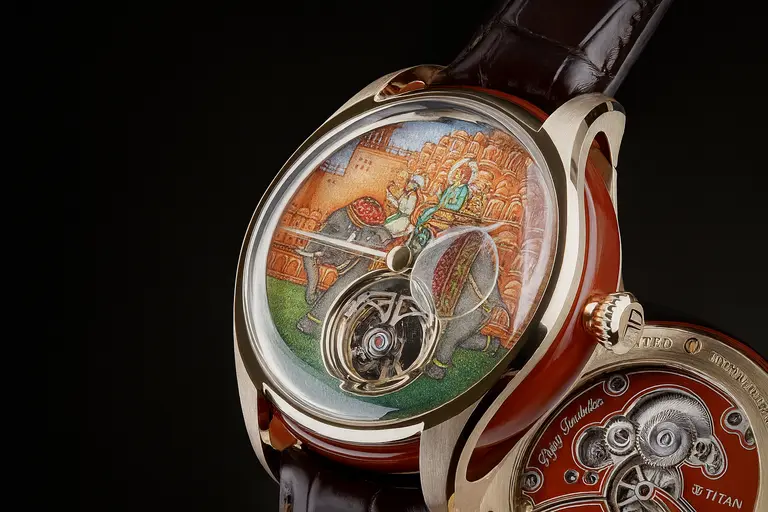
At the heart of the Jalsa lies its extraordinary dial. Unlike standard printed dials, artisans hand-paint this miniature on a genuine sliver of Marble, using natural gemstone pigments and a single-hair brush. Specifically, Padma Shri awardee Shakir Ali, a renowned Indian artist, creates each one. The artwork depicts a vibrant royal procession in front of Jaipur’s iconic Hawa Mahal.
This tribute not only honors Rajasthan’s royal legacy but also blends traditional Indian art with modern watchmaking. As the minute hand sweeps across the dial, a unique sapphire magnifier counterweight comes into play. It enlarges intricate details of the painting and the tourbillon below. Consequently, every glance at the time reveals new artistic nuances. It is wearable heritage.
If you are interested in the fusion of art and luxury, read my guide on Temple Jewelry South India.
Titan Nebula Jalsa Movement: The Flying Tourbillon
What truly elevates the Titan Nebula Jalsa is its mechanics. It features the Calibre 7TH2 flying tourbillon movement. Significantly, Titan developed this hand-wound mechanism entirely in-house, comprising 144 precision parts and 14 jewels.
Unlike standard tourbillons, which are held by two bridges, the “Flying” variant lacks an upper bridge. Therefore, it creates a visually striking, suspended cage that rotates to counter gravity’s effects on accuracy. Furthermore, this movement underscores Titan’s growing expertise. Previously known for quartz, the company now competes with brands like Audemars Piguet or Jaeger-LeCoultre in technical capability.
For deeper insights into why mechanical movements hold value, check my article on Luxury Watch Collectors India.
A Gemologist’s View: Agate and Gold
As a Gem Expert, I must draw your attention to the materials. Crafted for ultimate luxury, the Jalsa boasts an 18K Rose Gold case. However, the standout feature is the Red Agate inlay.
- The Stone: A bold Red Agate (a variety of Chalcedony) adorns the middle case and movement bridges.
- The Significance: In gemology, Agate is known for its durability (Mohs 6.5-7) and its historical use in Indian royalty. The vivid red hue evokes the sandstone of Jaipur.
Additionally, both the front and exhibition caseback feature scratch-resistant Sapphire Crystals. Therefore, the watch is not just beautiful; it is built to last. This material synergy—Gold, Agate, Marble, and Sapphire—creates a cohesive aesthetic that is distinctly Indian.
Titan Nebula Jalsa Price and Exclusivity
Exclusivity defines the Titan Nebula Jalsa: only 10 individually numbered pieces exist worldwide. Consequently, this scarcity targets serious collectors, not casual buyers.
Priced at ₹40.5 lakhs (approx. $45,000 USD), it exceeds many entry-level Rolex models. You might ask: Is it worth it?
- Logic: If you buy a Rolex, you pay for the Brand.
- Common Sense: If you buy the Jalsa, you pay for the Art and the Rarity. With only 10 pieces, you own something almost no one else has.
As a result, owning a Jalsa becomes a badge of foresight. It mirrors limited editions from independent watchmakers, but with Indian soul.
Global Recognition: GPHG 2025
The Jalsa’s pinnacle achievement is its submission to the Grand Prix d’Horlogerie de Genève (GPHG) 2025. Known as the “Oscars of Watchmaking,” this marks India’s formal foray into Haute Horlogerie.
Previously, Indian brands focused on affordability. Now, they vie for global acclaim. If awarded, the Jalsa could redefine perceptions of “Made in India” luxury. Until the final verdicts are cemented in history, the mere entry proves that Titan is ready for the world stage.
Conclusion: Investment or Passion?
In summary, the Titan Nebula Jalsa fuses art, engineering, and culture into 10 rare gems. From Shakir Ali’s brushstrokes to the 7TH2 tourbillon, every element screams innovation.
My Verdict: Do not buy this watch expecting to flip it for a quick profit like a Patek Philippe. Buy it because you believe in the future of Indian Luxury. It is an investment in history.
FAQ
What makes the Titan Nebula Jalsa unique?
It features a hand-painted marble dial by Padma Shri Shakir Ali, an in-house flying tourbillon, and Red Agate inlays. Only 10 pieces exist in the world.
How much does the Titan Nebula Jalsa cost?
It is priced at ₹40.5 lakhs (approx. $45,000 USD), making it Titan’s most expensive retail watch to date.
Is the Jalsa a smartwatch?
No. It is a fully mechanical, hand-wound luxury timepiece with high complications. It has no digital or smart features.
Where can I buy the Titan Nebula Jalsa?
Due to its extreme rarity (10 pieces), interested buyers must contact Nebula by Titan directly for allocation. It is not sold in standard showrooms.
Why use Red Agate in the watch?
Red Agate (Carnelian) is a durable gemstone that historically symbolizes protection and prosperity in Indian culture. Its color mimics the red sandstone architecture of Jaipur.
Author Bio
P.J. Joseph, also known as Saju Elizamma, Gemstone & Gold Consultant serving Kerala, Tamil Nadu, and Karnataka.